Holy Relationships

Notes for a sermon at St. Matthew’s Anglican Church, St. Albert AB, July 28, 2019. Texts: Hosea 1:2-10; Psalm 85; Colossians 2:6-15 (16-19); Luke 11:1-13

When your Rector invited me here, he asked for three weeks. I was glad to accept the invitation, but had to decline the third Sunday, August 11, because of a major event happening in our life that day. My wife Joanne & I are coming up to our 50th wedding anniversary and had already arranged to renew our marriage vows that day at Holy Trinity, Strathcona.

Milestone anniversaries should be occasions to celebrate, of course, but also to reflect on what went into all those years. No relationship, marriage or otherwise, is ever totally golden throughout its course. When clergy prepare couples for marriage in the church, we are required to ensure that they have had appropriate preparation. The Marriage Canon (lately in the news for other reasons) contains a list of the topics that should be addressed. Most of them deal with matters about which couple can and do have conflicts. The most important IMO is the matter of the importance of communication. If you can’t communicate, agreement will always be difficult.

There’s a huge amount of material available today in various media on building good relationships. In this social network age, when people are supposedly more connected, relationship problems sometimes seem to be getting worse, not better. It may be that interpersonal communications have tended to become text-driven and superficial—but I’m not here to slag Facebook and Instagram! Rather, I am here to suggest that our readings today have something to say about relationships, both interpersonal and between people and God.

Let’s start with Hosea, the most difficult one. Did it seem to be written in code? That’s because we miss the vivid wordplay in the original Hebrew. Hosea has given names to his children which point to the decline in the relationship between Israel and YHWH. The first part of the book is structured around an image some may find offensive, likening Israel’s behaviour to that of a prostitute.

In response to a word from God, Hosea married a woman on the fringes of society, and fathered children who would immediately also be marginalized. His marriage and children became a living metaphor for his people’s broken relationship with their God. They have gone off after false Gods. The children’s names, especially the latter two, express a divine reaction to the people’s unfaithfulness: they will not be pitied; they will no longer be YHWH’s people.

If we ended our reading at verse 9, things would look very bleak, but verse 10 turns things around: “it shall be said to them, ‘Children of the living God.’” The reversal of fortune here, echoed so beautifully in the Psalm, is a theme that will be repeated again in the book: [the] fact that we Christians must never forget but too often do: our faith is in the God who never gives up on us.”

In human relationships, as most of us well know, people do give up on each other. People’s willingness to keep promises is at times not matched by their ability to do so. Not so with God: the message is that our God not only will not give up on us but CAN not give up. It is God’s nature to be faithful and loving. As God self-described to Moses

The Lord, the Lord,
a God merciful and gracious, slow to anger,
and abounding in steadfast love and faithfulness,
keeping steadfast love for the thousandth generation, forgiving iniquity and transgression and sin…
(Exodus 34:6f)

The heart of the divine-human relationship is “steadfast love,” the usual translation of the Hebrew word “hesed.” It is the love that can not let go, not blindly, but out of deep compassion for the other. It is conscious. It is active. Above all, it is persistent. It stands as the model for all human relationships. If we fail to live up to this ideal, it is because we are human. The wonder is that God forgives, and will forgive, every time we turn and re-turn to God.

Continuing in our own relationship with God through Christ is not always easy. There are many occasions when we can stray from our life in Christ. Some of them may be obvious temptations. Others are not so clear, as in the issue Paul addresses in Colossians: people criticizing the church for not attending to some particulars of religious practice that they consider essential. How many of us have experienced the judgment of others in whose eyes our own faith walks don’t quite seem to measure up?

Paul will have none of this. He tells his readers to “live your lives in him,” as the NRSV puts it. Other translations give a more dynamic idea: the King James Version says “walk ye in him.” The Contemporary English Version has:

You have accepted Christ Jesus as your Lord.
Now keep on following him.

The point of the life of discipleship, a life lived in relationship to God, is thus not to believe we’ve arrived, or that we have it all figured out, but to keep on. Live in Christ. Walk in Christ. Keep on following Christ.

And how do we do that? One important part of that answer is to do just what we’re doing here today. We gather as God’s people, in relationship with each other and with God, seeking always to deepen our bonds of holy love. The life of discipleship doesn’t just mean gathering on Sunday, but in walking with Christ and being in relationship with him every day of the week.

The essential tool of building that relationship is the subject of today’s Gospel: prayer. The passage ties the Lord’s Prayer to teachings about the need to persist in prayer.

For many people, prayer mostly means asking God for something. We may and do take our desires and wishes to God, but that’s only the last and least part of it. Prayer is the conscious cultivation of our relationship with God—and that requires communication.

Remember those things we clergy are supposed talk to couples about, and how I suggested communication is the most important of them? Same thing with God. Prayer is keeping the lines of communication open, which means that listening is of prime importance. I believe that prayer is not so much about getting God to agree with us, as about getting us to agree with God.

It takes work.

It takes persistence.

And all of it comes through the gift of the Holy Spirit, freely poured out upon all who seek and all who ask.

God won’t give up on us.

Let us never give up on God.

Amen.

Safe, legal, and rare

Much internet bandwidth has been taken up over the last few days on the matter of abortion, after some legislative initiatives in a couple of states in the USA. It’s a fraught issue, no matter on which side of the divide you find yourself. Do I dare wade into the issue? I have a feeling that whatever position I take, I risk losing the affection of some friends.

Nonetheless…

When abortion first became legal in Canada, my father was deeply distressed. He was a dedicated doctor and committed Christian, regarding abortion as murder. He could not at first reconcile himself to its legality in this country. A few years later, somewhat against his wishes, he found himself as a member of the local “Therapeutic Abortion Committee” charged with reviewing abortion requests, as was then required in Canada.

His time on that committee changed his position dramatically. He told me that he had never before really encountered women seeking to terminate pregnancies, but now he was required to hear their stories first-hand. What he learned was that in almost of all the cases they considered, the “applicants” had no good choices. Desperation was the rule, and if they could not get a legal abortion, many women intended to procure one by any other available means.

In other words, these abortions were going to happen, whether my father liked it or not. If the committee did not approve a request, the procedure would likely happen in unsafe and illegal circumstances, putting the mother’s life at dire risk.

This was in the 1970’s. Unsafe and illegal abortions had been happening for centuries (millennia?) before that. Untold numbers of women had died seeking to assert some control over their lives and what was happening in their bodies. The new legislation in Canada sought to make abortion safe and legal, reducing the death toll. Surely that was a good thing.

But (again) nonetheless…

Whatever the legislators of the world may decree, women will continue to assert their right to reproductive choice. The decision whether or not to terminate a pregnancy should be up to the woman in question — and to no-one else.

Every abortion is in some way the ending of a life, however we understand it. No abortion is a good thing, but it well may be the least bad outcome of a bad situation.

I believe that abortions should be safe and legal, and that women have the right to choose when and if they will bear a child. I also believe that abortions should be rare.

Current moves to re-criminalize abortion focus only on the act. In economic terms, they are supply-driven. The thinking seems to be that if you cut off the supply of the service, the act will disappear. History and human experience such as my father’s tell us that this is a vain hope. Sending an Alabama doctor to jail for 99 years will never eliminate the desperate need experienced by many women.

Speaking again in economic terms, to make abortions rare, we should address the demand. What kinds of situations lead to women needing to terminate pregnancies? Incest and rape have been widely adverted to as particular circumstances, but they are in fact the exceptions. There are many others: poverty, domestic violence, illness, unemployment, lack of appropriate housing — all of these factors and others contribute to the demand for abortion.

To make abortion rare, we must build a society in which every child is wanted, every child is cared for, every child is safe in his or her home, every child has an equal prospect of growing up in peace and happiness.

Banning abortion will do none of this.

To be truly “pro-life” means to me to promote quality of life for everyone. To be truly “pro-choice” means to me to give the possibility of a real choice for a decent life for everyone. I can see no real conflict between these two positions.

Abortion should be safe.
Abortion should be legal.
Abortion should be rare.

As a man, I relinquish all supposed authority over what choices any woman may make about her sexual and reproductive choices. That’s not my right.

Here I stand.
I can do no other.

Believing is Seeing

Notes for a sermon at Holy Trinity Edmonton, April 28, 2019
Text: John 20:19-31

Many of us will be familiar with the adage “seeing is believing,” which may well originate in today’s Gospel story, and is sometimes taken to be the point of the story. I don’t think so. There’s a lot more happening in the story of Thomas’ encounter with the Risen Christ than how we often over-simplify it:

  1. Thomas hears the news from the other disciples and demands visual evidence before he believes.
  2. Jesus appears to Thomas and gives him the proof.
  3. Thomas believes. Seeing is believing. End of story.

Or is it? Has anyone else noticed that there’s a big gap in this story? There are two scenes, a whole week apart. A week can be a very long time: much can happen in seven short days, especially when something like the Resurrection has happened. The text is maddeningly silent about what went on between those two Sundays. We could speculate endlessly, but it seems to me the least likely answer is that “nothing happened”. Things surely happened—for Thomas, for the rest of the Twelve, and for all the disciples who received the Holy Spirit and were sent by Jesus on that first day. When he sent them, did they just sit there? Surely not—I have to believe that they went out from that room and told many people what they had seen and heard. In that week, there would have been time for Thomas to see what was going on, to talk to his companions, to ponder what was happening around him.

What happened when Jesus appeared again with Thomas present? Thomas saw and believed: that much is clear. But he would not have been there at all had he not believed on some level in his friends’ veracity. He knew something had happened, and he had not abandoned the group. He believed—and so he saw! Proof was offered, Thomas believed, and then he made the great acclamation that climaxes John’s Gospel: “My Lord and my God!” Belief in the reality of Jesus’s Resurrection led to this colossal insight. First among his companions, he now saw Jesus as he truly was and is.

Believing became seeing.

Something like this happened recently in the world of science. On April 10 an international team of scientists announced the first successful imaging of a black hole. The existence of these strange objects was first proposed over a century ago as a result of Einstein’s theory of general relativity. Half a century ago, when I was an undergraduate taking a course in astrophysics, they were believed to exist, but there was little evidence available. Succeeding years led to more and more evidence, almost to the level of complete proof. The announcement three weeks ago was the culmination of over a decade’s work, involving eight separate observatories and hundreds of people. Looking like a fuzzy yellow-orange doughnut, the image agrees almost exactly with theoretical predictions. Einstein was right!

I could go on at length about the science of black holes, but that’s not where we want to go.

What struck me about this achievement was the team’s dogged determination, and their clear belief that what they were seeking was truly there. If they had not trusted the theory and the mounting body of evidence, they would never had invested so much time and energy (not to say money!) in this arcane quest.

If they had not believed in black holes, they (and we) would never have seen one. Believing led to seeing!

The Risen Christ said, “Blessed are those who have not seen and yet have come to believe.” We can certainly include ourselves in this number.  The fact that we are gathered here today in this place testifies to our belief in the Resurrection – in a variety of ways and understandings, to be sure – and to the church’s continued faithfulness in proclaiming this central truth of the Gospel.

The contemporary Christian writer Diana Butler Bass (in “Christianity After Religion”) has suggested that the church needs to pay more attention to HOW we believe. We’ve been pretty good at enunciating WHAT we believe, in creeds and catechisms, but we have been less effective in putting wheels on the bus.

If we say we believe, what comes next?

What difference does it make in our lives?

Will our proclamation of the Resurrection be anything more than words?

Think of those scientists. They believed in the existence of black holes enough to devote over a decade’s work and many millions of dollars to produce the image they presented to the world. They believed, and so we see.

Friends, belief in the Resurrection can never be just a head game. It has consequences far beyond that upper room, consequences reaching into every aspect of our lives, consequences that give us a wholly new way of seeing the world.

We believe and proclaim that Christ rose from the dead. We affirm that this was not just a “one-off,” but as Paul wrote in 1 Cor 15:20, it is the “first fruits of those who have died.” The promise of the Resurrection is that death will never again have the last word.

Believing in the Resurrection of Jesus is a truly eye-opening event. To the believing eye, the world no longer needs to look like a medieval map, with “here be dragons” on its margins. Rather, we are enabled to see a world destined for renewal and resurrection – a world in which the forces of evil, while still present and active, are fighting a rearguard battle. As Fr. Chris said last Sunday, “We shall overcome,” and we can and should affirm that in our words and our actions.

Believing is seeing—seeing the world as the creation of a good and loving God, seeing death not as defeat but as the next step in God’s renewal of creation, seeing all others as heirs with us of God’s eternal kingdom.

As we believe, so may we see.

As we see, so may we act.

As we act, so may we proclaim.

And may our proclamation always be
“Alleluia! Christ is Risen!”

The Devil Quotes Scripture

Notes for a sermon preached at St. Matthew’s Cathedral, Brandon on February 21, 2010, the first Sunday in Lent. Texts: Luke 4:1-13; Ps 91:1-2, 9-16

As I worshiped this morning at Holy Trinity, Old Strathcona (Edmonton), I thought back to this sermon I preached nine years ago.
I believe it has continuing relevance to issues in the church today.

As many people are aware, there has been much turmoil in the Anglican Communion in recent years. If one only followed the secular press, the impression would likely be that the issues centered on sexuality, specifically same-gender relationships. While we should not ignore the significance of “the issue,” we in the church need to pay closer attention to the underlying questions that have served to make the presenting issue such a hot button. Among other issues, there are questions of “theological anthropology”—the doctrine of what it means to be human; questions of ecclesiology—the doctrine about the church; and very importantly, the matter that is my concern today, questions of our understanding and use of scripture.

As we begin the season of Lent, when the discipline of Bible reading and study is specially emphasized, we do well to take a careful look at how we approach the Bible. The first thing we need to observe is that there is no single right way to read scripture, and certainly no definitively Anglican one. The Anglican Communion has recently appointed an international commission to study Anglican use of the Bible. As one commentator noted, if we were all agreed everywhere on our use of the Bible, the commission would be unnecessary.

This morning we heard the traditional Gospel for the first Sunday of Lent, Jesus’ temptations. We could spend much time with the actual temptations. What I instead want to draw our attention to today is the manner of Jesus’ response to the devil—he quotes scripture, citing two texts from Deuteronomy. The devil presents the first two temptations in his own words, but in the third, he turns Jesus’ tactics back at him. The devil quotes scripture!—the very same psalm we used this morning.

Jesus’ response to the third temptation—another text from Deuteronomy—ends the debate. Using one text to counter another shows us very clearly that simply quoting a verse from the Bible never proves anything. If you search hard enough, you should be able to find a text supporting almost any position you want to take on any given issue. Texts taken out of context can be twisted into almost any interpretation we choose, and that is not an appropriate use of scripture. That’s what the devil does in the third temptation, and although Jesus counters the challenge with another verse, what he is really doing is pointing beyond the text to what came before it—God’s own purpose, God’s own ways.

In the temptation story, both Jesus and the devil appear to use scripture in a literal fashion, but Jesus’ final response goes beyond a literal reading to find the deeper reality behind the “plain sense” of the words.

As we open our Bibles seeking to receive God’s word, we should remember that God came before the book, which is written in human language and interpreted by human minds. No language can fully encompass the reality which is God and God’s ways. No written word can ever truly express the Living Word of God. Nonetheless, we rely on “The Good Book” to guide us into a deeper understanding of who God is, and who we are before God. This understanding comes as we live into the words, making them our own, seeking to model our lives on God’s ways, revealed through the pages of scripture, and in the life, work and person of Jesus.

The great 20th-century theologian Karl Barth said that the Bible is not the Word of God, but rather becomes the Word of God when it is interpreted in a community of believers. The interpretation—the meaning of the words—is found in the lives of those who seek by God’s grace to hear the truth within and beneath them. What do our words mean? We reveal the answer in and through our lives. What is the meaning of Jesus as the Word of God? The answer is revealed in his life, death and resurrection.

However we view the Bible, from a completely literal approach to the totally metaphorical, simply reading the words is not sufficient. As we together seek to live into the words we read and pray, we come together to embody the Word of God. We take the texts off the page, and into our lives, turning the words into the Living Word—the power of the Holy Spirit enlivening and mobilizing the People of God.

Even in its diversity. Anglican tradition does have a number of “fixed points.” One is that we use the Bible a lot. Our worship has much more actual scriptural content than you will find in some churches who proclaim themselves to be “Bible-based.” We read scripture in a disciplined and detailed fashion. Furthermore, our liturgies—both BCP and BAS—are full of scriptural quotations and allusions. The big differences within Anglicanism lie in manners of interpretation. Some read the Bible as literal words of God. Others receive scripture as a unique human response to hearing the word of God. The question that divides these two positions is “Did it actually happen that way?” Those who take the first viewpoint are inclined to say “Of course it did. The Bible (i.e. God) says so.” Those who take the second viewpoint will tend to give a less definitive answer, seeking to bring other evidence (science, history, archeology, etc.) to bear on the text. And the twain shall never agree.

A question which divides is not helpful in bringing people together and building up the Body of Christ. A question that can help us come together is “What does it mean for us today?” We seek to find meaning in action, in our lives together.

The devil can quote scripture, using the written word of God to tear down God’s people like someone bashing a wall with a hammer. Let us remember: a hammer may be used to tear down, but it can also be used to build up, just as the Word of God is intended to build up, to strengthen and empower God’s people.

Scripture was the fundamental tool of Jesus’ ministry, from his time in the desert to the time of his Ascension. So may we follow his example, using the written word to help us continue to become the Living Word, as we follow the Incarnate Word of God.


The clay and the potter

In the fall of 2008 I was going through a vocational crisis. One of the ways I used to deal with it was to go on an week-long solitary retreat. I booked time at a retreat center that offered a hermitage, and began preparing myself. I got a lot of advice from friends about how to spend my time, some of it helpful, some not so much, but all were well-meant.

Perhaps the best advice I was given was from a friend who just handed me a book, with the words “I think you might find this helpful.” Truer words were never spoken. The book was “Let Your Life Speak,” by Parker J. Palmer. Over my time on retreat, I read and re-read this little book, devouring and meditating on every word. I wrote to Parker afterwards, thanking him for the book, and telling him that it might just have saved my life — at least in the vocational sense!

More than ten years have passed. The crisis came and went over the ensuing year or so, and in due time I retired. Retirement poses its own vocational issues, some of which I have written about previously on this blog. I have come to a place where I seem to have things more or less in place for a decently comfortable and engaging retirement. I like to tell people that “I am as busy as I want to be,” adding that sometimes I really don’t want to be busy. That’s really quite OK — for the most part I find myself content with life as it is now.

I decided recently to re-read Palmer’s book on vocation, for reasons that are not immediately apparent to me. I’m reading it slowly this time, perhaps because there’s not such a sense of crisis, and I’m finding things I either didn’t notice then or had forgotten. This morning this passage struck me:

Making pottery … involves more than telling the clay what to become. The clay presses back on the potter’s hand, telling her what it can and cannot do–and if she fails to listen, the outcome will be both frail and ungainly.

Let Your Life Speak, p. 16
48313072 – pottery.

The point he’s making here has to do with vocation being more a response to our true inborn nature than to an external call. If we are clay, we are called to be as “clayish” as we can be. What struck me today was the role of the potter, allowing the clay to live into its true nature, working with what is available, and not cursing the clay for not being something else.

I’ve been on both sides of the table in dealing with vocational issues. I’ve wrestled with my own sense of calling, and I’ve walked with others in the same process. I recall one young man seeking ordination who responded to the question “Why do you want to be a priest?” by saying “Everyone says I should be.” Well and good–he had great gifts. But he was unable to say with any clarity how he experienced this supposed call in terms of his own self-perception. When we asked him “What else could you do?” he came to life, describing some of the academic work he had been doing, and the possibility of a doctoral dissertation coming out of it. It was very clear where his “clayness” lay. As the potter in this situation, my colleagues and I had to try to point the candidate towards his true being, and to encourage him to live into it.

I have worked with more than one superior who had very clear ideas about what constituted a good subordinate. I found these relationships difficult, because sometimes I found myself devalued for not quite being what they wanted, and also for having gifts that they did not seem to value. To use the clay metaphor, I sometimes felt like a piece of wood that refused to become a pot.

As a retired priest, I am less accountable for my time and work than before. Even so, I hold my current license as an honorary assistant at the pleasure of both the parish Rector and my Bishop. There is more freedom in this situation to live into my own unique clayness than I experienced when in stipendiary ministry. I wish for all my colleagues in ministry, as well as for all people dealing with vocational questions, that they may find similar freedom in their life and work.

Messiah – a credal oratorio

This article was first published in 1998 in the newsletter of Edmonton’s Richard Eaton Singers, with whom I sang from 1988 to 2002. I am reviving it in response to a conversation with a friend about Messiah, and its place in contemporary traditions, particularly as a fixture of the Christmas season.

Although by far the best-known of Handel’s (or anyone’s) oratorios, Messiah is not typical of the form. Most of his other oratorios are more like operas, with dramatic scenes, and characters portrayed by soloists. The choir often takes a lesser role, in some cases substituting for the action of a fully staged opera. (Mendelsohn’s Elijah is a good example of this type of work.) Israel in Egypt, almost without solos, was Handel’s other notable departure from the norm—and it was unsuccessful in his time.

Messiah is different. Apart from the “angel” scene (from the “Pastoral Symphony” through “Glory to God”), there is neither character nor action. In the libretto he put together for Handel, Charles Jennings drew on Biblical texts reflecting on the life, death, and resurrection of Jesus of Nazareth, known as the Christ or the Messiah. (The two titles are the Greek and Hebrew words meaning “anointed one.”)

If there is no dramatic development in its layout, what then is the organizing idea behind its structure? In the middle of a performance of the work, it occurred to me that Jennings’ choice of texts has close parallels to the Nicene Creed. It draws our attention to the whole of the Creed’s second article and part of the third. On reflection, this should be no surprise: the Creed is simply a summary of the Christian faith, and Messiah aims to depict and reflect musically upon the “kernel” of that faith, particularly with respect to the person and work of Jesus.

Each of the Creed’s three articles corresponds to one of the three persons of the Trinity. The first expresses faith in the one God, the creator of all. While this belief of course underlies the entire work, Messiah makes no specific reference to it. The second article deals with Jesus, telling of his birth AND making theological statements about his divine and human nature, his death by crucifixion, and his resurrection. It ends with an expression of faith in his return to judge “the living and the dead.” The first two sections of Messiah deal with Jesus’ birth, his passion and resurrection, ending with “Hallelujah,” whose text exalts the eternal Lordship of Jesus the Messiah, closely paralleling the credal statement.

The theological heart of the Creed is the proclamation “on the third day he rose again.” (Lat. et resurrexit tertia die). Mass settings typically make much of this text. For example, a critical turning-point in Bach’s B-Minor Mass is the joyful outburst of “Et resurrexit” after the darkness and grief of the “Crucifixus.”

Although not perhaps presenting it as vividly as does Bach, Handel gives us a similar turning-point at the tenor solo “But thou didst not leave His soul in hell.” The oratorio’s first reference to the resurrection, this aria brings relief and lightness after the stress and drama of the passion section, breaking in on the somber recitative “He was cut off out of the land of the living.” The change of mood is immediate and notable, and the sense of joy increases as the section progresses. Even the somewhat stern selections from Psalm 2 (“Why do the nations,” “Let us break their bonds,” and “Thou shalt break them”) are properly seen as expressing thanks and praise in anticipation of God’s victory. “Hallelujah” is a fitting response to these pieces, releasing the tension in a way that does full justice to the Creed’s affirmation “He shall come again in glory to judge both the living and the dead.”

The third article of the Creed speaks of the Holy Spirit and the church, ending with the assertion of hope in the “life of the world to come.” (Lat. et vitam venturi saeculi. Amen, set especially dramatically in Beethoven’s Missa Solemnis) Rarely performed in its entirety, Messiah’s third section is an extended meditation on the promise of resurrection through Jesus Christ. The link to the Creed’s closing affirmation is clear. For Part III Jennings drew heavily on 1 Corinthians 15, arguably the New Testament’s most important statement about the hope of the resurrection.

The final chorus “Worthy is the Lamb … Amen.” sums up the promise of the first section, the drama of the second, and the hope of the third.

In Messiah, Handel and his librettist have brought theology and music together in an unparalleled and happy union.

From 1965 to today

Think back to 1965 if you can. I suspect some readers of this post weren’t even born then. But in that year I was seventeen, a first-year student at the University of Alberta in Edmonton. I had skipped one year of school, so I was a year younger than most of my fellow frosh. I had also graduated at the top of my high school class, and was headed into the first year of an Honors program in Mathematics. I loved music, and was devoted to my church.

U of A logoSome of my high school colleagues were “rushed” by fraternities at U. of A. Not wanting to be left out, I went with them to a couple of rush parties, and experienced something close to outright disdain, as in “Who the heck are you, and what are you doing here?” It wasn’t a lot of fun. Some of my friends ended up as frat members, and for a while I was deeply envious. Until…

I started hearing stories about how they behaved at their parties, and how women were treated there. Do you know what a “Purple Jesus” is? Neither did I, but apparently it was a standard ruse to get young women drunk and take advantage of them. (It’s a mixture of port wine and vodka, BTW).

As I started to get into U. life, I found friends and like-minded people in choral, religious, and political circles. I sang, I prayed with people, and I was drawn into the peace movement of the late ’60’s. I lost touch with my high school friends who had joined fraternities, most of them with the avowed aim of making connections to get ahead in the future.

Clearly, I wasn’t welcome at those rush parties, and I couldn’t figure out why at the time. It seems I was a bit too much of a nerd, although that word wasn’t current at the time. I suspect also that my family didn’t have the “right” connections. My father was well-respected in medical circles, but we had no real roots in Alberta, having only arrived in Canada from the U.K. in 1952.

And now…
I have come to see the culture of those fraternities as part of the disease infecting our society. It’s a culture of entitlement: male, white, and connected. It is full of misogyny, racism, and “good-ol’-boy” thinking. I went my own way in University days and afterward, and ceased to have any real connection with that part of life. I have no regrets, as I have worked to build a life based on respect for ALL people, which eventually led me into the vocation I followed for most of my adult life.

I retired as a priest of the Anglican Church of Canada in 2013, having held a number of responsible positions in that church, but all the while refusing the attitude of entitlement that I found in many of my co-religionists.

brett-kavanaugh-1026586Which brings me to this past couple of weeks, watching the spectacle of the confirmation hearings for Brett Kavanaugh, now sworn in as a Justice of the Supreme Court of the USA. The process made me glad that I live in Canada, where the judiciary is far less politicized than in the U.S. The way the process worked out both astonished and appalled me: the duplicity evinced by partisans on both sides was almost beyond belief. But what struck me more than anything else was the attitude displayed by the nominee. He’s a frat boy, I realized. And in some ways that says it all. He is there because he’s entitled to be there, whether or not he has abused other people on the way to where he has arrived. For the record, I believe Dr. Christine Blasey Ford’s testimony to the Senate committee.
These events took me back to the humiliation I experienced at those rush parties, where the people in charge looked at me as less than them, and derided me for who I was.

Does Brett Kavanaugh deserve to be where he is now? Many people seem to think so. But for me, his elevation to such a high office is further testimony to how warped our society has become. I know I’m writing from Canada, where we do not have such a process, but it is clear to me that we are not immune to this kind of entitlement thinking.

I look for the day when our courts are visibly representative of, and speak to, all segments of our society, especially those who have been seen as underclasses in the past and still today. I think particularly of women, Indigenous people, the poor, the LBGTQB2+ community, religious minorities, racial minorities, immigrants of all origins, and all who have felt the sting of not being entitled.

I follow the way of Jesus, the one who came to invite all people into the Kingdom of the God whom he called “Abba.” No-one should be excluded, just as no-one should believe themselves entitled to inclusion.

We are all here and beloved by the Grace of God. May our courts and our legislatures live by that truth.

Thinking About David

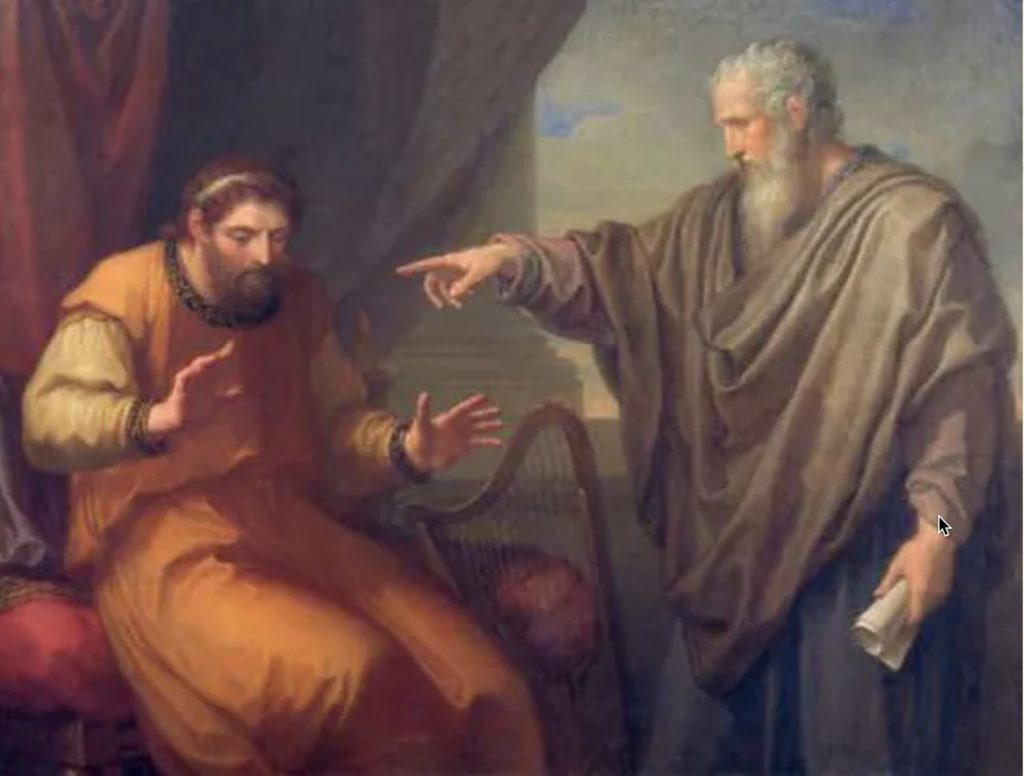
David & NathanThis is a working draft of a sermon which I decided not to use. Comments are welcome!

In the version of the Revised Common Lectionary used by our church, the Hebrew Bible readings in this summer have been working their way through the story of King David, the greatest hero of Israel’s history. We are told that he united the twelve tribes, established the capital in Jerusalem, and expanded the boundaries of the kingdom. He may have written many (certainly not all) of the psalms. Although the kingdom would only remain united until the reign of his grandson, he became the prototype of a great King. His symbol – the star of David – is the most important symbol of the modern state of Israel.

We have more information about his life and career than almost any other figure in the Hebrew Scriptures, taking up half of 1 Samuel and all of 2 Samuel.

In the lesson for Aug. 5 (2 Samuel 11:26-12:13a), we read of the pivotal moment in David’s reign, when the triumphs of his early reign start to turn to troubles for David and his family. Nathan’s accusation of David refers directly to the events recounted in last Sunday’s lesson, so it’s worthwhile to remind ourselves of that story.

Read that passage (2 Samuel 11:1-15) in full, or in brief: David was at home with his army away waging battle. He saw Bathsheba, the wife of Uriah the Hittite, bathing, and sent for her. When she became pregnant, he tried to cover up his involvement by bringing Uriah home, intending that he will go to his wife. Uriah did not do so, due to soldierly scruples, so David then sent him back to the war, directing that he be sent into the heaviest fighting where he will be killed. The verses between the two passages tell how Uriah died, and Bathsheba became David’s wife.

It’s not a pretty story, is it? He has committed the sins of adultery and murder, both of which carry the death penalty. When the people of Israel had demanded a king (1 Samuel 8:4-22), they told Samuel they wanted a King to lead them, so that they could be like the peoples around them. Samuel said they would get a King, but they wouldn’t like it. In this story, David has done some of the things which Samuel warned a king would do. (He’s dead by this point in the story, so he can’t say “Told you so!”)

Samuel’s prophetic role in David’s early career was taken over by Nathan the prophet, who would eventually anoint David’s son Solomon as King. He acted in a positive way earlier to tell David that he would not build a house for God, but that God would make of David “a house,” his dynasty. Now Nathan comes to challenge him, not by directly accusing him of his sins, but by telling him a story of rich man stealing a poor man’s ewe lamb. David was righteously angry, demanding death for the rich man. Nathan’s response turns David’s anger back at him.

David indeed deserved death for his sins. But God was merciful to him. Even though great troubles will come to David and his family, he will be spared the ultimate penalty.

David’s confession perhaps comes a bit too late, but it does reveal a man who understands that his power is limited, coming not from him, but from God, to whom he is ultimately accountable. He became King of Israel because God chose him. God had “unchosen” Saul, and he could just as easily do the same for David.

David wasn’t perfect – far from it, as we have seen – but he understood his place in the scheme of things. His power wasn’t absolute, and when he acted as if it was, he was forcibly reminded of how things should be. Absolute rulers have been quite common in human history. Perhaps the most incisive commentary on them is Shelley’s sonnet Ozymandias:

I met a traveller from an antique land
Who said: “Two vast and trunkless legs of stone
Stand in the desert. Near them on the sand,
Half sunk, a shattered visage lies, whose frown
And wrinkled lip and sneer of cold command
Tell that its sculptor well those passions read
Which yet survive, stamped on these lifeless things,
The hand that mocked them and the heart that fed.
And on the pedestal these words appear:
‘My name is Ozymandias, King of Kings:
Look on my works, ye mighty, and despair!’
Nothing beside remains. Round the decay
Of that colossal wreck, boundless and bare,
The lone and level sands stretch far away”.

King or Emperor, President for Life or Fuehrer – whatever we call such people, Shelley reminds us that their legacy will not last.

What saved David from the trash-heap of history was not his military prowess or his administrative genius. Rather, what kept him on the throne to become the progenitor of a long dynasty was his recognition that he served something greater than himself. Even if he didn’t always act that way, he understood that he served the people of Israel under God’s Law. He had a conscience and a moral compass, and when the chips were down, he placed himself under God’s judgment.

Our Canadian history of constitutional monarchy, going back through British history at least as far as 1215 (Magna Carta), is one of placing increasing limits on our rulers. No-one is above the law, just as David understood himself to be subject to God’s law. Leadership is an issue today, when the trend in many parts of the world is away from democracy to a more authoritarian model.

The story of David is an object-lesson in the limits of leadership, from which we can continue to learn in today’s troubled world. It applies wherever people are given power over other people: in business, in government, and even in the church. Leaders in all places need to keep aware that they are there not simply to serve their own needs and desires, but rather to serve others.

At one time I was considering writing a book of advice for young clergy. I was going to title it “It’s Not About You.” Much of what I might have written (and still might) would apply not just to clergy (although that’s what I know best), but I believe to leadership in other areas.

Against all expectations…

Notes for a sermon on John 6:1-21, July 29, 2018,
Holy Trinity Anglican Church (Strathcona), Edmonton

Some life-changing events come about almost by accident. I had an epiphany once at a clergy conference on Christian Education. The presenter was talking about how various kinds of educational events and programs attract people at various stages of spiritual development. In part of her talk, she said that one group of people were the sort who would always support certain programs, but we shouldn’t expect there to be very many of them.

Then she stopped, saying that she got very impatient with people who said things like “We had a mission event, and it was a total failure – only 6 people showed up!” “What do you mean, ONLY 6? You had 6 people who were moved to turn up. God sent you those people. Give thanks for that, and work with them!”

After that digression, she resumed her prepared talk, but I don’t recall taking much of it in. I had been totally blown away by what I had just heard. I sat and thought about it, realizing that it was just what Jesus did in the first part of our Gospel for today.

The feeding of the 5,000 was a major event in Jesus’ ministry. It’s one of the few stories that appears in all four Gospels, with the details nearly identical between them, and in all four it is followed immediately by Jesus walking on the water. We could spend a lot of time speculating on the “how” of the story; to do that seems to me rather to miss the point.

Jesus’ exchange with Phillip and Andrew shows how the disciples are thinking: there is not enough to feed the masses, and there’s no reasonable expectation that they could get enough together to do it. There’s just not enough! What Jesus does is not to ask if there’s enough, but rather to ask what they can put their hands on. Five loaves and two fish! A realist might say at that time “Better send them all home – there’s nothing we can do.” Jesus has a different idea: he takes what God has provided, gives thanks, and proceeds to work with what he has.

Against all expectations, the people were fed, with 12 baskets left over.

DSCN0370
Loaves and fishes mosaic, Church of the Multiplication, Tabgha, Israel

How it happened is unanswerable. What happened is clear: as the story has come to us, Jesus acted, and people were fed. He challenged his disciples’ scarcity mindset. He used what was at hand to show that God’s generosity will not be limited. Why it happened is the point: very simply, to demonstrate God’s unbounded love in action.

Against all expectations, God’s abundance will defeat our myth of scarcity – every time! But like Phillip and Andrew we need to learn to trust in it.

But isn’t the scarcity narrative powerful? Our society is built on the notion of shortages. People believe there is never enough, so we hoard our wealth and live in fear of running short. It becomes a dog-eat-dog world, dedicated to the survival of the fittest, as people compete for what we believe are increasingly scarce resources.

I believe the results are clear.

There are people going hungry all over the world, not just in far-flung places, but in homes in this wealthy province.

There are people without access to clean water, not just in far-flung places, but in areas of our country largely populated by Indigenous people.

There are people without adequate (or any) housing, not just in far-flung places, but within a few blocks of this church building.

Why does this happen? I believe it is because we become so focused on scarcity that we lose our trust in God’s abundance and God’s desire to share this bounty with all of God’s people.

The scarcity bug often infects the church. “We can’t do that, because we don’t have…” (fill in the blanks!)

Not long after that clergy conference I had the opportunity to put my epiphany into practice. The parish where I was then the Rector was joining a multi-church program called NeighborLink. The program pools volunteers from churches to provide helping services to people in the community. Each participating church recruits a coordinator and a roster of volunteers, who are then deployed through a central office. We had appointed a coordinator and put out a call for volunteers with a date set for commissioning them.

Three weeks before the date, the coordinator came into my office and said, “Robin, we’ve got to pull the plug. It won’t work. We have only three volunteers.” Thinking that we had no reasonable expectation of any more, I was about to agree, when I thought of that insight from the conference. “Wait a second,” I said, “we have three volunteers. Let’s give thanks for them, and then work with what God has given us.” She sat there for a moment looking stunned, and then said, “Maybe you’re right.”

Against all expectations, three weeks later we commissioned 10 volunteers.

It wasn’t quite 5 loaves and 2 fish feeding 5,000, but it certainly felt a bit like that. We trusted in God’s goodness, gave thanks, and worked with what we had.

My friends, let us strive never to live with a mindset of scarcity, but rather rejoice in the abundance of God’s creation, giving thanks for all things at all times.

Jesus came to show us God’s love in action.

Against all expectations, he fed people in their time of hunger.

Against all expectations, he brought peace to his disciples, terrified on the storm-tossed sea.

Against all expectations, he defeated the powers of sin and death by giving up his own life.

Against all expectations, he lived God’s love in a world which so desperately needed (and still needs) to know it.

Against all expectations, he showed that God’s love can never be exhausted.

Against all expectations, he loves us all.

May we live in that love, rejoicing in God’s inexhaustible abundance. Let us give thanks, and then let us work with what God has given us.

Thanks be to God. Amen.

An Interesting Number

Many Math. majors (like me in a former life) will have heard the “proof” that all numbers are interesting.

  1. Assume there is a non-empty set of natural numbers (i.e. 1,2,3,…) which are uninteresting.
  2. This set must have a smallest member.
  3. Being the smallest uninteresting number is itself interesting.
  4. Since a number cannot be both interesting and uninteresting, the assumption in 1. must be false.
  5. Therefore, all numbers are interesting.

But then, to riff on George Orwell (cf. Animal Farm), all numbers may be interesting, but some are more interesting than others.

70Today I encountered a number which for me is very interesting, the number 70. What’s interesting about it? Only that age 70 sounds to me a lot older than age 69. Maybe it’s the change in the first digit, something that’s only happened to me 6 times before. Age is a physical reality, but it’s also a mental and emotional reality.

A friend once said of a mutual acquaintance that he had been “born 80 years old.” Even in middle age, he presented as tired and crotchety, often harking back to earlier days. I hope no-one ever says that of me, although I recall that someone once described me as “stuffy.” My rather warped sense of humor tends to hide when I’m in a public role. People who know me better know that my wit sometimes gets the better of me.

passing-days-3292952 greyI’ve now been retired for about 5 years (Since June 23 or July 31, 2013, depending on how you reckon it.) I’ve enjoyed most of those years, especially the last two or three. It’s good to be free to make your own decisions about what to do with your time, without too many occupational restrictions. I had some plans when I retired. Some have borne fruit, others have been deferred, still others have been put away permanently, and some new things have arisen. I’m not making many new plans at the moment, except for our 50th wedding anniversary celebrations in just over a year.

When I was in school and looking forward to the great challenges of University and adult life, anyone older than my parents seemed absolutely ancient. I’m much older now than they were then, and I don’t feel old at all … at least not most of the time!

The interest of this particular birthday is that it the first one in a long time that has turned me to thinking about the future. Not the past — there’s still plenty of time for that — but what is to come. If my parents’ and grandparents’ lives are any indication, I should have 15 years or so to look forward to. I don’t look forward today in the same way I looked forward at age 16, which was filled with both eagerness and anxiety. Rather, I welcome each day as it comes, with new light in the window, and both new and old things to do.

Life continues to be good.
Thanks be to God.