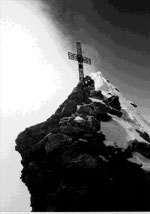
The Cross—From the Other Side

Notes for a Good Friday sermon preached at Holy Trinity Strathcona
Edmonton AB, March 25, 2016

3 crossesWhy did Jesus have to die?” is a very common question, arising from believers and sceptics alike.


St. Anselm’s simple answer, known as “substitutionary atonement,” was that this was the only way to pay the price for our sin. It has become the dominant answer in much of Western Christianity. The early church did not have the doctrine and the Eastern (Orthodox) churches have never embraced it, but almost every hymn in the Holy Week section of Common Praise shows its influence.

The doctrine found early roots in the High Middle Ages, a troubled and turbulent era, when many theologians emphasized the wretchedness of human existence. Its influence continued into the Protestant churches, finding fertile ground in the teaching of John Calvin and his followers.

It works on a kind of quid pro quo economic system: Everything has a price, so somehow someone has to pay the price of sin.

However—it’s a very troubling doctrine in many ways, depicting God as vengeful, demanding blood sacrifice – of his only Son! Some have called it “divine child abuse.”

Under Anselm’s system, the Incarnation (God taking human form) was necessitated by the need for the cross. Jesus’ ministry was almost by-the-by. Our creeds don’t help us in this respect: both Apostles’ and Nicene Creeds contain “the great comma,” sliding directly from Jesus’ birth to the passion.

As one writer pointed out in a recent blog, the whole thing could have been accomplished much more quickly if Jesus had perished with the Holy Innocents of Bethlehem.

There are other problems, but let’s not spend much time on them. Let’s instead try to look at the death of Jesus of Nazareth through the teaching of another medieval saint – Francis of Assisi, who turned the whole equation around, only a century after Anselm.

Francis held that God’s fundamental act of redemption and salvation was the Incarnation. By entering into human life, God blessed and redeemed all of human existence. God loved humanity enough, that to step into our midst, and pitch his tent among us. And the Incarnation led inevitably to the cross.

What do I mean by that? Simply put: when the Word became flesh in Jesus of Nazareth, “flesh” included and assumed all of human existence. Jesus had to die because Jesus was human – and human beings die.

This human being differed from all others in his pre-existence as the Word (Logos), but as a human being he lived into the failings, all the limitations, all the frailties of ordinary people like you and me.

This human being – God incarnate – came to his own people – and “his own knew him not.” He was rejected by those who should have known him, religious leaders who accused him of blasphemy, people who looked for a human solution to their oppression and found Jesus wanting, leaders of the nation who were prepared to sacrifice one man for his supposed sedition to keep the peace, disciples who were drawn to him but could not hear the fullness of his message.

He was despised and rejected by others; a man of suffering and acquainted with infirmity; and as one from whom others hide their faces he was despised, and we held him of no account.
(Isaiah 53:3-4)

He came to bring divine light into this world. “The light shines in the darkness, and the darkness did not overcome it.” (John 1:5) Jesus came to open the doors to eternal life. And what does that take?

For God so loved the world that he gave his only Son, so that everyone who believes in him may not perish but may have eternal life. Indeed, God did not send the Son into the world to condemn the world, but in order that the world might be saved through him. (John 3:16-17)

This is the action of a loving God – who desires that all his people should share his divine life, which is what eternal life means.

Jesus offended the blinded leaders of his nation by his words and actions. He made their lives uncomfortable, making it expedient to have him executed.

Crucifixion makes an example of the offender. It did so in this case, but ultimately not in the way his accusers could ever have imagined. Jesus died as one of us, taking with him to the cross all our triumphs and defeats, all our joys and sorrows, all our gains and all our losses. He died the most shameful death his age could give him. He died a criminal’s death, turning that death into victory, shaming those who wielded the lash and drove the nails, triumphantly proclaiming at the last “It is finished!”

He took the worst the powers of this world could muster against him, and turned it against them through the power of love.

In his birth, in his life, and in his death, God in Jesus took upon himself all that it means to be human.

When we rejoice, remember how Jesus rejoiced over his disciples.

When we weep, remember that Jesus wept at Lazarus’ tomb.

When a child is born, remember that Jesus also was born of a woman.

And when we meet death, remember that Jesus also knew its pains.

Today we remember that God loved us so much that he gave us his Son to lead all people to eternal life. As we look to the cross, let us see not a sign of shame and suffering but the throne of the King of Glory. Our King is crowned with thorns, his face streaked with tears for the people who would not receive him as their king, and handed him over to the powers of this world.

Today and every day, Jesus weeps for us.

Today and every day, let us weep for him and with him.

But finally let us remember that today is not the end of the story. We will tell the next chapter over the great 50 Days of Easter, as we rejoice in the fullness of God’s salvation of the world.

[repeat John 3:16-17]

Thanks be to God!

A new ___ ?

Some time in the ’90’s, the Rev. Loren B. Mead led a clergy conference for the Anglican Diocese of Edmonton. He had graciously agreed to come on a reduced fee, but we did not receive a discounted conference. Far from it — I recall it as one of the best of the various clergy conferences I attended while in parish ministry. I don’t recall much of the specific conference topics, and I have long since lost my notes from it, but one thing stands out.

In the final session, after recapping the major areas of discussion, Mead left us with “twelve truths” for ministry. Some of them were explicitly about church issues, but several could be applied very generally. The one that made the most immediate sense to me at the time was:

“A new ___ won’t solve all your problems.”

shutterstock_101551237When I posted this on Facebook without any referent, all sorts of people responded with either a question about what the blank represented, or their own suggestion for filling it in. The thing is, they’re all right in their own ways. What Mead was getting at in the original context (or so I heard it) was the tendency for people to latch onto a single solution for complex problems.

At the time of the conference, I was well into my second parish charge. When I arrived there, the Bishop told me to get them a building quickly, because the issue threatened to tear the congregation apart. There were a few people who resisted the whole idea of having our own building instead of the rented space we were using, but most of them were utterly fixated on getting into our own church. “It’ll be better once we get our building” was the mantra, spoken in a variety of ways, but always with the same subtext: all the problems of the congregation would be fixed by a building.

Wrong!

We did get into our own building, less than 3 years after my arrival in the parish, but the hordes of new people many were expecting never materialized. Rather, several families who had worked hard on the building project started to drift away from the church. Our income dropped by 10% in the first year, while the building occupancy costs drove the budget up by 20%. It was true that we had space to meet, we could advertise a fixed location, and we could set our service time without bumping into another congregation. But… (there’s always a “but,” isn’t there?) people’s energy levels were low. Years of working on a project had taken its toll. The new building didn’t solve all the problems — it merely helped with some existing ones, and brought along a whole set of new ones.

It took some time, but by the time I left there, the parish had managed to put its edifice complex behind it, and was beginning to behave like a missional church.

I had an analogous experience in my first charge, where I was the first resident cleric in 20 years. They had worked hard to become self-supporting once again, instead of being linked to the parish in the neighbouring town. A lot of hope was pinned on having me there, which I didn’t really wake up to until my first annual meeting, about 7 months in. One man said, “We thought the church would come to life again, and the Sunday School would be full like it was in the ’50’s.” The new priest was to be the solution to all their problems, leading them straight ahead into a glorious past. Those expectations were just as misplaced as the expectations around my next charge’s building. During my time there, we made a number of advances together, but the unrealistic expectations around my presence in an ageing congregation could never quite be overcome.

I have also seen this kind of magical thinking at work in all sorts of places inside and outside the church — enough material here to fill a small book! It appears to be happening to some extent in my former diocese, which has been through some very difficult times. A new Bishop is now taking office, and some of my acquaintances appear to me to have placed all their hope on him. I wish him and them well: they have a huge task ahead of them. Nonetheless, a change of leadership, while often very important, will not by itself solve all the problems of the diocese, nor of any other organization.

DSC_0011Individuals often fall prey to this tendency. Clergy (of whom I know quite a few!) can fall into the trap of thinking that a new charge will be the solution to their vocational and professional problems. It’s known as the “geographical cure” among some bishops of my acquaintance. It rarely works, because moving a cleric in burnout simply moves his or her problems from one place to another.

“A new ___ won’t solve all your problems.”

You can fill in your own blanks according to your situation. I’m certain it will be appropriate for you. Whatever happens, let it be a warning not to place all your hope in one solution, expecting a magical solution. There’s no magic on tap! In Christian theological terms, we might call it “pseudo-Messianic thinking,” looking for a new Messiah when the truth is we have one already. Following the true Messiah, Jesus of Nazareth, is the only real solution, as long as we don’t treat God like a kind of fairy godmother. Rather, the solution to problems is to be found in hard work, careful consideration of issues, working to change things that we can change, and turning what we can’t change over to God.


Note: I intend no offense to anyone in my former parishes or diocese. If any is taken, I apologize. Things are what they are, and this is my experience and my own opinion.


To respond to violence

peace-dove-and-sign

Many people dead…
Massive terror…
The borders of France closed…
Strong responses promised…

And how are we to respond?

I am a Christian, a person who attempts to follow the way Jesus of Nazareth taught and demonstrated in his life, death, and resurrection. That said, I recognize that the term “Christian” has taken on a number of loaded meanings in this highly politicized world, this world beset by civil, religious, and inter-ethnic strife. Far too many people who claim the name of Jesus Christ are espousing violence, and violent responses to others’ violence.

Events of a few years ago taught me the huge value in Jesus’ teachings in the Sermon on the Mount,  particularly his teachings about response to violence. Note that I understand violence to include not just physical violence, but any assault on one’s person, including professional and personal insults.

Jesus said:
‘You have heard that it was said, “An eye for an eye and a tooth for a tooth.” But I say to you, Do not resist an evildoer. But if anyone strikes you on the right cheek, turn the other also; and if anyone wants to sue you and take your coat, give your cloak as well; and if anyone forces you to go one mile, go also the second mile.’ (Matthew 5:38-41)

Turning the other cheek has often been interpreted to suggest that Christians should be wusses: lie down and let your attacker beat you again. Nothing could be further from the truth. Without going into a detailed exposition of the text, suffice it to say that this is better interpreted as standing up and requiring that you be treated as an equal. We expose the attacker for who he or she is by countering their hate with our selves: sons and daughters of the Most High, equally deserving of respect as those who present as enemies.

I had long believed this, but some events in my ministry a few years ago taught me its truth in a way that I could never have imagined before. It’s a long story, but let’s just say that I found myself under attack from some quite unexpected quarters. I had various people counselling me through this. Some urged me to fight back in kind. Others said I should go away for a while, and let things die down. Fight or flight, the classic responses to aggression.

I chose to do neither. Instead, I held my head high, and continued on in my ministry, doing my work in the best way I knew how. A year later, the parish had changed, as my co-worker observed. She had gone on a year’s leave just before the stuff blew up, and when she returned, she encountered a radically different atmosphere. Another friend told me later that my example had helped the parish turn the corner. I turned the other cheek, standing up and saying (by example) that you can’t treat people with disrespect as had been done to me.

That’s my story. Now on the world stage we find ourselves once again faced with appalling acts of violence against innocent people. The standard response — fighting back — has not worked. Read about it HERE. I believe with all my heart that we need to find a new way, one in keeping with the Gospel of Christ. A collective turning the other cheek and loving our neighbours. And yet, the words coming out of France can best be summed up as “REVENGE!”

There has to be a better way. Seeking revenge, even the limited revenge demanded by the Old Testament (“eye for eye, tooth for tooth…” cf. Exodus 21:23-25), perpetuates the cycle of violence. Revenge proves the attacker right, sucking us into an inescapable vortex. The last 14 years have proved this beyond any doubt. Revenge does not work; it does not stop violence.

What is the better way? It won’t be popular. Seeking with Jesus to halt the cycle of violence will inevitably lead to cries of betrayal and cowardice. My admittedly limited personal experience proved to me that loving our enemies is costly, but is ultimately of immeasurable value.

Let us seek to find that better way in our lives, our communities, and between nations. Let’s leave the last word to the prophet Micah:

For out of Zion shall go forth instruction,
   and the word of the Lord from Jerusalem.
He shall judge between many peoples,
   and shall arbitrate between strong nations far away;
they shall beat their swords into ploughshares,
   and their spears into pruning-hooks;
nation shall not lift up sword against nation,
   neither shall they learn war any more;
but they shall all sit under their own vines and under their own fig trees,
   and no one shall make them afraid;
   for the mouth of the Lord of hosts has spoken. (Micah 4:2b-4)

Post-script: Bishop Pierre Whalon has written eloquently on the same topic. Read his comments HERE.


Remembrance Day 2015

Red-PoppyOur parish church is the regimental church of the Southern Alberta Light Horse. Their retired colours hang in the ceiling of the nave; a regimental memorial display sits at the rear of the south aisle, below the WWII Roll of Honour; and every November 11, we host a Remembrance Day service, beginning with prayers at the Church, followed by a procession to Light Horse Park on 104 St., where wreaths are laid at the cenotaph. I have participated in many different events for Remembrance Day, but the practice at Holy Trinity is special, bringing together in a highly explicit way the Christian faith and the public commemoration of our war dead.

Today’s service was better attended than any in the past, because Premier Rachel Notley attended and took a special role, reading a lesson from Micah, and a “Commitment to Service” at the end of the church prayers. It was standing room only. Ms Notley had attended our service for some years as the MLA for our area, and many of us had expected that she would be at one of the larger events around the city. Instead, she chose to continue her commitment to her constituency. I congratulate her for that. It’s too bad that the media mucked up the time, in one case announcing the service for 10:45 — we began at 9:45.

Another special element was the inspired preaching of our Rector. I have rarely seen him more passionate in the pulpit, delivering a truly heart-felt message of calling us to remember until the age to come is fully upon us.

It was a very good service, and many people commented on it. However, the thing that made it special for me was something very personal. My brother (the family historian) managed to find our grandfather’s service record on the website of the Royal Leicestershire Regiment. Grandpa Jack died one month before the Armistice in 1918. Our grandmother kept much of the story to herself: a very private person, for the rest of her life she grieved privately for the husband who had left her with three young children and a fourth on the way. A few years ago, my brother tracked down the location of his grave in France. We had hoped to visit it in 2013, in conjunction with a trip to a conference in Paris, which did not come to fruition. It remains on my bucket list.

His death had profound implications for our family. Granny moved from the Lake District in the north of England to Eastbourne, on the English Channel — about as far away as she could get and still be in England. My mother grew up with a horror of war, which I first really realized at the time of the Cuban missile crisis in 1962. She took to her bed for days, terrified that war was coming. Her feelings about war conflicted with my father’s sense of duty, contributing to my own very mixed emotions around this day.

We didn’t have much more than a few sketchy details about the circumstances of Grandpa’s death. The entry on the regimental website explains much that I didn’t know before, including a wonderful testimony to my grandfather’s character. What this gave to me this morning as I watched wreaths being laid, as we stood in silence for two minutes, as the piper piped the lament, was a focus to my thoughts I had rarely had before. William JackI found myself asking all kinds of “What if’s” What if he had not died? He would have returned to his medical practice, my mother’s life would have been vastly different. She would probably never have met my father — and I wouldn’t be standing here today.

The death of Cap’t William Boyd Jack in France on October 11, 1918 is in that sense one of the defining moments of my own life, even though it happened almost 30 years before I was born. How many others standing around that cenotaph had similar stories to tell? My Grandpa’s death seems at the same time heroic and futile — but utterly and profoundly important 97 years later.

Remembrance Day will never be the same for me again. I will always seek to remember, and to ask “What if?”

Why are the poor in poverty?

A sermon on Mark 12:38-44, with a nod to Ruth 3:1-5; 4:13-17
Delivered at Holy Trinity Anglican Church, Edmonton, November 8, 2015

When I meet someone from another denomination who asks me about what I do in the church, the title “Honorary Assistant” usually confuses them. I explain it by saying that I’m a retired priest who hangs around the church, helping out as needed and as I’m able. Retirement has its benefits, not least the freedom from some of the duties that full-time paid ministry entails.

Over my years in parish ministry I built up an archive of sermons. There have been times when I’ve simply pulled something of the shelf, touched it up a bit, and used it here or elsewhere. I confess to being tempted to do so once more for today.

However…

Another benefit of retirement is the opportunity to reflect on past deeds, and in some cases, to repent of them. Today, I repent of most of the sermons I have preached on the Gospel story from Mark known as “The Widow’s Mite.” For a variety of reasons, I have almost always connected this to the theme of sacrifice and faithful giving, using it as the text for both stewardship and Remembrance sermons. Particular contexts pointed me in that direction and I failed to take account of what I have come to see as the story’s main point.

Let’s try to imagine ourselves in that scene in the temple. Jesus is talking to his disciples, watching a stream of wealthy people deposit their offerings. We see these folks dropping bags of coins noisily into the treasury boxes, making sure that others see them. Then we see a poor woman approaching the treasury, and dropping two tiny coins in, with an almost inaudible tinkle. Who else might be watching? Maybe she came with a friend or two, and maybe they’re saying something like, “What are you doing? That’s your last coin! Now how will you live?”

Notice that Jesus doesn’t actually commend her, but notes the same thing—she has given “everything she had, all she had to live on.” What might have led her to do this? What would it take for one of us to give everything—every last cent!—to a religious institution? And why is she so destitute? Why does she have nothing left but two small coins?

Jesus has already answered the question, in the first part of the story:

Beware of the scribes… They devour widows’ houses …

The people who were able to pour bags of money into the temple treasury were able to do so because they had made a great deal of money, very likely at the expense of the least able in the community. They participated in a system backed by the religious authorities which worked greatly in their favour. The widow was likely giving her two coins to the temple out of a sense of obedience to the dictates of this same system. God requires that you make your gift to the temple, but does God also demand that you leave yourself with no means of support whatsoever? I think not—and I believe this story suggests that Jesus also thought not.

Clearly the temple and its economic underpinnings had become corrupted in Jesus’ time. The story stands not so much as an affirmation of the widow’s sacrificial giving, but rather as an indictment of a social, economic, and religious system that abused those on the margins of society.

Throughout the prophetic writings in the Hebrew Bible, care for widows and orphans is one of the signs of the age to come. Widows and orphans had no standing in the community, having to rely on the generosity of others. The book of Ruth, from which we heard two excerpts, revolves around the plight of two widows, Naomi and Ruth, who use their slim resources (and some “feminine wiles”) to come under the protection of Boaz, who becomes Ruth’s husband. It is a story that moves from desperation to a renewed life, quite the opposite of the widow’s situation in the Gospel.

If Jesus challenges the religious and economic system of his time that has led to the utter poverty of this nameless widow, surely we are bound to challenge the systems of our world that conspire to keep many people in poverty. The fourth of the Five Marks of Mission of the Anglican Communion, now enshrined as part of our Diocese’s constitution, acknowledges this:

To seek to transform unjust structures of society, to challenge violence of every kind, and to pursue peace and reconciliation.

The church is thus committed to challenging the ways of the world, seeking to live into the peace and justice of the Kingdom of God. It’s not always going to be popular. Dom Hélder Câmara, the late Roman Catholic Archbishop of Recife, Brazil, who was widely known for his work among the poor, famously said

When I give food to the poor, they call me a saint. When I ask why they are poor, they call me a communist.

The Diocese’s Social Justice Committee held a “Day on Poverty” just over a week ago. In the morning, we participated in the United Way’s poverty simulation, followed by an afternoon of theological reflection on poverty, including a presentation by Bishop Jane on the work of the Task Force on poverty which she co-chaired with the Mayor.

Another speaker spoke of the types of social ministry: relief, individual development, community development, and structural change. There is a role for the church at every level. It is fair to say that most church work in the area of poverty is on the level of relief. Relief work is necessary, but it will not by itself eliminate poverty, which is deeply rooted in society. Structural, systemic change must happen in order to make any real progress towards the elimination of poverty.

Some will quote Jesus, who said to Judas “The poor will always be with you…”, as if this somehow absolves us of responsibility for the poor and the hungry. However, as a Bible study we did at the Day on Poverty showed us, the out-of-context quote from Jesus refers to a passage from Deuteronomy which first states that there should not be any poor in the land, going on to say that because the will always be with you, you should never miss an opportunity to help them.

The Mayor’s Task Force has challenged us to work for the elimination of poverty. It’s a big goal, but it’s a goal that comes with Jesus’ own blessing. When the Kingdom of God comes in its fullness, there will be no poor in our midst. May God give us the grace to work towards that day.

What’s Missing?

I haven’t posted much in the past year, ever since passing the 1st anniversary of my retirement. Some, maybe most, of the issues that were on the top when I first left full-time ministry have evaporated, or at least receded into the background. It’s now two years since I retired, and I’m feeling more in tune with what a newly-retired colleague once said: “I have discovered that God made me for retirement.”

I have several places to serve in the community, plus frequent-enough opportunities to preach and preside at worship. There’s not a lot of pressure in my life, and that’s just fine with me. My health is pretty good, we have enough income to live on, and we have reasonable reserves for the future. All told, life is pretty much OK.

And yet…

It feels like there may be something missing. Many days I accomplish almost exactly nothing that anyone else might consider useful. I’m going to take more time in the next while to think and pray about where I’m headed. I know I need to read more: there are several books on my shelf with bookmarks in them, mostly pretty near the beginning. That’s a start.

Reconciliation in the Name of the Trinity

Trinity Sunday, 2015 – joint service of Trinity Lutheran Church and Holy Trinity Anglican Church

I am grateful for the opportunity to be in this pulpit today, on a Trinity Sunday which holds special meaning for me. I have had many years of close association with the ELCiC, including the privilege of preaching and participating in the laying-on-of-hands at my sister-in-law’s ordination to the Lutheran pastorate. More recently, I have developed a closer relationship with some members of Trinity Lutheran, including Pastor Ingrid. The date is significant because I was ordained a deacon on May 31, and preached my first sermon as an ordained person on Trinity Sunday, 1987.

About a year before that, I was beginning Clinical Pastoral Education at the Royal Alexandra Hospital. One of the nursing units to which I was assigned was in maternity, where I made one of my very first pastoral visits. When I introduced myself to a young woman seated on her bed, she first said she was just waiting to be discharged, and then said, “What church do you belong to?” I gave her the standard hospital answer: hospital chaplains served everyone without denominational distinction. That wasn’t good enough for her: she demanded to know what church I was associated with when I wasn’t in the hospital. When I told her “Anglican,” her response was immediate and negative, something like “That’s one of those churches who believe in the Trinity! It’s not in the Bible, so you can just leave.” I started to argue with her (major mistake!), but quickly realized that nothing would be gained by proceeding.

It was a real surprise to me that there were people who called themselves Christians who denied the Trinity, something I had understood as an essential tenet of the faith. In the decades since, then, those few minutes by a hospital bed became foundational as I strove to understand what we mean by “I believe.”

Our faith is Trinitarian in shape: the Nicene Creed which we will recite in a few minutes has a three-part structure: we believe in God the Father; we believe in his Son Jesus Christ; we believe in the Holy Spirit. But what do we mean by the word “believe,” and where is that belief grounded? Lutherans and Anglicans share a history of being rooted in Scripture as well as the traditional teachings of the Church, going back to the time of the Church Fathers, who were expounding doctrine well before the Canon of the Bible was agreed upon. Don’t get me wrong: scripture is important, but we should remember that the Church came before the Bible, not vice versa.

As members of two congregations dedicated to the Trinity, we are reminded of the doctrine’s centrality every time we enter one of our buildings—you can’t escape the name. I don’t recall hearing of either congregation spending much (if any) time debating the nuances of the doctrine, but members of both certainly devote ample time to living out the faith in church activities, and in ministries beyond our walls.

We tend to understand belief as a kind of “head exercise,” giving intellectual assent to propositions about God and God’s works. The question asked of the church is often “What do we believe?” In her ground-breaking book “Christianity After Religion,” Diana Butler Bass has suggested that we rephrase the question as “How do we believe?” Pointing to the German root of the verb, she says that belief is less about the head than the heart—what we believe is where place our trust, as we set our hearts to follow God in the divine mission.

How do we live into a Trinitarian faith? That’s a huge, life-changing, and life-long question, because it encompasses the whole of God’s being. St. Augustine wrote:

“If we speak of God, what wonder is it is you do not comprehend. For, if you comprehend, He is not God. Let there be a pious profession of ignorance rather than a rash profession of knowledge. That one’s mind only touch God a little is great happiness; to comprehend Him is utterly impossible.”
St. Augustine, Sermon 67 on the New Testament – http://www.newadvent.org/fathers/160367.htm

Seeking to know God and to follow God’s ways is the task of a lifetime, the ongoing process called progressive sanctification, the continuing work of the Holy Spirit in making us ever more holy.

There are many aspects to growth in holiness. Let me focus today on only one: the work of reconciliation. Paul expressed the importance of this ministry in these words:

All this is from God, who reconciled us to himself through Christ, and has given us the ministry of reconciliation; that is, in Christ God was reconciling the world to himself,
2 Corinthians 5:18-19a NRSV

This week in Ottawa, the Truth and Reconciliation Commission of Canada will deliver its final report on the Residential Schools. The Anglican Church has been deeply involved in this process for years. I note that the ELCiC has held some recent events focusing on the on-going work of reconciliation with our indigenous brothers and sisters. At the TRC’s event last year in Edmonton, Mayor Don Iveson proclaimed the next year to be a “Year of Reconciliation.” Well and good, but a year is a short time to work on a century-old issue. It’s very tempting to take shortcuts, like the person who responded to an appeal for the Residential Schools Settlement Fund by walking into my office, slapping a large cheque on my desk and saying, “There! I hope that’s the last we hear of this.” Not by a long shot! Justice Murray Sinclair, the chair of the TRC, has said

Reconciliation is about forging and maintaining respectful relationships.
There are no shortcuts.
http://www.trc.ca/websites/trcinstitution/index.php?p=3

The Residential Schools created a gulf between indigenous and non-indigenous people in this country. I heard a great deal of that pain in my time in Brandon, which brought me into contact with many survivors and their families. Reconciliation—building respectful relationships—will take time in listening, in walking together, in working together. It is important work for our nation and for our churches.

Reconciliation goes against the flow of human behavior. We’re very good at building walls and creating enclaves in which to live. We’re less good at reaching out across those walls, and learning to see those on the other side as God’s children deserving of every bit as much respect as we are.

One sign of the ongoing work of reconciliation is the continuing and developing relationship between our two congregations. It is truly the work of the Holy Spirit as we seek to build and maintain a respectful relationship.

There are no shortcuts to the Kingdom: relationships must be carefully fostered and lovingly maintained, whether between Lutherans and Anglicans or between indigenous and non-indigenous people. We have been entrusted in the name of the Trinity with the ministry of reconciliation, hearing the call of the God who called Isaiah, seeking to follow the one who reconciled us to God through his death on the cross, and always and ever empowered by the Holy Spirit.

May it be so.

Wearing the Cross

Notes for a sermon for Holy Cross Day, 2014, at Holy Trinity, Edmonton.

Texts: Num 21:4b-9; Ps 98:1-6; 1 Cor 1:18-24; John 3:13-17

cross222At Choir practice on Thursday night, one member asked what this “Holy Cross Day” was. Good question! It goes back to the year 335, when the Church of the Resurrection (now called the Church of the Holy Sepulchre) in Jerusalem was dedicated. Helena, the mother of the Emperor Constantine, the chief organizer of the building of the Church, had found some wood on the site which she held to be the True Cross of Christ. The day became associated with the exaltation of the cross as the symbol of Christ’s victory. It has been in the calendar of the RC Church and many Orthodox churches ever since.

In Anglican practice, it was regarded as a lesser feast, which meant it was never observed on a Sunday. The revision of the calendar in the BAS raised it to the status of a “Feast taking precedence over a Sunday.” Because it’s on a fixed date, it doesn’t turn up very often—today is only the fifth time since the new calendar came into use, and the first since 2008. I am glad that Fr. Chris chose to celebrate Holy Baptism on this day, because the symbol and the sacrament are closely related. The cross is the most widely-used symbol of Christ’s victory over death. In Baptism—the sacrament of new birth—a person is brought into participation in the Risen Life: the old self is dead! Our practices of Baptism obscure that a bit, but if you have ever taken part in an outdoor full-immersion Baptism, the symbolism can’t be missed. There’s danger here!

In that light, we observe that the cross can be a powerful symbol of danger and death. Again, our practices have tended to shield us from that reality: it can be hard to see a gleaming, jewel-bedecked cross as an instrument of torture and death, but that’s where the symbol comes from.

The cross was almost unknown as a symbol for the church’s first three centuries. The most common symbol was a fish. At a time when Christian faith was at best tolerated by the state, and at worst persecuted, the cross was a reminder of Imperial oppression and cruelty. Perhaps paradoxically, the use of the cross as we now know it only began to appear after Constantine had made the faith legal, and after the abolition of crucifixion as a mode of punishment and execution—right around the time when his mother is said to have discovered the True Cross. (If that seems like an odd coincidence, well…maybe it really isn’t.)

Revolutions bring huge changes—that’s what the word means! Among other things, Constantine’s religious revolution made the church safe for the first time in its history. Somewhat ironically, the church then adopted the most “unsafe” symbol of all as its emblem. This exemplifies the upending of so much of the Church’s life in the 4th Century, some of which we heard about in the first session of our Thursday morning study. For one, we heard how Harvey Cox in “The Future of Faith” called the pre-Constantinian period “the age of faith” and the subsequent era “the age of belief.” The two things are not at all the same thing: belief has to do with thought, while faith has to do with action. “Belief” in this sense is a noun, while “faith” is really a verb.

The early church was primarily concerned with how people lived and behaved—a desire for “orthopraxy.” After Constantine, the church’s focus changed to what people thought—a desire for “orthodoxy.” Harvey Cox suggests that we are now in the early days of a new age of the church, which he calls “the age of the Spirit.” The cross stands as the pre-eminent symbol of the age of belief, and it has often been used to teach particular beliefs.

When I say “the cross,” you might well ask “which cross?” The commonest version is the so-called “Latin cross,” like the one I’m wearing; there are many variations on this very simple theme. Every one recalls in its own way the death of Jesus, but various churches and movements have adopted particular kinds of crosses, sometimes for historical reasons, but very often to emphasize a particular way of understanding Jesus’ death.

Latin crosses have no figure of Jesus, reminding us that Jesus has passed through death to the Risen Life.

Crucifixes remind us of Jesus’ suffering, a key aspect of substitutionary atonement, one doctrine of how we are saved through the death of Jesus.

Orthodox crosses have three horizontal pieces, a visual reminder of the Gospel accounts of the Crucifixion.

Each cross in its own way recalls Jesus’ death and resurrection—the central story of the mystery of salvation.

To recall the story and to seek to understand it is one thing: that’s a matter of belief (orthodoxy). It is entirely another thing to ask “so what?” What difference does the cross make in our lives (othopraxy)? What kind of mission does it point to in the life of the church and of us as individuals? What difference will the cross on our candidate’s forehead make in his life?

It seems to me that we can talk about a “cross-shaped” or “cruciform” mission. The cross on which Christ gave up his life for us was rooted in the earth, reached up to heaven, and outward in loving embrace. Christian life and mission should therefore:

  • Be rooted in the here and now of human life.
  • Reach upward, seeking to want what God wants.
  • Not condemn, but reach out to the world.

And, above all:

  • Reveal the self-giving love that led Jesus to the cross.

Every Christian wears the cross, invisibly from our baptism. Many choose to wear visible crosses like lapel pins, neck chains, or bumper stickers. Whether visible or not, the question is then: do our lives reflect and proclaim the message of the cross we bear?

As we have inherited it, the cross stands as a challenge to the existing order: the symbol of state oppression and cruelty becoming the paramount sign of holy freedom and love. As Paul said, it was (and still is!) foolishness or a stumbling block to people outside the faith, but “to those who are the called…Christ the power of God and the wisdom of God.

May our lives, and the lives of all the baptised, proclaim the power, the wisdom, and the love of the God who gave his only son “in order that the world might be saved through him.”

Amen.

Sleep, blessed sleep

sleep not foundFor quite a few years, I didn’t sleep well. In the year when I turned 50, I found myself waking up ridiculously early, often at 4:42 AM (What’s that all about, I ask you?). My doctor said that this kind of thing happens for men over 50, and not to worry about it, but …. if I really couldn’t sleep, he had a pill for me to take. It might be addictive, so he said, but a good night’s sleep was even more addictive.

Well,that worked for a number of years, right through my time of retirement. If I didn’t take the pill, I woke up in the middle of the night (4:42 again!), and couldn’t get back to sleep. Lack of sleep made me cranky, unfocused, and generally less than fully functional. So — I went on taking the pills right through my retirement. For all my time in Manitoba, my doctors renewed the prescription without question. I was officially diagnosed with anxiety, which may in fact have been the truth.

Then last year I retired and we moved back to Alberta, and we had to find new medical care. The doctors here looked at my 15-year history on this medication, and would not renew it. It was addictive! Ouch.

Last fall, I had to learn to sleep again, without the pharmaceutical aid I had relied upon for years. It was hard. For a while, I found myself waking up even earlier than in the early years — 3:30 AM was not uncommon. Sleep deprivation became the law of my life.

But things change. I found a different, non-addictive and non-prescription, chemical sleep aid. It has helped me learn to sleep better, and often to sleep undisturbed until 7 AM or later. That may not sound much to some people, but for most of my working life, I set the alarm for 6, to be at work by 8. Now… I don’t often have to up for anything much before 9. So sleeping later is a bonus, and more and more a blessing.

Sleep is a wonderful thing. Sleep deprivation is a curse. I have seen this in the lives of many people. Being able to sleep as much as one needs is a real blessing, and it is only in retirement that I have really been able to enjoy this.

Finding myself able to sleep so late (yes: 7:30 AM is late in my books!) is a real blessing. Realizing that I can, and often do, sleep this well, is one of the things that makes me realize that I may really be retired — in the best sense of the word.

Now… I invite you to listen to Eric Whitacre’s wonderful choral ode to sleep:

https://www.youtube.com/watch?v=6WhWDCw3Mng

Did I have anxiety? Maybe, but you’d have to ask my wife to get the goods on that. What I do know is that I have let go of a lot of things in the past year, and I have realized that I have much less to be anxious about. I go for coffee after Sunday services, and enjoy the camaraderie of other parishioners. I look around the room and see our stipendiary clergy earnestly in conversation with people, and see the anxiety on their faces. That’s not a bad thing. It’s just the way the church order things, by putting heavy stress on a few “special” people. I wish for my colleagues that they may find the joy of SLEEP — blessed sleep, and may know the joy of knowing that God’s work does not depend entirely on them.

On Earth as In Heaven

Notes for a sermon preached on July 27, 2014 at Holy Trinity Anglican Church, Edmonton.
Text: Matthew 13:31-33, 44-52

Recent world and local news has given me occasion to give thanks.

Two weeks ago, my spouse & I were at a family gathering, which included a BBQ on a beach. No incoming artillery threatened the crowd enjoying the BC sun. Thanks be to God.

This week, we will travel by air to Vancouver Island. We can be quite sure that no one will aim a surface-to-air missile at our flight. Thanks be to God.

The reports about the condo fire in SW Edmonton made me grateful that we live in a building with a full sprinkler system and a non-combustible exterior. Thanks be to God.

None of these—or any other bits of dire news—point us toward God’s Kingdom, except in a negative sense. This is not what God desires for his people. For that, we turn to the Gospel—the Good News!

That gospel passage we just heard could almost make us a bit dizzy, with its repeated refrain “The kingdom of heaven is like…” We hear it five times, associated with five very different images: a mustard seed, yeast, treasure, a merchant, a net—images with no apparent connection with each other—they are just piled up together. The closing comment about the scribe trained for the kingdom adds another layer.

We’re talking about parables here, most of them coming without any explanation. As Fr. Paul Fromberg said from this pulpit last Sunday, explanations actually go against the nature of parables, which are less like object lessons than Zen koans: they just sit there, challenging us to find meaning in them.

The theologian Sally McFague says that parables open “cracks in reality,” to allow us to see things freshly.

As Leonard Cohen wrote:

There’s a crack in everything.
That’s how the light gets in.

Jesus uses parables to open cracks in our carefully built world-view, challenging us to see things in a new light. He takes the stuff of ordinary life, and gives it a twist, and all of a sudden new light is streaming!

He asks his disciples if they have understood, and they answer “Yes.” I recall a saying of Albert Einstein:

If one is asked “Do you believe in God,”
the answer least likely to be understood is “Yes.”

Even the shortest parables have multiple layers and shades of meaning.

Recall that Jesus says “The kingdom of heaven,” a term found only in Matthew, generally in contexts where Mark and Luke use “the kingdom of God.” Matthew’s use of this term is widely believed to be a circumlocution: Jews avoid misusing the name of God by avoiding talking directly about God. It is one of the reasons many scholars believe this Gospel was written for a church composed mainly of Jewish converts. The two expressions mean the same, so it is important not to assume that “heaven” points to something entirely beyond this world. Every time we pray the Lord’s Prayer, we pray for the coming of the kingdom:

Your kingdom come, your will be done,
on earth as in heaven.

God reigns in heaven—he always has and always will—but our prayer is for God’s reign to come in its fullness on earth. God’s kingdom will be fulfilled when the holy will is done in all of creation—on earth as in heaven.

When will that be? How will we know it? The five short parables have one thing in common—they all involve action, as people do things that point to what life looks like when we seek to allow God’s will to govern our lives. Let’s take a look at just the first two of them, beginning with the mustard seed.

The kingdom of heaven is like a mustard seed that someone took and sowed in his field…

It sounds pretty straightforward, doesn’t it? It has a “standard” interpretation, stressing how the very small becomes the very large. That’s correct, as far as it goes, but if we end there, we’ve missed the point. Mustard gives useful seeds and oil, but it is actually a weed—a fast-growing, invasive plant that is almost impossible to eradicate once it is established. What sane person would sow mustard in a field, where it crowds out the wheat, and provides shelter for birds that eat the growing grain? So why does Jesus liken the kingdom to such an apparently counter-productive action? The people who first heard this parable would surely have sat up straight, and scratched their heads at such a suggestion.

And so? The kingdom of heaven is like… well, it’s not always what we expect it to be.

A mustard plant in the middle of a wheat field may be unwelcome, but it can’t be ignored. It is urgent business. The kingdom Jesus announces can also at times be unwelcome, as he challenges us:

Repent, for the kingdom of heaven has come near. (Matt 4:17)

The urgency of God’s business puts demands on us: action, commitment, sometimes extreme behaviour, as we work for the coming of God’s kingdom, on earth as in heaven.

Mustard seeds remind us that even the simplest and seemingly most insignificant actions can have big consequences—sometimes unexpected, even undesired. What about yeast? Same thing! The yeast used in ancient Palestine wasn’t the nice domesticated stuff we are familiar with. It was more like what we today call sourdough starter, kept over from the previous batch of bread to leaven the next one. It goes bad or dies very easily, and must be refreshed from time to time. If proper care is not taken, you can produce a loaf of bread laced with poison.

Just so, small actions can produce very large and very negative results, not because people mean to do evil, but more often because they do not take the proper care and attention. This past week, a single cigarette butt caused $10M in damage to a west-end condo, and made 400 people homeless for months or years.

Jesus invites us to be part of that kingdom which has come near. The invitation is a challenge—to us individually, to the church, and to the world around us. The call to follow Jesus can mean being a nuisance like the mustard bush—sometimes unwelcome, but unavoidable in its urgency.

However urgent it may be, the call to follow Jesus is not a call to act blindly or rashly, but to take care in what we do, seeking always to do God’s will, seeking to be good yeast in a world that critically needs God’s leavening.

Far be it from me to suggest that these interpretations are anything more than an opening of a crack—how do YOU hear?

We do have urgent matters before us. Let us therefore seek to know God’s will, through prayer, study, and worship—and then in the holy action—God’s Mission!—that arises from these disciplines. Let us be wise and diligent in attending to them, and may our lives reflect our prayer:

Your kingdom come, your will be done,
on earth as in heaven.