Wearing the Cross

Notes for a sermon for Holy Cross Day, 2014, at Holy Trinity, Edmonton.

Texts: Num 21:4b-9; Ps 98:1-6; 1 Cor 1:18-24; John 3:13-17

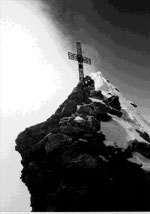
cross222At Choir practice on Thursday night, one member asked what this “Holy Cross Day” was. Good question! It goes back to the year 335, when the Church of the Resurrection (now called the Church of the Holy Sepulchre) in Jerusalem was dedicated. Helena, the mother of the Emperor Constantine, the chief organizer of the building of the Church, had found some wood on the site which she held to be the True Cross of Christ. The day became associated with the exaltation of the cross as the symbol of Christ’s victory. It has been in the calendar of the RC Church and many Orthodox churches ever since.

In Anglican practice, it was regarded as a lesser feast, which meant it was never observed on a Sunday. The revision of the calendar in the BAS raised it to the status of a “Feast taking precedence over a Sunday.” Because it’s on a fixed date, it doesn’t turn up very often—today is only the fifth time since the new calendar came into use, and the first since 2008. I am glad that Fr. Chris chose to celebrate Holy Baptism on this day, because the symbol and the sacrament are closely related. The cross is the most widely-used symbol of Christ’s victory over death. In Baptism—the sacrament of new birth—a person is brought into participation in the Risen Life: the old self is dead! Our practices of Baptism obscure that a bit, but if you have ever taken part in an outdoor full-immersion Baptism, the symbolism can’t be missed. There’s danger here!

In that light, we observe that the cross can be a powerful symbol of danger and death. Again, our practices have tended to shield us from that reality: it can be hard to see a gleaming, jewel-bedecked cross as an instrument of torture and death, but that’s where the symbol comes from.

The cross was almost unknown as a symbol for the church’s first three centuries. The most common symbol was a fish. At a time when Christian faith was at best tolerated by the state, and at worst persecuted, the cross was a reminder of Imperial oppression and cruelty. Perhaps paradoxically, the use of the cross as we now know it only began to appear after Constantine had made the faith legal, and after the abolition of crucifixion as a mode of punishment and execution—right around the time when his mother is said to have discovered the True Cross. (If that seems like an odd coincidence, well…maybe it really isn’t.)

Revolutions bring huge changes—that’s what the word means! Among other things, Constantine’s religious revolution made the church safe for the first time in its history. Somewhat ironically, the church then adopted the most “unsafe” symbol of all as its emblem. This exemplifies the upending of so much of the Church’s life in the 4th Century, some of which we heard about in the first session of our Thursday morning study. For one, we heard how Harvey Cox in “The Future of Faith” called the pre-Constantinian period “the age of faith” and the subsequent era “the age of belief.” The two things are not at all the same thing: belief has to do with thought, while faith has to do with action. “Belief” in this sense is a noun, while “faith” is really a verb.

The early church was primarily concerned with how people lived and behaved—a desire for “orthopraxy.” After Constantine, the church’s focus changed to what people thought—a desire for “orthodoxy.” Harvey Cox suggests that we are now in the early days of a new age of the church, which he calls “the age of the Spirit.” The cross stands as the pre-eminent symbol of the age of belief, and it has often been used to teach particular beliefs.

When I say “the cross,” you might well ask “which cross?” The commonest version is the so-called “Latin cross,” like the one I’m wearing; there are many variations on this very simple theme. Every one recalls in its own way the death of Jesus, but various churches and movements have adopted particular kinds of crosses, sometimes for historical reasons, but very often to emphasize a particular way of understanding Jesus’ death.

Latin crosses have no figure of Jesus, reminding us that Jesus has passed through death to the Risen Life.

Crucifixes remind us of Jesus’ suffering, a key aspect of substitutionary atonement, one doctrine of how we are saved through the death of Jesus.

Orthodox crosses have three horizontal pieces, a visual reminder of the Gospel accounts of the Crucifixion.

Each cross in its own way recalls Jesus’ death and resurrection—the central story of the mystery of salvation.

To recall the story and to seek to understand it is one thing: that’s a matter of belief (orthodoxy). It is entirely another thing to ask “so what?” What difference does the cross make in our lives (othopraxy)? What kind of mission does it point to in the life of the church and of us as individuals? What difference will the cross on our candidate’s forehead make in his life?

It seems to me that we can talk about a “cross-shaped” or “cruciform” mission. The cross on which Christ gave up his life for us was rooted in the earth, reached up to heaven, and outward in loving embrace. Christian life and mission should therefore:

  • Be rooted in the here and now of human life.
  • Reach upward, seeking to want what God wants.
  • Not condemn, but reach out to the world.

And, above all:

  • Reveal the self-giving love that led Jesus to the cross.

Every Christian wears the cross, invisibly from our baptism. Many choose to wear visible crosses like lapel pins, neck chains, or bumper stickers. Whether visible or not, the question is then: do our lives reflect and proclaim the message of the cross we bear?

As we have inherited it, the cross stands as a challenge to the existing order: the symbol of state oppression and cruelty becoming the paramount sign of holy freedom and love. As Paul said, it was (and still is!) foolishness or a stumbling block to people outside the faith, but “to those who are the called…Christ the power of God and the wisdom of God.

May our lives, and the lives of all the baptised, proclaim the power, the wisdom, and the love of the God who gave his only son “in order that the world might be saved through him.”

Amen.

On Earth as In Heaven

Notes for a sermon preached on July 27, 2014 at Holy Trinity Anglican Church, Edmonton.
Text: Matthew 13:31-33, 44-52

Recent world and local news has given me occasion to give thanks.

Two weeks ago, my spouse & I were at a family gathering, which included a BBQ on a beach. No incoming artillery threatened the crowd enjoying the BC sun. Thanks be to God.

This week, we will travel by air to Vancouver Island. We can be quite sure that no one will aim a surface-to-air missile at our flight. Thanks be to God.

The reports about the condo fire in SW Edmonton made me grateful that we live in a building with a full sprinkler system and a non-combustible exterior. Thanks be to God.

None of these—or any other bits of dire news—point us toward God’s Kingdom, except in a negative sense. This is not what God desires for his people. For that, we turn to the Gospel—the Good News!

That gospel passage we just heard could almost make us a bit dizzy, with its repeated refrain “The kingdom of heaven is like…” We hear it five times, associated with five very different images: a mustard seed, yeast, treasure, a merchant, a net—images with no apparent connection with each other—they are just piled up together. The closing comment about the scribe trained for the kingdom adds another layer.

We’re talking about parables here, most of them coming without any explanation. As Fr. Paul Fromberg said from this pulpit last Sunday, explanations actually go against the nature of parables, which are less like object lessons than Zen koans: they just sit there, challenging us to find meaning in them.

The theologian Sally McFague says that parables open “cracks in reality,” to allow us to see things freshly.

As Leonard Cohen wrote:

There’s a crack in everything.
That’s how the light gets in.

Jesus uses parables to open cracks in our carefully built world-view, challenging us to see things in a new light. He takes the stuff of ordinary life, and gives it a twist, and all of a sudden new light is streaming!

He asks his disciples if they have understood, and they answer “Yes.” I recall a saying of Albert Einstein:

If one is asked “Do you believe in God,”
the answer least likely to be understood is “Yes.”

Even the shortest parables have multiple layers and shades of meaning.

Recall that Jesus says “The kingdom of heaven,” a term found only in Matthew, generally in contexts where Mark and Luke use “the kingdom of God.” Matthew’s use of this term is widely believed to be a circumlocution: Jews avoid misusing the name of God by avoiding talking directly about God. It is one of the reasons many scholars believe this Gospel was written for a church composed mainly of Jewish converts. The two expressions mean the same, so it is important not to assume that “heaven” points to something entirely beyond this world. Every time we pray the Lord’s Prayer, we pray for the coming of the kingdom:

Your kingdom come, your will be done,
on earth as in heaven.

God reigns in heaven—he always has and always will—but our prayer is for God’s reign to come in its fullness on earth. God’s kingdom will be fulfilled when the holy will is done in all of creation—on earth as in heaven.

When will that be? How will we know it? The five short parables have one thing in common—they all involve action, as people do things that point to what life looks like when we seek to allow God’s will to govern our lives. Let’s take a look at just the first two of them, beginning with the mustard seed.

The kingdom of heaven is like a mustard seed that someone took and sowed in his field…

It sounds pretty straightforward, doesn’t it? It has a “standard” interpretation, stressing how the very small becomes the very large. That’s correct, as far as it goes, but if we end there, we’ve missed the point. Mustard gives useful seeds and oil, but it is actually a weed—a fast-growing, invasive plant that is almost impossible to eradicate once it is established. What sane person would sow mustard in a field, where it crowds out the wheat, and provides shelter for birds that eat the growing grain? So why does Jesus liken the kingdom to such an apparently counter-productive action? The people who first heard this parable would surely have sat up straight, and scratched their heads at such a suggestion.

And so? The kingdom of heaven is like… well, it’s not always what we expect it to be.

A mustard plant in the middle of a wheat field may be unwelcome, but it can’t be ignored. It is urgent business. The kingdom Jesus announces can also at times be unwelcome, as he challenges us:

Repent, for the kingdom of heaven has come near. (Matt 4:17)

The urgency of God’s business puts demands on us: action, commitment, sometimes extreme behaviour, as we work for the coming of God’s kingdom, on earth as in heaven.

Mustard seeds remind us that even the simplest and seemingly most insignificant actions can have big consequences—sometimes unexpected, even undesired. What about yeast? Same thing! The yeast used in ancient Palestine wasn’t the nice domesticated stuff we are familiar with. It was more like what we today call sourdough starter, kept over from the previous batch of bread to leaven the next one. It goes bad or dies very easily, and must be refreshed from time to time. If proper care is not taken, you can produce a loaf of bread laced with poison.

Just so, small actions can produce very large and very negative results, not because people mean to do evil, but more often because they do not take the proper care and attention. This past week, a single cigarette butt caused $10M in damage to a west-end condo, and made 400 people homeless for months or years.

Jesus invites us to be part of that kingdom which has come near. The invitation is a challenge—to us individually, to the church, and to the world around us. The call to follow Jesus can mean being a nuisance like the mustard bush—sometimes unwelcome, but unavoidable in its urgency.

However urgent it may be, the call to follow Jesus is not a call to act blindly or rashly, but to take care in what we do, seeking always to do God’s will, seeking to be good yeast in a world that critically needs God’s leavening.

Far be it from me to suggest that these interpretations are anything more than an opening of a crack—how do YOU hear?

We do have urgent matters before us. Let us therefore seek to know God’s will, through prayer, study, and worship—and then in the holy action—God’s Mission!—that arises from these disciplines. Let us be wise and diligent in attending to them, and may our lives reflect our prayer:

Your kingdom come, your will be done,
on earth as in heaven.

Surprise!

Notes for a sermon preached at the Great Vigil of Easter, April 19, 2014, at Holy Trinity Anglican Church, Edmonton.

Texts: Matthew 28:1-10; Romans 6:3-11; Exodus 14:10-31, 15:20-21 


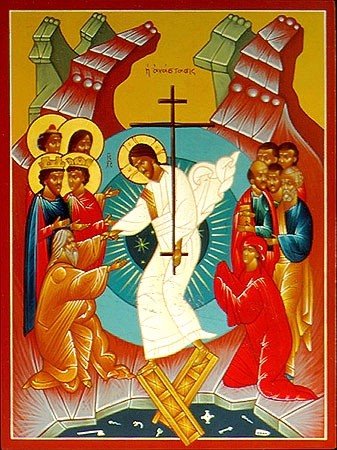
Resurrection Icon

When Fr. Chris asked me if I would preach at this service, I hardly waited a heartbeat before saying “Yes.” In my previous position in a different diocese I always had to relinquish the pulpit to the Bishop on major festivals, so it has been some years since I last preached at a main Easter service. Nonetheless, as I was preparing this sermon, I was reminded of the advice to be careful what you ask for, because you just might get it!

Major festivals can be major problems for preachers. Both Christmas and Easter pose the challenge of bringing something fresh to stories which “everyone knows.” There’s nothing very surprising for most church-goers in hearing the Easter Gospel.

Or is there? Can there be? I believe so…

I was once asked to help some people deal with a difficult situation. They had been close friends for many years, but the relationship was now under severe strain. In the course of a long conversation, one of them turned to another and said “I know our old friendship is dead, but I am hoping there may be a resurrection,” and started to muse about what that might look like. My heart instantly said, “Yes!” and I was about to jump in and start addressing that possibility—but something stopped me short. Instead of affirming that hope aloud, I said “Just a second. Let’s back up a bit.” Why? Because my head then told me was that resurrection is never, and can never be, something of our devising, but is rather an act of God. It is not up to us to tell God what God should do (and then be cheesed off at God when God doesn’t come through), but rather to give God space to let God do what God will do.

What is the space into which God can bring resurrection? In one word: death. We cannot fully comprehend resurrection unless we have fully grappled with the reality of death. There is no Resurrection without Crucifixion. There is no empty tomb without an occupied tomb. As the Apostles’ Creed says,

He descended to the dead.

Three times Jesus’ disciples had heard him foretell his passion and death, and then say “on the third day rise again,” but it seems very clear to me from the various accounts of the resurrection that what actually happened came as a total surprise. The women in today’s Gospel reading were not going there to wait for Jesus to rise again, but simply to “see the tomb.” It was an act of mourning and grief that led them there in the pre-dawn greyness. They had seen their Lord die on the cross. They had seen his body lain in the tomb. They had kept the Sabbath, and they returned to their graveside vigil as soon as it was possible to do so.

They went in grief, in full knowledge of the actual death of their master. What happened at the tomb is shrouded in mystery: the four Gospel writers all tell the story a bit differently, as they strive to bear witness to a unique event. What happened at the tomb was unlike anything anyone had seen before, or has seen since, so it should is hardly surprising that the four stories differ. Police today will tell you that eye-witness testimony is highly unreliable, even when reporting something as commonplace as a motor vehicle accident. There is nothing commonplace about the Resurrection!

In this one great act, God reached into our human history and reset everything. What humankind had accepted as normal and expected as our due—the eternal nature of death—suddenly becomes not so! The Resurrection makes everything new for all humanity, with the promise of a new creation, a new way of living, a whole new reason for being.

It is always and eternally new—even if the story is 2,000 years old! It says that what was is now over—including and especially the ultimate rule of death. As Paul wrote:

We know that Christ, being raised from the dead, will never die again; death no longer has dominion over him.

It is so tempting to leapfrog the tough stuff: the Gethsemanes and Calvarys and silent tombs of our lives, and get immediately to the bright daylight of Easter. However, if we truly wish to enter the light, and to experience it for what it really is, we must first embrace the darkness. Barbara Brown Taylor, the noted Episcopalian teacher, preacher, and author, has recently published a book called “Learning to Walk in the Dark,” which I intend to read very soon.

In an interview about the book, she said this.

The great hope in the Christian message is not that you will be rescued from the dark but if you are able to trust God all the way into the dark, you may be surprised. [1]

I believe that my friends who hoped for a resurrection of their friendship needed first to trust that God was with them in the darkness of the loss of that friendship—and then God could surprise them with what the truly new looked like.

Two young people come for baptism on this holy night. The waters of baptism are a sign of cleansing and rebirth, to be sure, but before that they remind us of danger and death, like the waters of the sea that overwhelmed Pharaoh’s armies. Amazingly, almost beyond surprise, the people of Israel found themselves on the farther shore, set forth into their new life as God’s chosen people. The risen life—the life of the baptized—is a holy life of wholly unexpected surprises. Let us pray that God will part the waters for these two, leading them into a life of seeking not their wishes but God’s.

Let our alleluia’s tonight and in the days to come be shouted with joy and thanksgiving—and with a renewed sense of surprise and wonder at how God has made all things new.

Alleluia! Christ is risen!
The Lord is risen indeed. Alleluia!

[1] http://jonathanmerritt.religionnews.com/2014/04/14/barbara-brown-taylor-encourages-christians-embrace-darkness/

I am an Anglican

I am an Anglican. It’s a historical faith, born out of the strife of the 16th century, committed by that strife to reach out to all people, bringing them into the reach of the love of God. We follow Jesus of Nazareth, who embraced the whole world by his death on the cross, and redeemed all humanity by that ultimate act of love.

In my early years in the church, I learned to love its ways — liturgy, scripture, prayer and service. In my latter years, I have come to question its historical identification of the Gospel with a particular cultural and ethnic orientation. Even though my forebears in this church have made errors, I stand with those today whose commitment to a new and Christ-like way of being are calling this Communion into God’s future.

We are a Church that has been in constant Reformation for almost 600 years, as we have striven to open our doors to all people in the name of Christ. Sometimes that has been successful, sometimes not. Sometimes the work we have done has borne appropriate witness to our Lord, sometimes not.

We are human, and like all humanity can only seek to follow Jesus in all or humanity.

This a warts-and-all church. Thanks be to God.


I Thirst—for What?

Text for a sermon given at Holy Trinity Anglican Church, Edmonton
March 23, 2014
Lent 3, Year A
Lectionary Texts: John 4:5-42; Exodus 17:1-7

I hunger and I thirst;
   Jesus, my manna be:
ye living waters, burst
   out of the rock for me.[i]

The American author Gertrude Stein was dying. As she was being wheeled into the operating room for surgery, she asked her life partner Alice B. Toklas, “What is the answer?” When Toklas did not reply, Stein said, “In that case, what is the question?”[ii]

Some of you may have seen signs in various places proclaiming “Jesus is the answer.” It’s a saying that has been much used by some churches in recent years, and it is now the official slogan of one para-church organization.[iii] The first time I remember noticing it, the same thought came to me as to Gertrude Stein: “What is the question?”

Image
Today’s Gospel reading shows us Jesus asserting a similar idea: he is the answer to all our thirst.

“…those who drink of the water that I will give them will never be thirsty.”[iv]

If Jesus is the answer to our thirst, then we may ask, “For what do (or should) we thirst?”

The woman in the Gospel story interprets Jesus’ offer very literally and physically. Her response shows that she is thinking of the kind of water she draws daily from Jacob’s well, the same ordinary stuff we expect to come out of our taps whenever we need it. You can almost hear her thinking, “Oh, great! Now I won’t have to come out in the scorching sun to carry this heavy water jug home…” Even today, there are millions of women around the world who would welcome such relief from this burdensome but essential labour.

Water: plain, old everyday water—the most basic necessity of life. That’s what she thought Jesus was talking about. But just as in Jesus’ dialogue with Nicodemus, heard last Sunday, Jesus is using this word in a metaphorical or spiritual sense. Nicodemus heard “born from above” and thought of the physical impossibilities that phrase seems to suggest. The woman hears “living water” and thinks of cold running water from a never-ending spring.

In both cases, Jesus is pointing beyond the physical reality to something eternal and spiritual. We will continue to thirst for ordinary H2O – without dealing with that thirst we will die physically. The people of Israel knew that when they asked Moses,

Why did you bring us out of Egypt, to kill us and our children and livestock with thirst?[v]

Likewise, without responding to hunger we will die physically, if somewhat more slowly than from thirst. Hunger and thirst are necessary to life, but we can have too much of a good thing: it is possible to die from over-consumption of water[vi], and severe over-eating can also be life-threatening.[vii]

We can be sure about this: Jesus is talking about something beyond physical thirst. Typically in John’s Gospel, the text does not spell out the full implications, but rather it points towards a deeper meaning. Jesus’ encounter with the woman at the well leads us out of the ordinary and trusted into the realm of the sacramental and the risk of faith. We begin with Jesus in “enemy territory,” the land of the Samaritans, traditional religious antagonists of the Jewish people. Jesus shouldn’t even have been there, and then he goes on to break more boundaries, first by approaching a woman in public, violating social customs, then by asking her for a drink, violating religious imperatives.

The dialogue moves beyond the physical thirst into what the theologian Paul Tillich called “the dimension of depth.”[viii] The woman’s concerns progress from dealing with ordinary daily needs to making a declaration of faith and giving witness that brings many others to Christ – in this case both physically and in faith.

At the story’s start, the woman is dealing with ordinary physical thirst – she is getting water for her household. By story’s end, she is addressing the deep eternal thirst for salvation – however she and her people may understand it. Both thirsts are real and vital. Thirst is the awareness of the need for something essential to life.

Life becomes difficult, complicated, even unmanageable or dangerous, when we try to slake our thirst with that which will not—cannot!—satisfy. We can find this happening in addictions, in our personal and economic lives, and even (alas!) in politics, both locally and on the world stage.

No substance can ever satisfy—there’s never enough.

No possessions can satisfy—there’s never enough.

No amount of money can satisfy—there’s never enough.

No exercise of power can satisfy—there’s never enough.

There really is no area of life immune from this urge to slake our thirsts at the wrong wells.

There’s nothing new about this all-too-human tendency. As we read in Isaiah:

Ho, everyone who thirsts,
   come to the waters;
and you that have no money,
   come, buy and eat!
Come, buy wine and milk
   without money and without price. 
Why do you spend your money
   for that which is not bread,
   and your labour for that which does not satisfy?[ix]

Jesus blesses only one thirst: the thirst for a life lived in relationship with God through him. We hear later in John:

Jesus said…, ‘I am the bread of life. Whoever comes to me will never be hungry, and whoever believes in me will never be thirsty.’[x]

And in Matthew:

‘Blessed are those who hunger and thirst for righteousness, for they will be filled.’[xi]

Lenten disciplines help us to re-direct our hungers and thirsts, to turn again to the one who can satisfy all the yearnings of our souls. And so we shall enter eternal life:

The water that I will give will become in them a spring of water gushing up to eternal life.[xii]

Ask the right question, and the answer shall be given.

For still the desert lies
   my thirsting soul before;
O living waters, rise
   within me evermore.[xiii]

Amen.


[i] “I hunger and I thirst,” John Samuel Bewley Monsell, Jr., 1866, vs. 1

[iv] John 4:14a (NRSV)

[v] Exodus 17:3b (NRSV)

[vii] As in Prader-Will Syndrome: Characteristic of PWS is … a chronic feeling of hunger that can lead to excessive eating and life-threatening obesity. http://en.wikipedia.org/wiki/Prader%E2%80%93Willi_syndrome

[viii] Tillich, Paul, “The Lost Dimension in Religion,” in “The Essential Tillich,” University of Chicago Press 1999

[ix] Isaiah 55:1-2a (NRSV)

[x] John 6:35 (NRSV)

[xi] Matthew 5:6 (NRSV)

[xii] John 4:14b (NRSV)

[xiii] “I hunger and I thirst,” vs. 5

My friend’s questions

It seemed appropriate to post the questions which occasioned my previous post. Here they are, in his words:

  1. Tell me about God: Is He a he? Is He in any way like a person? Is He conscious? Does He interact with humans? Does He hear and answer specific prayers? Does He have a plan? Is He all-loving? All-knowing? All-powerful? How do you know He’s real?
  2.  Tell me about the Bible: Is it the word of God? Was it written by men inspired by the God you told me about? Is it history? Is it mythology? Is it perfect? Are there errors?
  3.  Tell me about Worship and Prayer: What is it? What is it for? Does God need it in some sense? Is it a kind of meditation? Is it an art form? Why are some prayers answered and others ignored? Are 10 people praying for something better than one?
  4.  Tell me about Heaven and Hell: Is there literal life after death? Will I be aware and conscious? Will I remember anything of my life on earth? Are Heaven and Hell metaphors for what we do and experience in the here and now?

Believing: What or How?

A friend posted some questions on Facebook a few weeks ago, wanting to know what modern Christians believe. As I told him in my reply, the questions point to some of the most basic and profound theological issues. It would take a library to address them in any comprehensive way that would make sense to my very intelligent friend. At one time he would have described himself as a Christian, but now… I’m not sure what label he would accept, if anything other than “sceptic.”

Facebook is certainly not the venue to address his questions, and neither is this blog. Matters of God’s being, of how we know that being, of the nature of the Bible, of prayer, of heaven and hell — all these require more words than most people would have the patience to digest. Of course, I would end up answering the questions more in a sense of my own beliefs rather than others’. No-one can escape their own point of view, and even a sociological analysis of “what people believe” will inevitably be coloured by the analyst’s perspective.

I won’t try to answer “what?” for myself or for anyone else. You can read the various books of theology and religious studies for those answers. Suffice it to say that Christian belief today has a huge multidimensional spectrum. Even in my last parish, I could introduce you to people who held an almost fundamentalist view of scripture and theology, sitting in the same pew as others who regarded it all as one big metaphor.

What I want to address is a different question: “How do modern Christians believe?” I am indebted to Diana Butler Bass, whose book Christianity After Religion has helped me to understand some of the most important  tensions in modern Christianity, and what the future might look like. The book is an extended look at the question of what it means to be “spiritual but not religious,” a phrase often heard in contemporary  In its central section, Butler Bass re-frames the traditional central religious questions in spiritual terms. (Broadly speaking, “religion” pertains to matters of structure and institution, while “spiritual” pertains to more fluid aspects of living in relationship to the divine.

The traditional religious approach to forming new members follows this sequence: first we’ll teach you what to believe, then we’ll teach you how to behave, then we’ll let you belong. Butler Bass first re-frames the questions at each step:

  1. Believing:
    The religious question “What do I believe?” becomes the spiritual question “How do I believe?”
  2. Behaving:
    The religious question “How do I do that?” becomes the spiritual question “What do I do?”
  3. Belonging:
    The religious question “Who am I?” becomes the spiritual question “Where am I?”

But it doesn’t’ stop there. Butler Bass turns the whole process on its head, by suggesting that people do not enter at the question of belief, but at the other end, with a community that attracts people, who then learn what it is that the community does by being among the community. Intentionally doing what others doing leads us to share an understanding of what they are doing, and what lies at its roots.

Belief in this sense grows out of doing rather than the reverse. As Butler Bass, points out, the word has a German root “beliebt,” related more to loving than to knowing and understanding.

So…
To understand what Christians believe, you should look at how they believe.

  • What drives them?
  • What passions energize their lives?
  • What does that look like?
  • How they behave?
  • What’s their mission?

Re mission:
A retired bishop told a clergy conference some years ago that everyone has a mission and a mission statement. “Just look at a person’s chequebook. That will tell you what their mission in life is.”

Or as Jesus put it:

For where your treasure is, there your heart will be also.
(Matthew 6:21)