Why are the poor in poverty?

A sermon on Mark 12:38-44, with a nod to Ruth 3:1-5; 4:13-17
Delivered at Holy Trinity Anglican Church, Edmonton, November 8, 2015

When I meet someone from another denomination who asks me about what I do in the church, the title “Honorary Assistant” usually confuses them. I explain it by saying that I’m a retired priest who hangs around the church, helping out as needed and as I’m able. Retirement has its benefits, not least the freedom from some of the duties that full-time paid ministry entails.

Over my years in parish ministry I built up an archive of sermons. There have been times when I’ve simply pulled something of the shelf, touched it up a bit, and used it here or elsewhere. I confess to being tempted to do so once more for today.

However…

Another benefit of retirement is the opportunity to reflect on past deeds, and in some cases, to repent of them. Today, I repent of most of the sermons I have preached on the Gospel story from Mark known as “The Widow’s Mite.” For a variety of reasons, I have almost always connected this to the theme of sacrifice and faithful giving, using it as the text for both stewardship and Remembrance sermons. Particular contexts pointed me in that direction and I failed to take account of what I have come to see as the story’s main point.

Let’s try to imagine ourselves in that scene in the temple. Jesus is talking to his disciples, watching a stream of wealthy people deposit their offerings. We see these folks dropping bags of coins noisily into the treasury boxes, making sure that others see them. Then we see a poor woman approaching the treasury, and dropping two tiny coins in, with an almost inaudible tinkle. Who else might be watching? Maybe she came with a friend or two, and maybe they’re saying something like, “What are you doing? That’s your last coin! Now how will you live?”

Notice that Jesus doesn’t actually commend her, but notes the same thing—she has given “everything she had, all she had to live on.” What might have led her to do this? What would it take for one of us to give everything—every last cent!—to a religious institution? And why is she so destitute? Why does she have nothing left but two small coins?

Jesus has already answered the question, in the first part of the story:

Beware of the scribes… They devour widows’ houses …

The people who were able to pour bags of money into the temple treasury were able to do so because they had made a great deal of money, very likely at the expense of the least able in the community. They participated in a system backed by the religious authorities which worked greatly in their favour. The widow was likely giving her two coins to the temple out of a sense of obedience to the dictates of this same system. God requires that you make your gift to the temple, but does God also demand that you leave yourself with no means of support whatsoever? I think not—and I believe this story suggests that Jesus also thought not.

Clearly the temple and its economic underpinnings had become corrupted in Jesus’ time. The story stands not so much as an affirmation of the widow’s sacrificial giving, but rather as an indictment of a social, economic, and religious system that abused those on the margins of society.

Throughout the prophetic writings in the Hebrew Bible, care for widows and orphans is one of the signs of the age to come. Widows and orphans had no standing in the community, having to rely on the generosity of others. The book of Ruth, from which we heard two excerpts, revolves around the plight of two widows, Naomi and Ruth, who use their slim resources (and some “feminine wiles”) to come under the protection of Boaz, who becomes Ruth’s husband. It is a story that moves from desperation to a renewed life, quite the opposite of the widow’s situation in the Gospel.

If Jesus challenges the religious and economic system of his time that has led to the utter poverty of this nameless widow, surely we are bound to challenge the systems of our world that conspire to keep many people in poverty. The fourth of the Five Marks of Mission of the Anglican Communion, now enshrined as part of our Diocese’s constitution, acknowledges this:

To seek to transform unjust structures of society, to challenge violence of every kind, and to pursue peace and reconciliation.

The church is thus committed to challenging the ways of the world, seeking to live into the peace and justice of the Kingdom of God. It’s not always going to be popular. Dom Hélder Câmara, the late Roman Catholic Archbishop of Recife, Brazil, who was widely known for his work among the poor, famously said

When I give food to the poor, they call me a saint. When I ask why they are poor, they call me a communist.

The Diocese’s Social Justice Committee held a “Day on Poverty” just over a week ago. In the morning, we participated in the United Way’s poverty simulation, followed by an afternoon of theological reflection on poverty, including a presentation by Bishop Jane on the work of the Task Force on poverty which she co-chaired with the Mayor.

Another speaker spoke of the types of social ministry: relief, individual development, community development, and structural change. There is a role for the church at every level. It is fair to say that most church work in the area of poverty is on the level of relief. Relief work is necessary, but it will not by itself eliminate poverty, which is deeply rooted in society. Structural, systemic change must happen in order to make any real progress towards the elimination of poverty.

Some will quote Jesus, who said to Judas “The poor will always be with you…”, as if this somehow absolves us of responsibility for the poor and the hungry. However, as a Bible study we did at the Day on Poverty showed us, the out-of-context quote from Jesus refers to a passage from Deuteronomy which first states that there should not be any poor in the land, going on to say that because the will always be with you, you should never miss an opportunity to help them.

The Mayor’s Task Force has challenged us to work for the elimination of poverty. It’s a big goal, but it’s a goal that comes with Jesus’ own blessing. When the Kingdom of God comes in its fullness, there will be no poor in our midst. May God give us the grace to work towards that day.

What’s Missing?

I haven’t posted much in the past year, ever since passing the 1st anniversary of my retirement. Some, maybe most, of the issues that were on the top when I first left full-time ministry have evaporated, or at least receded into the background. It’s now two years since I retired, and I’m feeling more in tune with what a newly-retired colleague once said: “I have discovered that God made me for retirement.”

I have several places to serve in the community, plus frequent-enough opportunities to preach and preside at worship. There’s not a lot of pressure in my life, and that’s just fine with me. My health is pretty good, we have enough income to live on, and we have reasonable reserves for the future. All told, life is pretty much OK.

And yet…

It feels like there may be something missing. Many days I accomplish almost exactly nothing that anyone else might consider useful. I’m going to take more time in the next while to think and pray about where I’m headed. I know I need to read more: there are several books on my shelf with bookmarks in them, mostly pretty near the beginning. That’s a start.

Reconciliation in the Name of the Trinity

Trinity Sunday, 2015 – joint service of Trinity Lutheran Church and Holy Trinity Anglican Church

I am grateful for the opportunity to be in this pulpit today, on a Trinity Sunday which holds special meaning for me. I have had many years of close association with the ELCiC, including the privilege of preaching and participating in the laying-on-of-hands at my sister-in-law’s ordination to the Lutheran pastorate. More recently, I have developed a closer relationship with some members of Trinity Lutheran, including Pastor Ingrid. The date is significant because I was ordained a deacon on May 31, and preached my first sermon as an ordained person on Trinity Sunday, 1987.

About a year before that, I was beginning Clinical Pastoral Education at the Royal Alexandra Hospital. One of the nursing units to which I was assigned was in maternity, where I made one of my very first pastoral visits. When I introduced myself to a young woman seated on her bed, she first said she was just waiting to be discharged, and then said, “What church do you belong to?” I gave her the standard hospital answer: hospital chaplains served everyone without denominational distinction. That wasn’t good enough for her: she demanded to know what church I was associated with when I wasn’t in the hospital. When I told her “Anglican,” her response was immediate and negative, something like “That’s one of those churches who believe in the Trinity! It’s not in the Bible, so you can just leave.” I started to argue with her (major mistake!), but quickly realized that nothing would be gained by proceeding.

It was a real surprise to me that there were people who called themselves Christians who denied the Trinity, something I had understood as an essential tenet of the faith. In the decades since, then, those few minutes by a hospital bed became foundational as I strove to understand what we mean by “I believe.”

Our faith is Trinitarian in shape: the Nicene Creed which we will recite in a few minutes has a three-part structure: we believe in God the Father; we believe in his Son Jesus Christ; we believe in the Holy Spirit. But what do we mean by the word “believe,” and where is that belief grounded? Lutherans and Anglicans share a history of being rooted in Scripture as well as the traditional teachings of the Church, going back to the time of the Church Fathers, who were expounding doctrine well before the Canon of the Bible was agreed upon. Don’t get me wrong: scripture is important, but we should remember that the Church came before the Bible, not vice versa.

As members of two congregations dedicated to the Trinity, we are reminded of the doctrine’s centrality every time we enter one of our buildings—you can’t escape the name. I don’t recall hearing of either congregation spending much (if any) time debating the nuances of the doctrine, but members of both certainly devote ample time to living out the faith in church activities, and in ministries beyond our walls.

We tend to understand belief as a kind of “head exercise,” giving intellectual assent to propositions about God and God’s works. The question asked of the church is often “What do we believe?” In her ground-breaking book “Christianity After Religion,” Diana Butler Bass has suggested that we rephrase the question as “How do we believe?” Pointing to the German root of the verb, she says that belief is less about the head than the heart—what we believe is where place our trust, as we set our hearts to follow God in the divine mission.

How do we live into a Trinitarian faith? That’s a huge, life-changing, and life-long question, because it encompasses the whole of God’s being. St. Augustine wrote:

“If we speak of God, what wonder is it is you do not comprehend. For, if you comprehend, He is not God. Let there be a pious profession of ignorance rather than a rash profession of knowledge. That one’s mind only touch God a little is great happiness; to comprehend Him is utterly impossible.”
St. Augustine, Sermon 67 on the New Testament – http://www.newadvent.org/fathers/160367.htm

Seeking to know God and to follow God’s ways is the task of a lifetime, the ongoing process called progressive sanctification, the continuing work of the Holy Spirit in making us ever more holy.

There are many aspects to growth in holiness. Let me focus today on only one: the work of reconciliation. Paul expressed the importance of this ministry in these words:

All this is from God, who reconciled us to himself through Christ, and has given us the ministry of reconciliation; that is, in Christ God was reconciling the world to himself,
2 Corinthians 5:18-19a NRSV

This week in Ottawa, the Truth and Reconciliation Commission of Canada will deliver its final report on the Residential Schools. The Anglican Church has been deeply involved in this process for years. I note that the ELCiC has held some recent events focusing on the on-going work of reconciliation with our indigenous brothers and sisters. At the TRC’s event last year in Edmonton, Mayor Don Iveson proclaimed the next year to be a “Year of Reconciliation.” Well and good, but a year is a short time to work on a century-old issue. It’s very tempting to take shortcuts, like the person who responded to an appeal for the Residential Schools Settlement Fund by walking into my office, slapping a large cheque on my desk and saying, “There! I hope that’s the last we hear of this.” Not by a long shot! Justice Murray Sinclair, the chair of the TRC, has said

Reconciliation is about forging and maintaining respectful relationships.
There are no shortcuts.
http://www.trc.ca/websites/trcinstitution/index.php?p=3

The Residential Schools created a gulf between indigenous and non-indigenous people in this country. I heard a great deal of that pain in my time in Brandon, which brought me into contact with many survivors and their families. Reconciliation—building respectful relationships—will take time in listening, in walking together, in working together. It is important work for our nation and for our churches.

Reconciliation goes against the flow of human behavior. We’re very good at building walls and creating enclaves in which to live. We’re less good at reaching out across those walls, and learning to see those on the other side as God’s children deserving of every bit as much respect as we are.

One sign of the ongoing work of reconciliation is the continuing and developing relationship between our two congregations. It is truly the work of the Holy Spirit as we seek to build and maintain a respectful relationship.

There are no shortcuts to the Kingdom: relationships must be carefully fostered and lovingly maintained, whether between Lutherans and Anglicans or between indigenous and non-indigenous people. We have been entrusted in the name of the Trinity with the ministry of reconciliation, hearing the call of the God who called Isaiah, seeking to follow the one who reconciled us to God through his death on the cross, and always and ever empowered by the Holy Spirit.

May it be so.

Wearing the Cross

Notes for a sermon for Holy Cross Day, 2014, at Holy Trinity, Edmonton.

Texts: Num 21:4b-9; Ps 98:1-6; 1 Cor 1:18-24; John 3:13-17

cross222At Choir practice on Thursday night, one member asked what this “Holy Cross Day” was. Good question! It goes back to the year 335, when the Church of the Resurrection (now called the Church of the Holy Sepulchre) in Jerusalem was dedicated. Helena, the mother of the Emperor Constantine, the chief organizer of the building of the Church, had found some wood on the site which she held to be the True Cross of Christ. The day became associated with the exaltation of the cross as the symbol of Christ’s victory. It has been in the calendar of the RC Church and many Orthodox churches ever since.

In Anglican practice, it was regarded as a lesser feast, which meant it was never observed on a Sunday. The revision of the calendar in the BAS raised it to the status of a “Feast taking precedence over a Sunday.” Because it’s on a fixed date, it doesn’t turn up very often—today is only the fifth time since the new calendar came into use, and the first since 2008. I am glad that Fr. Chris chose to celebrate Holy Baptism on this day, because the symbol and the sacrament are closely related. The cross is the most widely-used symbol of Christ’s victory over death. In Baptism—the sacrament of new birth—a person is brought into participation in the Risen Life: the old self is dead! Our practices of Baptism obscure that a bit, but if you have ever taken part in an outdoor full-immersion Baptism, the symbolism can’t be missed. There’s danger here!

In that light, we observe that the cross can be a powerful symbol of danger and death. Again, our practices have tended to shield us from that reality: it can be hard to see a gleaming, jewel-bedecked cross as an instrument of torture and death, but that’s where the symbol comes from.

The cross was almost unknown as a symbol for the church’s first three centuries. The most common symbol was a fish. At a time when Christian faith was at best tolerated by the state, and at worst persecuted, the cross was a reminder of Imperial oppression and cruelty. Perhaps paradoxically, the use of the cross as we now know it only began to appear after Constantine had made the faith legal, and after the abolition of crucifixion as a mode of punishment and execution—right around the time when his mother is said to have discovered the True Cross. (If that seems like an odd coincidence, well…maybe it really isn’t.)

Revolutions bring huge changes—that’s what the word means! Among other things, Constantine’s religious revolution made the church safe for the first time in its history. Somewhat ironically, the church then adopted the most “unsafe” symbol of all as its emblem. This exemplifies the upending of so much of the Church’s life in the 4th Century, some of which we heard about in the first session of our Thursday morning study. For one, we heard how Harvey Cox in “The Future of Faith” called the pre-Constantinian period “the age of faith” and the subsequent era “the age of belief.” The two things are not at all the same thing: belief has to do with thought, while faith has to do with action. “Belief” in this sense is a noun, while “faith” is really a verb.

The early church was primarily concerned with how people lived and behaved—a desire for “orthopraxy.” After Constantine, the church’s focus changed to what people thought—a desire for “orthodoxy.” Harvey Cox suggests that we are now in the early days of a new age of the church, which he calls “the age of the Spirit.” The cross stands as the pre-eminent symbol of the age of belief, and it has often been used to teach particular beliefs.

When I say “the cross,” you might well ask “which cross?” The commonest version is the so-called “Latin cross,” like the one I’m wearing; there are many variations on this very simple theme. Every one recalls in its own way the death of Jesus, but various churches and movements have adopted particular kinds of crosses, sometimes for historical reasons, but very often to emphasize a particular way of understanding Jesus’ death.

Latin crosses have no figure of Jesus, reminding us that Jesus has passed through death to the Risen Life.

Crucifixes remind us of Jesus’ suffering, a key aspect of substitutionary atonement, one doctrine of how we are saved through the death of Jesus.

Orthodox crosses have three horizontal pieces, a visual reminder of the Gospel accounts of the Crucifixion.

Each cross in its own way recalls Jesus’ death and resurrection—the central story of the mystery of salvation.

To recall the story and to seek to understand it is one thing: that’s a matter of belief (orthodoxy). It is entirely another thing to ask “so what?” What difference does the cross make in our lives (othopraxy)? What kind of mission does it point to in the life of the church and of us as individuals? What difference will the cross on our candidate’s forehead make in his life?

It seems to me that we can talk about a “cross-shaped” or “cruciform” mission. The cross on which Christ gave up his life for us was rooted in the earth, reached up to heaven, and outward in loving embrace. Christian life and mission should therefore:

  • Be rooted in the here and now of human life.
  • Reach upward, seeking to want what God wants.
  • Not condemn, but reach out to the world.

And, above all:

  • Reveal the self-giving love that led Jesus to the cross.

Every Christian wears the cross, invisibly from our baptism. Many choose to wear visible crosses like lapel pins, neck chains, or bumper stickers. Whether visible or not, the question is then: do our lives reflect and proclaim the message of the cross we bear?

As we have inherited it, the cross stands as a challenge to the existing order: the symbol of state oppression and cruelty becoming the paramount sign of holy freedom and love. As Paul said, it was (and still is!) foolishness or a stumbling block to people outside the faith, but “to those who are the called…Christ the power of God and the wisdom of God.

May our lives, and the lives of all the baptised, proclaim the power, the wisdom, and the love of the God who gave his only son “in order that the world might be saved through him.”

Amen.

Sleep, blessed sleep

sleep not foundFor quite a few years, I didn’t sleep well. In the year when I turned 50, I found myself waking up ridiculously early, often at 4:42 AM (What’s that all about, I ask you?). My doctor said that this kind of thing happens for men over 50, and not to worry about it, but …. if I really couldn’t sleep, he had a pill for me to take. It might be addictive, so he said, but a good night’s sleep was even more addictive.

Well,that worked for a number of years, right through my time of retirement. If I didn’t take the pill, I woke up in the middle of the night (4:42 again!), and couldn’t get back to sleep. Lack of sleep made me cranky, unfocused, and generally less than fully functional. So — I went on taking the pills right through my retirement. For all my time in Manitoba, my doctors renewed the prescription without question. I was officially diagnosed with anxiety, which may in fact have been the truth.

Then last year I retired and we moved back to Alberta, and we had to find new medical care. The doctors here looked at my 15-year history on this medication, and would not renew it. It was addictive! Ouch.

Last fall, I had to learn to sleep again, without the pharmaceutical aid I had relied upon for years. It was hard. For a while, I found myself waking up even earlier than in the early years — 3:30 AM was not uncommon. Sleep deprivation became the law of my life.

But things change. I found a different, non-addictive and non-prescription, chemical sleep aid. It has helped me learn to sleep better, and often to sleep undisturbed until 7 AM or later. That may not sound much to some people, but for most of my working life, I set the alarm for 6, to be at work by 8. Now… I don’t often have to up for anything much before 9. So sleeping later is a bonus, and more and more a blessing.

Sleep is a wonderful thing. Sleep deprivation is a curse. I have seen this in the lives of many people. Being able to sleep as much as one needs is a real blessing, and it is only in retirement that I have really been able to enjoy this.

Finding myself able to sleep so late (yes: 7:30 AM is late in my books!) is a real blessing. Realizing that I can, and often do, sleep this well, is one of the things that makes me realize that I may really be retired — in the best sense of the word.

Now… I invite you to listen to Eric Whitacre’s wonderful choral ode to sleep:

https://www.youtube.com/watch?v=6WhWDCw3Mng

Did I have anxiety? Maybe, but you’d have to ask my wife to get the goods on that. What I do know is that I have let go of a lot of things in the past year, and I have realized that I have much less to be anxious about. I go for coffee after Sunday services, and enjoy the camaraderie of other parishioners. I look around the room and see our stipendiary clergy earnestly in conversation with people, and see the anxiety on their faces. That’s not a bad thing. It’s just the way the church order things, by putting heavy stress on a few “special” people. I wish for my colleagues that they may find the joy of SLEEP — blessed sleep, and may know the joy of knowing that God’s work does not depend entirely on them.

On Earth as In Heaven

Notes for a sermon preached on July 27, 2014 at Holy Trinity Anglican Church, Edmonton.
Text: Matthew 13:31-33, 44-52

Recent world and local news has given me occasion to give thanks.

Two weeks ago, my spouse & I were at a family gathering, which included a BBQ on a beach. No incoming artillery threatened the crowd enjoying the BC sun. Thanks be to God.

This week, we will travel by air to Vancouver Island. We can be quite sure that no one will aim a surface-to-air missile at our flight. Thanks be to God.

The reports about the condo fire in SW Edmonton made me grateful that we live in a building with a full sprinkler system and a non-combustible exterior. Thanks be to God.

None of these—or any other bits of dire news—point us toward God’s Kingdom, except in a negative sense. This is not what God desires for his people. For that, we turn to the Gospel—the Good News!

That gospel passage we just heard could almost make us a bit dizzy, with its repeated refrain “The kingdom of heaven is like…” We hear it five times, associated with five very different images: a mustard seed, yeast, treasure, a merchant, a net—images with no apparent connection with each other—they are just piled up together. The closing comment about the scribe trained for the kingdom adds another layer.

We’re talking about parables here, most of them coming without any explanation. As Fr. Paul Fromberg said from this pulpit last Sunday, explanations actually go against the nature of parables, which are less like object lessons than Zen koans: they just sit there, challenging us to find meaning in them.

The theologian Sally McFague says that parables open “cracks in reality,” to allow us to see things freshly.

As Leonard Cohen wrote:

There’s a crack in everything.
That’s how the light gets in.

Jesus uses parables to open cracks in our carefully built world-view, challenging us to see things in a new light. He takes the stuff of ordinary life, and gives it a twist, and all of a sudden new light is streaming!

He asks his disciples if they have understood, and they answer “Yes.” I recall a saying of Albert Einstein:

If one is asked “Do you believe in God,”
the answer least likely to be understood is “Yes.”

Even the shortest parables have multiple layers and shades of meaning.

Recall that Jesus says “The kingdom of heaven,” a term found only in Matthew, generally in contexts where Mark and Luke use “the kingdom of God.” Matthew’s use of this term is widely believed to be a circumlocution: Jews avoid misusing the name of God by avoiding talking directly about God. It is one of the reasons many scholars believe this Gospel was written for a church composed mainly of Jewish converts. The two expressions mean the same, so it is important not to assume that “heaven” points to something entirely beyond this world. Every time we pray the Lord’s Prayer, we pray for the coming of the kingdom:

Your kingdom come, your will be done,
on earth as in heaven.

God reigns in heaven—he always has and always will—but our prayer is for God’s reign to come in its fullness on earth. God’s kingdom will be fulfilled when the holy will is done in all of creation—on earth as in heaven.

When will that be? How will we know it? The five short parables have one thing in common—they all involve action, as people do things that point to what life looks like when we seek to allow God’s will to govern our lives. Let’s take a look at just the first two of them, beginning with the mustard seed.

The kingdom of heaven is like a mustard seed that someone took and sowed in his field…

It sounds pretty straightforward, doesn’t it? It has a “standard” interpretation, stressing how the very small becomes the very large. That’s correct, as far as it goes, but if we end there, we’ve missed the point. Mustard gives useful seeds and oil, but it is actually a weed—a fast-growing, invasive plant that is almost impossible to eradicate once it is established. What sane person would sow mustard in a field, where it crowds out the wheat, and provides shelter for birds that eat the growing grain? So why does Jesus liken the kingdom to such an apparently counter-productive action? The people who first heard this parable would surely have sat up straight, and scratched their heads at such a suggestion.

And so? The kingdom of heaven is like… well, it’s not always what we expect it to be.

A mustard plant in the middle of a wheat field may be unwelcome, but it can’t be ignored. It is urgent business. The kingdom Jesus announces can also at times be unwelcome, as he challenges us:

Repent, for the kingdom of heaven has come near. (Matt 4:17)

The urgency of God’s business puts demands on us: action, commitment, sometimes extreme behaviour, as we work for the coming of God’s kingdom, on earth as in heaven.

Mustard seeds remind us that even the simplest and seemingly most insignificant actions can have big consequences—sometimes unexpected, even undesired. What about yeast? Same thing! The yeast used in ancient Palestine wasn’t the nice domesticated stuff we are familiar with. It was more like what we today call sourdough starter, kept over from the previous batch of bread to leaven the next one. It goes bad or dies very easily, and must be refreshed from time to time. If proper care is not taken, you can produce a loaf of bread laced with poison.

Just so, small actions can produce very large and very negative results, not because people mean to do evil, but more often because they do not take the proper care and attention. This past week, a single cigarette butt caused $10M in damage to a west-end condo, and made 400 people homeless for months or years.

Jesus invites us to be part of that kingdom which has come near. The invitation is a challenge—to us individually, to the church, and to the world around us. The call to follow Jesus can mean being a nuisance like the mustard bush—sometimes unwelcome, but unavoidable in its urgency.

However urgent it may be, the call to follow Jesus is not a call to act blindly or rashly, but to take care in what we do, seeking always to do God’s will, seeking to be good yeast in a world that critically needs God’s leavening.

Far be it from me to suggest that these interpretations are anything more than an opening of a crack—how do YOU hear?

We do have urgent matters before us. Let us therefore seek to know God’s will, through prayer, study, and worship—and then in the holy action—God’s Mission!—that arises from these disciplines. Let us be wise and diligent in attending to them, and may our lives reflect our prayer:

Your kingdom come, your will be done,
on earth as in heaven.

One Year In

Yesterday was a significant date for me, and I almost let it slip by. One year ago, on June 23, 1013, I handed in my keys, and ended my tenure as the Rector of St. Matthew’s Cathedral and the Dean of the Diocese of Brandon. It seems very far away now, but as readers of this blog may realize, it took some time for that distance to take shape.

A lot has happened. Much of it has been good, but there have been some bumps along the way. I spent a lot of time in the fall re-living and re-thinking my time in Brandon, until my dearly beloved challenged me (gently!) to let it go. She’s a wise woman. It’s not healthy to live in the past, as I told many people over the years. Still, it’s one thing to counsel people through grief, and quite another to live through it yourself.

And that’s what I now recognize this past year to have been: it has been a grief process. All the standard aspects of grief (aka response to loss) have been present — except perhaps for denial. It was hard to deny the reality of the change when we were living 1,200 km away from the scene of our previous life. But all the rest were there, including most recently some depression. There have been days in recent months when I have woken up saying to myself “…another b****y day!”

But…
Things change, and indeed things have improved. I have come to recognize in myself the prevailing pathology of clergy: the need to be needed. That thirst hardly needs to be slaked when you’re the Rector of a busy parish, but when I spend most days at home, it became almost overwhelming. Solving the problem simply meant finding meaningful things to do in the church and the community.

That’s happening now, with involvement in leadership or supportive  roles in Vocal Alchemy, the Memorial Society of Edmonton and District, Holy Trinity Anglican Church, and Education for Ministry in the Diocese of Edmonton. That should keep me busy, and involved with people as much as I need. We’re glad to be in Edmonton, part of a vibrant faith community, close to our family, and with time to do the things we really want to do.

Now… when am I going to find time to start writing that book?


Home? And home again.


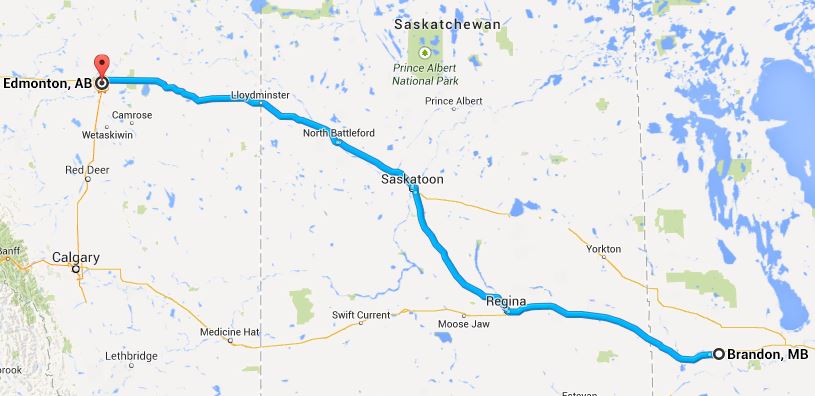
My spouse and I went back to Brandon this past weekend for the first time since I retired last June. It was a very quick trip, squeezed in between commitments here in Edmonton, but it was not a short trip. Our total road time was over 25 hours, somewhat  inflated by poor weather in Saskatchewan on Monday morning.

JourneyThe purpose of the trip was to attend a wedding. The bride had joined the choir as a choral scholar at St. Matthew’s Cathedral three years ago, becoming in time not just a paid singer but an active congregant. Her fiance came with her in the second year. It was a joy to be asked to celebrate their marriage with them and old friends.

On the Sunday morning, we decided that we had to go to church at St. Matthew’s. There is something of an unwritten rule that departed clergy should steer clear of the previous place for a while, but we really wanted to see some people. Besides, the parish is still between rectors, so I was hardly stepping on the toes of my successor.

I left a happy, healthy parish, and I found that not much had changed. A few people had left, but there were also a number of fresh faces in the pews, along with (hallelujah!) a substantial contingent of children. Most things were much the same, with a few things now done a bit differently, but the folks we talked to were still the same great people whom we had come to love over our 10½ years there.

DSCN0165A big difference for me was sitting in the congregation for a Sunday for the first time ever, realizing just how long a building it is, and how far away is the celebrant at the Eucharist. It might have helped my ministry there if I’d taken some time to sit in the pews — but that’s history now. That parish was home for a decade, and the people there still hold a big piece of my heart. Nonetheless, it is clear that we have moved, both physically and spiritually. Holy Trinity is becoming home, for which we are very glad.

Some people wanted to discuss parish issues with me, but I was quite able to say, “That’s not my problem.” That ended the discussion, but not the conversation. The relationship is different now — simply as friends, not as pastor and congregant. For at least one person, that seemed to be a relief! And indeed, it is a bit of a relief for me too, because I don’t have to be “on,” as clergy always have to be in public. Today I can go to coffee time after worship and see the stipendiary clergy having serious conversations with various people, and I can think, “That used to be me,” and then I can smile.

We went to our previous home, and then we came home again.

Surprise!

Notes for a sermon preached at the Great Vigil of Easter, April 19, 2014, at Holy Trinity Anglican Church, Edmonton.

Texts: Matthew 28:1-10; Romans 6:3-11; Exodus 14:10-31, 15:20-21 


Resurrection Icon

When Fr. Chris asked me if I would preach at this service, I hardly waited a heartbeat before saying “Yes.” In my previous position in a different diocese I always had to relinquish the pulpit to the Bishop on major festivals, so it has been some years since I last preached at a main Easter service. Nonetheless, as I was preparing this sermon, I was reminded of the advice to be careful what you ask for, because you just might get it!

Major festivals can be major problems for preachers. Both Christmas and Easter pose the challenge of bringing something fresh to stories which “everyone knows.” There’s nothing very surprising for most church-goers in hearing the Easter Gospel.

Or is there? Can there be? I believe so…

I was once asked to help some people deal with a difficult situation. They had been close friends for many years, but the relationship was now under severe strain. In the course of a long conversation, one of them turned to another and said “I know our old friendship is dead, but I am hoping there may be a resurrection,” and started to muse about what that might look like. My heart instantly said, “Yes!” and I was about to jump in and start addressing that possibility—but something stopped me short. Instead of affirming that hope aloud, I said “Just a second. Let’s back up a bit.” Why? Because my head then told me was that resurrection is never, and can never be, something of our devising, but is rather an act of God. It is not up to us to tell God what God should do (and then be cheesed off at God when God doesn’t come through), but rather to give God space to let God do what God will do.

What is the space into which God can bring resurrection? In one word: death. We cannot fully comprehend resurrection unless we have fully grappled with the reality of death. There is no Resurrection without Crucifixion. There is no empty tomb without an occupied tomb. As the Apostles’ Creed says,

He descended to the dead.

Three times Jesus’ disciples had heard him foretell his passion and death, and then say “on the third day rise again,” but it seems very clear to me from the various accounts of the resurrection that what actually happened came as a total surprise. The women in today’s Gospel reading were not going there to wait for Jesus to rise again, but simply to “see the tomb.” It was an act of mourning and grief that led them there in the pre-dawn greyness. They had seen their Lord die on the cross. They had seen his body lain in the tomb. They had kept the Sabbath, and they returned to their graveside vigil as soon as it was possible to do so.

They went in grief, in full knowledge of the actual death of their master. What happened at the tomb is shrouded in mystery: the four Gospel writers all tell the story a bit differently, as they strive to bear witness to a unique event. What happened at the tomb was unlike anything anyone had seen before, or has seen since, so it should is hardly surprising that the four stories differ. Police today will tell you that eye-witness testimony is highly unreliable, even when reporting something as commonplace as a motor vehicle accident. There is nothing commonplace about the Resurrection!

In this one great act, God reached into our human history and reset everything. What humankind had accepted as normal and expected as our due—the eternal nature of death—suddenly becomes not so! The Resurrection makes everything new for all humanity, with the promise of a new creation, a new way of living, a whole new reason for being.

It is always and eternally new—even if the story is 2,000 years old! It says that what was is now over—including and especially the ultimate rule of death. As Paul wrote:

We know that Christ, being raised from the dead, will never die again; death no longer has dominion over him.

It is so tempting to leapfrog the tough stuff: the Gethsemanes and Calvarys and silent tombs of our lives, and get immediately to the bright daylight of Easter. However, if we truly wish to enter the light, and to experience it for what it really is, we must first embrace the darkness. Barbara Brown Taylor, the noted Episcopalian teacher, preacher, and author, has recently published a book called “Learning to Walk in the Dark,” which I intend to read very soon.

In an interview about the book, she said this.

The great hope in the Christian message is not that you will be rescued from the dark but if you are able to trust God all the way into the dark, you may be surprised. [1]

I believe that my friends who hoped for a resurrection of their friendship needed first to trust that God was with them in the darkness of the loss of that friendship—and then God could surprise them with what the truly new looked like.

Two young people come for baptism on this holy night. The waters of baptism are a sign of cleansing and rebirth, to be sure, but before that they remind us of danger and death, like the waters of the sea that overwhelmed Pharaoh’s armies. Amazingly, almost beyond surprise, the people of Israel found themselves on the farther shore, set forth into their new life as God’s chosen people. The risen life—the life of the baptized—is a holy life of wholly unexpected surprises. Let us pray that God will part the waters for these two, leading them into a life of seeking not their wishes but God’s.

Let our alleluia’s tonight and in the days to come be shouted with joy and thanksgiving—and with a renewed sense of surprise and wonder at how God has made all things new.

Alleluia! Christ is risen!
The Lord is risen indeed. Alleluia!

[1] http://jonathanmerritt.religionnews.com/2014/04/14/barbara-brown-taylor-encourages-christians-embrace-darkness/

Holy Week … rediscovered

daliFor many years, this week has been the most intense, the most emotional, and the most stressful time of the year. For clergy in Catholic tradition, the observance of Holy Week is at the same time the ultimate spiritual experience and professionally the most demanding few days one can imagine.

I used to be responsible for making sure that a whole week of services happened, from the “light into dark” of the Palm/Passion Sunday liturgy through the gathering darkness of the week to the blackness of Good Friday — and then to the new fire, and the glories of Easter Day. One of the secrets of clergy life is that Holy Week is never complete until the priest has completed the final act — the liturgy of the Holy Face Plant!

I rejoiced to be a part of this for many years, even as it was so exhausting physically, but spiritually fulfilling.

This year is different. I am not responsible for anything except for a few assigned roles. The pressure is off! That’s a good thing, to some extent. Except… I am feeling this lack of pressure rather keenly. Holy Week seems a little emptier this year, and I have to realize that this will be the case in the future. This year, for the first time in a quarter-century, I skipped the Maundy Thursday service in favour of family commitments. I am happy to be with my family, but I look at posts of pictures from services, and I know what I am missing.

Professional or vocational responsibilities are one thing. My spiritual life is another. The years ahead will help me find a new balance, when the one that is now so much less has probably outweighed the other in the years past.

I will be part of the rest of the paschal liturgies: Good Friday, the Great Vigil of Easter, and the glories of Easter Sunday. That will be good!