God is With Us or “What’s Next?”

Notes for a sermon preached at Holy Trinity Anglican Church,
Edmonton, Alberta, November 9, 2025
Texts: Hag 1:15b-2:9; Ps 145:1-5, 18-; 2 Th. 2:1-5, 13-17; Luke 20:27-38

In twenty-six years as a parish priest, I was only once involved in prison ministry. The man I was called to visit had asked to see an Anglican minister, which suggested to me that he might have some church background. What I found was a person who had been dragged to church as a child by abusive parents. He said, “I guess I’m Anglican—that’s what I was baptized,” but he knew next to nothing of the Christian faith and wasn’t even sure he believed there was a God. He told me he had decided that he needed “a faith,” a statement that raised so many questions I hardly knew where to begin. In many ways, his life had been a battlefield for over thirty years. And he was wondering “What’s next?”

It seems to me that this question relates in various way to all of today’s readings, to observances of Remembrance Day, and to our parish’s current situation.

When the Sadducees came to Jesus with a trick question about marriage in the resurrected life, their interest was not so much in getting a legal opinion, but in continuing their ongoing argument with other Jews over whether there is life after death. They would answer “What’s next?” by saying “nothing.” Dead is dead, and that’s that—a position which Jesus demolishes with an appeal to scripture: the patriarchs remain alive to God, so the question is simply foolish. “What’s next?”—life in the nearer presence of God.

Paul wrote to the Thessalonians, who were sure they knew what was next—Jesus was coming back any day now, and the delay was shaking their faith. He urged them to stand firm, living as if the day of the Lord had already arrived, giving glory to God who has sanctified them by the Spirit. “What’s next?”—life lived in the awareness of God’s presence in all things.

The prophet Haggai exhorted the returned exiles to get on with re-building the temple. Work had started, but they were dispirited and disorganized, and the new temple was unfinished. Life in the ruins of Jerusalem was nothing like they had dreamed it would be, maybe even far inferior to their existence in Babylon. “What’s next?” Why bother rebuilding the temple? Things were bad, and it didn’t seem that they were going to get any better. But the prophet told them that God was with them, and would be with them, and would give them prosperity in this place.

“What’s next?” In every case, we are assured that God is present and at work among his people, always leading them into new life, in this world and the next. I think of in-between times like this as “Holy Saturday experiences,” recalling the day between Cross and the Resurrection when Jesus’ disciples waited in fear, grief, and confusion behind closed doors for a future they could not begin to comprehend or foresee. But God was with them even on that darkest of days! Another writer has called such times the “Sacred In-Between,” saying this:

…what’s next will come. It always does. But who you’ll be when it comes, that’s what the in-between is shaping right now.[i]

This week we remember those who died in the wars of the past century, conflicts which overshadowed and profoundly shaped our country’s history. We sent men and women overseas to fight for “King and country,” often to die. In retrospect some of those battles were questionable, and some of the so-called sacrifices almost meaningless.

Veterans of various combats often came home to a hero’s welcome, but all too often that home had changed almost beyond recognition. War changes people—on both the battlefront and the home front. Many veterans of both wars bore scars of the battle in their psyches for the rest of their lives. And both world wars changed our society profoundly, sometimes for the good and sometimes not.

The difficult memories and the challenges our country faced in post-war times were tempered by our being on the winning side. But what happens on the other side? The reading from Haggai may help us understand.

For many years, the exiles in Babylon had lived with the knowledge of defeat and destruction. They had been sustained by the dream of their homeland, and the memory of Jerusalem’s lost glory. When they returned, reality did not match their dreams. The temple lay in ruins, the city walls were piles of rubble, and the people of the land seemed to have given up. As a line in the hymn “Abide with Me” says, “Change and decay in all around I see.”[ii] Defeat had become the people’s mindset. Is it any wonder they could not find the energy to rebuild the temple?

And then the prophet said to them:

…take courage, all you people of the land, says the Lord; work, for I am with you, says the Lord of hosts, according to the promise that I made you when you came out of Egypt. My spirit abides among you; do not fear.[iii]

“What’s next?”—a new temple, a fresh start, and new prosperity, for God is with them. It may not have been what they had been dreaming of for half a century, but it was where God had been leading them.

It’s easy to perceive God’s spirit among us when things are going well. When things are not going so well, during the muddy hell of World War I, or on the return to a defeated land, we may have a different awareness of God. The man I met at the jail was not sure he could believe in God, because his life had been a personal hell. Nonetheless, he was wondering if he did in fact believe, because he sometimes found himself praying to God for help. I wish I could tell you that his story ended as he prayed, but what was next for him was a court appearance. He was sentenced to time served in that province, but police from another province were waiting for him at the back of the courtroom to re-arrest him for other offences.

We need to remember, to know our story, and to understand how we got here. On Remembrance Day, we give thanks for our war dead who helped bring this story to where we are today. Nonetheless, we do not live in the remembered past, but in the often-uncertain present, in hope for the future, always asking God “What’s next?” Always we know that God’s answer—for the people of ancient Israel, for the earliest Christians, and for us today—is “I am with you.”

Holy Trinity is facing challenges in the months ahead. Clergy changes are always difficult, and the community is justified in asking “What’s next?” But the prophet’s words continue to ring true:

…take courage…; for I am with you, says the Lord of hosts

And the hymn continues,

“O thou who changest not, abide with me.”[iv]

God abides with us, in war and in peace, in victory and in defeat, in hardship and in prosperity, in times of change and in times of stability. May we always remain aware of God’s presence, ready to hear God’s call into the future waiting for us.

“What’s next?”

God is with us always. That’s what’s next.

Thanks be to God.

Amen


[i] Shawn C. Branch, https://shawnbranch.substack.com/p/the-sacred-in-between?triedRedirect=true

[ii] Henry Francis Lyte, vs. 2, line 3

[iii] Haggai 2:4b-5

[iv] Henry Francis Lyte, vs. 2, line 4

Post scripts:

  1. Holy Trinity is about to enter into an interim period, after the resignations of our Rector and her Associate.
  2. I was introduced to the idea of “Holy Saturday” experiences through “Between Cross and Resurrection: a Theology of Holy Saturday,” by Alan E. Lewis, Eerdmans, 2001.

Come Out!

Notes for a sermon preached at Holy Trinity Anglican Church (Strathcona), Edmonton, on June 1, 2025. Text: John 17:20-26 – Easter 7, Year C

Thirty-eight years ago today, Edmonton was in a celebratory mood, after the Oilers won the Stanley Cup on home ice. The street party on Jasper Avenue went on for hours, trapping some friends who had come from Saskatoon for another event. They had parked their car near All Saints Cathedral, right on Jasper. They sat there for a while.

The event they had come for was an ordination at All Saints, when Archbishop Kent Clarke ordained a priest and three deacons, one of whom was me. The ordination took place on the seventh Sunday of Easter, the Sunday we are observing today. My family and friends and I had reason to celebrate, although our celebrations were a bit more muted than the near-chaos on the streets.

Looking back at that day, I realize that I don’t remember much of it, except for a few odd details. What I do know is that the Gospel lesson read that night was taken from the same chapter as the selection we just heard. John 17, known as Jesus’ “High-Priestly Prayer”, is spread over the three years of the Lectionary. The Prayer is at the end of the Farewell Discourse, after the Last Supper, immediately before the Passion. As John tells it, these are the last words in Jesus’ earthly ministry. As his time draws to its end, Jesus first prays for his own “glorification,” going on to pray for his disciples, that they will be protected from evil and sanctified in truth. Finally, in today’s lesson, he prays “…on behalf of those who will believe in me through their word, that they may all be one.”

This passage has often been used as the Gospel lesson for services of Christian Unity, as churches from different traditions gather to pray that we may be one. In my University years, in the first excitement of the ecumenical movement after Vatican II, many of my Christian friends were running around proclaiming that organic unity was just around the corner. I wish it were so, but historic change usually takes a lot longer than 50 or 60 years. Churches don’t change easily! In recent decades we have entered full communion with other denominations, all taking years of talk and prayer, and those full communion declarations are only half-steps toward visible unity.

However …

One of the things I have observed since June 1, 1987, is that while churches may have erected barriers between themselves and others, those walls often vanish when we seek to serve the wider community. Time does not permit me to elaborate on the many examples in have in mind. Suffice it to say that Churches which have deep differences in doctrine and worship often find themselves much more united when they are called to do things like feed the hungry, care for the homeless, and advocate for people on society’s margins. Getting outside our church buildings brings us together in ways that inviting people to worship with us does not. Shared worship is valuable in itself, but I believe that it is an act with a wider purpose – calling on all God’s people to follow Jesus in the world.

Look over to your right, at the second stained glass window from the front. The image in the central panel is a rendering of William Holman Hunt’s 1854 painting “The Light of the World.” It was inspired by the text of Revelation 3:20: “Listen! I am standing at the door, knocking; if you hear my voice and open the door, I will come in to you and eat with you, and you with me.” One of the notable features is that there is no door handle on the outside. Jesus cannot enter unless someone inside opens the door.

Shortly after Pope Francis died, I read a story allegedly dating from the conclave which elected him. It seems that Cardinal Bergoglio, as he was then, preached a short homily to the assembled cardinals, referring to this same image. He suggested that it could be viewed in another way: Jesus, the Light of the World, is inviting people huddled behind locked doors and closed minds to come out and share in his ministry – to come out into the world, to be light-bearers with him amid all the world’s strife and needs. In this view, Jesus is not saying “Let me in,” but “Come out!” The story went on to say that it may have been this homily that helped Cardinal Bergoglio become Pope Francis. I believe his ministry shows how much importance he gave to this message.

While it is sometimes comforting to shut ourselves into our safe spaces (which we absolutely do need!), it is important to remember that the holy havens to which we retreat are not the only places, or even the main places, where the church’s mission is fulfilled. The gathered church is like a ship in harbor, doing little as it remains there. It must eventually set sail to carry its cargo across the open seas. Jesus prays for those who will follow him into those wider places (his disciples) and then for those who believe in him through the disciples’ words – US! – for protection, for unity, and for the bonds of love, which bear us up as we venture into the world beyond these walls. As we go, we are to shed the light of Christ in all places.

As Jesus said in the Sermon on the Mount:

‘You are the light of the world. A city built on a hill cannot be hidden. No one after lighting a lamp puts it under the bushel basket, but on the lampstand, and it gives light to all in the house. In the same way, let your light shine before others, so that they may see your good works and give glory to your Father in heaven.’                                                                                       (Matthew 5:14-16)

When the Oilers beat the Flyers 38 years ago, people felt the need to get out to share their joy, to celebrate with others their faith in their hockey heroes. That’s one kind of celebration (and a pretty good one!), but we Christians have something more to share. We are called to share in the joy of the Resurrection of Christ, which calls us out of our safe places to share the Good News with the wider world.

And how do we share that joy? How are we to be the light of the world? We could, of course, buy an amplifier and shout over the crowds on Whyte Avenue. Some have done that, but it seems to me to be self-defeating, shedding more heat than light. Instead, we should share our joy and light by being joy and light for others. That joy and light takes different forms for different people at different times. For the hungry, it is food. For those who mourn, it is comfort. For the lost, it is a helping hand, a guiding presence. For the lonely, it is a friendly presence. All of these and others are ways to shed God’s light into a world which so often seems plunged into darkness.

So, I believe the question for each of us today is this:

How am I light for other people, and
        How do I share Resurrection joy with them?

Friends, let us come out of our safe places.

Let us come out and spread Christ-light wherever we go.

Let us come out and be the Church,
doing God’s holy work among God’s people.

May it be so.

The Hardest Part of Following Jesus?

Families are wonderful, until they’re not! Families have great power to provide loving care and nurture. But there is a downside: they also have the power to inflict enormous hurt upon their members. The high expectations we place on families means that when they fail, they fail badly. The same can be said for churches, the difference being that we can choose our church community, but usually have no choice in belonging to a family. Hurt caused within a family is uniquely devastating to the one sinned against.

Today’s lesson from Genesis is the climax of a story that begins with a massive wrong done to one family member by other members. It began when Joseph’s older brothers were well and truly fed up with him, their father’s favorite and dreamer of troubling dreams, so they planned to be rid of him. Although they did not kill him as they originally intended, he ended up being sold into slavery in Egypt.

We have to fast forward our story for some time, maybe decades, to get to today’s reading. (See Genesis chapters 37 – 43 for the back-story.)

By the time of today’s reading, a famine has spread across all of Egypt and the neighbouring countries. Jacob has sent his ten older sons to Egypt to look for food, because they have heard that Egypt has sufficient stores to feed themselves. What they do not know is that their younger brother had risen to become the second-in-command to Pharaoh, and was responsible for the prudent planning that saved the Egyptians from starvation.

Joseph recognizes the brothers when they come into his presence, but they don’t know who he is. He was a boy of seventeen when he was taken, and years have passed. He might have looked vaguely familiar, but they certainly wouldn’t have expected to see their brother dressed as a high official. It fell to Joseph to make the connection, to reveal his identity to his brothers, who reacted in dismay and fear. Joseph! The brother they had conspired against, now in a position to pay them back. And here’s where the story takes its decisive turn: Joseph is not angry and vengeful, but asks after his father, and calls them to him. He sends them back to bring his father and his brother Benjamin, promising them food, land, and livelihood in Egypt.

Although the word “forgive” doesn’t appear in the text, Joseph forgave his brothers, saying that God had brought him to this place to be a blessing both to the people of Egypt and to his own people. Forgiveness changed the story beyond imagining. It’s easy to see the story taking a different turn. What if Joseph had harbored anger in his heart throughout those years? Thoughts of hatred and vengeance might have ruled his life. At the very least, he would have sent them back to their father empty-handed. At worst? Let’s not go there! We could easily understand a story which went that way, but that way was not God’s purpose. God had promised to Abraham, Isaac, and Jacob that a great people would come from their line. Joseph became God’s unexpected human agent in keeping that promise alive.

Rather than lashing out at the brothers who had sinned against him, Joseph displayed the kind of behaviour Jesus held up to his disciples in the second two parts of the “Sermon on the Plain” in Luke’s Gospel. In the NRSV, these sections are titled “Love for Enemies” and “Judging Others.” The commands we read there are almost the same as we find in the “Sermon on the Mount” in Matthew (Matt 5 – 7), with only a few changes in wording.

What Jesus tells his disciples – tells us – is that the kind of behaviour the world has come to expect is not how we are to act. Calls to love your enemies and turn the other cheek are objects of scorn from others, but Jesus’ call is based on love. God loves his whole creation: the good and the bad together. Jesus calls us to act accordingly, regarding all others as God regards them. Other people may hurt us, and the world around may expect us to seek vengeance, but Jesus said:

Instead, love your enemies, do good, and lend, expecting nothing in return. Your reward will be great, and you will be children of the Most High, for he himself is kind to the ungrateful and the wicked.

Friends, nobody said that following Jesus would be easy. In fact, it can be very difficult. As G.K. Chesterton wrote:

The Christian ideal has not been tried and found wanting.
It has been found difficult; and left untried.

The call to forgive may be the very hardest of Jesus’ hard sayings. I know this personally, and I suspect many of you here today know it too. It’s all too tempting not to forgive, to dwell on past hurts – sometimes long past! – and to consider how you might get back at the other. But as it has been said:

Bearing a grudge is like drinking poison,
and waiting for the other person to die.

If I nurse a long-held grudge, it hurts no-one but me. On the other hand, forgiving the other is a healing act, even when there is no possibility of letting them know of our forgiveness. By letting go of past pain, we move towards the healing that is God’s desire for all people. We can not change another person, but by the grace of our loving God, we can certainly change ourselves. If there is an opportunity to tell the other of our forgiveness, there may well be an opening to healing that relationship.

We can’t change the past. It’s over and done. But we can change the way the past holds on to us. But forgiving is not easy. Henri Nouwen wrote this:

Maybe the reason it seems hard for me to forgive others is that I do not fully believe that I am a forgiven person. If I could fully accept the truth that I am forgiven and do not have to live in guilt or shame, I would really be free. My freedom would allow me to forgive others seventy times seven times. By not forgiving, I chain myself to a desire to get even, thereby losing my freedom. [1]

Forgiving begins at home, in our own hearts, in seeking to see how God’s love may move us towards God’s ideal for us.

Turning back to Joseph, he likely had much time to ponder how his life had turned out, seeing how God was at work, leading Joseph to do good where he had been planted. He probably also had time to reflect on his youthful behaviour that had led his brothers to hate him, leading him to the repentance and forgiveness of himself that made today’s story possible. His insight about God’s purpose in leading his brothers to him was both sudden, and long-prepared.

Did he expect to see his brothers and his father again? We can’t answer that, but we can see how his years in Egypt made it possible for him to forgive them absolutely.

This was God’s work, leading Joseph to reach out in love to his long-lost family, forgiving them, welcoming them, making them part of his world once more.

Friends, let us strive to forgive, setting the past aside, not forgetting it, but not being bound by past hurts. Let us seek only to heal, building and re-building the family of God. In this way, God’s great love may become the basis of all our relationships, in our families, in our churches, and in the world.

May it be so.


  • [1] Henri Nouwen, The Road to Daybreak, Penguin Random House 1990

God is Calling

Notes for a sermon preached at Holy Trinity, Old Strathcona, Edmonton, June 16, 2024
Text: I Samuel 15:34 – 16:13.1

Adults often ask children what they want to be when they grow up, and often the responses are unrealistic. Someone once said that adults ask kids this question so that they can get some new ideas! When we put on one of our favourite CD’s,2 my wife often says “When I grow up, I want to be Tommy Banks.” My own history is one of changing direction several times, most recently from full-time to retired ministry, which took a while to figure out what it meant – it wasn’t totally by choice! The “churchy” word about discerning your path in life is “vocation”, about which our lesson from I Samuel has something to teach us.

This is where we first meet David, as he is summoned from herding the sheep to have Samuel anoint him as God’s chosen King. Samuel’s coming meant that something important was afoot, and surely David wanted to be part of it. As the youngest son, the task of tending the sheep fell to him, while his brothers could stay home to greet the great man. I can almost hear him saying “It’s not fair!” just like any other teenager.

Was he wondering about Samuel’s purpose in visiting his father? He might have had an idea about what was up: King Saul had fallen from God’s favour, and Samuel’s visit likely had something to do with that. Did he have any idea of what God intended that day? Had he heard some kind of call? We’re not told. What we are told is that none of his older brothers passed muster as they paraded by, while Samuel listened for God’s voice. None of them were called to be King.

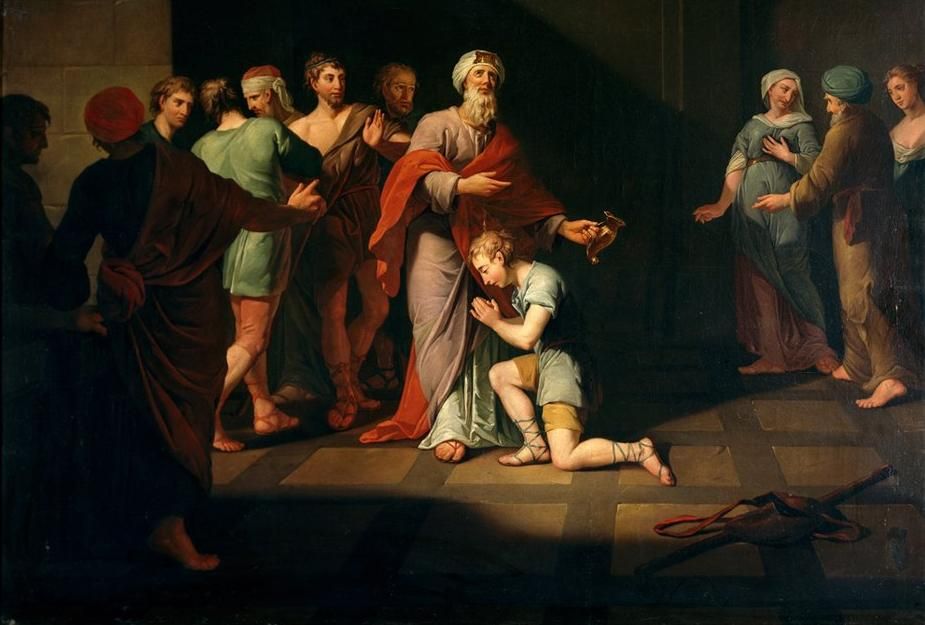
The rest of the family was surprised when Samuel told them to bring David to him. The youngest? A mere boy? Directed by God, Samuel saw otherwise, and called David out of his family to become King. Samuel named David’s vocation. Had David already heard it? We don’t know, but later events show him growing into the realization and fulfillment of his divinely-ordained role in life.

I have twice been an assessor for ACPO3, a major part of the process our church uses for discernment of vocations to the priesthood. Candidates are interviewed in a variety of settings, looking at the “3 C’s”: Character, Charism, and Call. Dealing with the first two is a bit like a conventional job interview, but the third presents some special issues. “Call” means both the candidate’s personal sense, and the affirmation of their community. I met some who said strongly that they knew that God needed them for the priesthood, but whose recommendations from others were more equivocal. Contrariwise, I met one young man, immensely gifted, by all accounts a really fine person – charism and character in spades! – but who simply could not articulate any kind of personal call. When we asked, “Why do you want to be a priest?” his only response was “Everyone says I should be.” When we asked him what he would do otherwise, he was able to map out a clear direction in academic work – he almost had his Ph.D. dissertation written in his head. We recommended that he continue with that work, and if at some time he was able to say, “I believe God is calling me to be a priest,” he should once more present himself as a candidate.

Vocations to Christian ministry come from both within the person (the “inner call”), and from the community (the “outer call”). Both must be present. Samuel gave David his outer call in dramatic fashion. We will hear more over the summer how David’s inner call developed, but we may be sure that he heard it.

Church folks most often use the word “vocation” in the context of ordained ministry. But please remember this: Christian ministry is not confined to the three-fold ministry of Deacons, Priests, and Bishops – not by a very long shot! The Catechism of the Episcopal Church of the USA teaches that there are four orders of ministry, naming the ministry of all the baptized (laypeople) as primary. I wish our Church had adopted this Catechism.

The ministry of the laity does include the various roles people assume in the church: lay readers and assistants, sides people, sanctuary guild, lectors, intercessors, musicians, teachers, wardens and vestry members, to name some of the most obvious. More importantly, it means the ministries that lay people exercise in the wider world, in all the many and varied ways they follow their calling as disciples of Christ. Every baptized person is called to a new life, dedicated to living into the promises found in the Baptismal Covenant. There is a good reason why this covenant is renewed by the whole congregation at every celebration of Baptism: the newly baptized are welcomed into a community of people who are striving to be God’s ministers in the world – people with many and varied vocations.

What’s your vocation? Some of us – a very few – can say “I’m called to be a priest or deacon in the Church.” But others might say something like “I’m called to be a (_______), the best one that I can be, so that people around me can see Christ at work through my life.”

When an ordination candidate is presented to the Bishop, the Bishop describes the nature of the ministry in question, and then asks, “Do you believe you are called to this ministry?” The Baptismal Covenant is the counterpart of ordination for the ministry of the laity. Any Baptized person can ask the call question for themselves, and then seek the affirmation of the wider Church when they believe they have heard a special call. Just like David, just like that gifted young man, we all need to hear both inner and outer call. We need to listen for the voice of God. And then we need to test our insight with others who are similarly striving to follow Jesus.

And let us never assume that a calling once heard is once and for all time. I once thought I wanted to be a railroad engineer – that didn’t last long! Things change over time, and God may lead us in ways that we hadn’t previously imagined or couldn’t imagine. No-one in my school years could have articulated a desire to design video games! And the kind of job I had with the Provincial government in the ‘70’s and ‘80’s has been almost totally changed by the internet.

We need to keep on listening for God’s call, because it can and does change. But make no mistake about it: God is calling you, and you, and you, and me. God is calling every one of us. We may not always hear clearly, but we may be assured that God will in God’s time send us our own Samuel or Samuels to help us hear better.

God is calling. Listen, pray, test, and respond.

God is calling. Live into that call, and rejoice!

God is calling. In Jesus’s name, may we hear and follow.

Amen.


  1. Video of the sermon and the full service may be found at https://www.facebook.com/holytrinityanglican ↩︎
  2. Yes Indeed“, Tommy Banks, solo piano, Royalty Records RRI-300-9647, 1997 ↩︎
  3. Advisory Committee on Postulants for Ordination ↩︎

A Call from the Edge

Notes for a sermon preached at Holy Trinity (Strathcona/Edmonton), Dec. 10, 2023
Texts: Mark 1:1-8; Isaiah 40:1-11  
  

I once saw a priest start a kid’s talk with the question, “What’s a prophet?” It’s great when the answers you get lead into what you want to talk about, but this time the response from one young person was “It’s when you make money.” The talk went sideways from there, because the kids really didn’t seem to know the biblical word, and just wanted to talk about money. They understood that! “Prophet” is a word that doesn’t turn up very often in daily speech, and when it does, its usual sense is a person who foretells the future.

Predicting the future can be part of the prophetic role, but it’s not the whole story – not by a long shot! This past fall I thought a lot about prophets, when our Wednesday morning Bible study group read the Book of Ezekiel. If you haven’t read Ezekiel, let me tell you that the group found it very challenging, often harsh and violent, with relatively few signs of hope, notably in the first half. People left some sessions saying things like “I sure hope things get better!” Not a fun read, but if a doom and gloom kind of guy like Ezekiel is considered a major prophet, we might well be excused for wondering why these people play such a large role in Scripture, especially in the Hebrew Bible.

Fr. Richard Rohr says that all the prophets speak from “the edge of the inside,”[i] and Ezekiel is a case in point. The book is set in the early years of the exile to Babylon. A member of the priestly class (an insider), Ezekiel is among the deportees, far removed from the centre of his people’s life – Jerusalem and the Temple. The big question is why this disaster has happened. The prophet condemns the people of Jerusalem, whose faithless ways have led to the departure of God’s glory from the holy city. From the edge of his people’s existence, the previous insider can speak God’s message clearly.

The latter part of the book is devoted to a vision of a restored Temple and land, which bears little resemblance to what actually happened some years later, when a new Temple was eventually built. Before that could happen, the people had to return, an event on the near horizon for the prophet whose words we heard in today’s first reading, so-called “Second Isaiah,” who proclaimed:

Comfort, O comfort my people, says your God.
Speak tenderly to Jerusalem, and cry to her
that she has served her term, that her penalty is paid,
that she has received from the Lord’s hand double for all her sins.

The exile in Babylon was drawing to its end. The deportees would be led home to the land of Israel, forging their way through the wilderness, protected by God’s hand as they journeyed through a place of great discomfort. God would give them comfort, which is not the same as making them comfortable. This would be no easy chair kind of existence, but a journey through a wilderness transformed and turned upside-down by the hand of God. Like Ezekiel, Isaiah also spoke “from the edge of the inside,” but now of a return to the centre.

Receiving comfort from God means to be strengthened by God for the days ahead. It means being empowered by God to work through and in places of discomfort. The message of all the prophets, including Ezekiel, Isaiah, and John, is not to “get comfortable”, but to seek God’s way, knowing that God’s way may well – may often! – involve discomfort.

Writing in the December 2023 issue of The Christian Century, Pastor Melissa Bills said this:

Discomfort is holy when it leads us to deeper love for God and neighbor. It is sacred when it spurs our hearts to love and good deeds. It is a blessing when it drives us to seek justice and liberation. It does not cut us off from God’s promises of comfort but rather makes space for us to receive them.[ii]

Chapter 40 of Isaiah ends this way:

[God] gives power to the faint, and strengthens the powerless.
Even youths will faint and be weary, and the young will fall exhausted;
but those who wait for the Lord shall renew their strength,
   they shall mount up with wings like eagles,
they shall run and not be weary, they shall walk and not faint.

This is the prophet whom John invoked in his call to prepare the way of the Lord. John stood in the heritage of Isaiah and all the Hebrew prophets, speaking and acting as God had directed. That’s what makes a prophet a prophet: they don’t speak for themselves, but for God!

John’s message was clear: the Kingdom of God was drawing near, soon to be fulfilled in the one to whom John pointed – Jesus!

John’s life was not comfortable – living in the wilderness, clothed roughly, eating what he could find on the land. But he surely took comfort from knowing that he was doing God’s work, speaking for God, proclaiming the one coming after him, pointing away from himself and his own desires to God’s wishes, pointing to what God would do among those who heeded the call.

I have sometimes heard people say things like “If you say, ‘yes’ to Jesus, your life will be great from then on.” If only that were true! Following Jesus has a cost. It demands much of us. But the good news is that God offers the same comfort – the same strength – that was offered to the Hebrew people in exile. John called the people to repent, and to accept baptism as a token of that repentance – and repentance is hard work. It takes strength and determination, and the courage to refuse the easy way – the comfortable way.

On this Sunday of John the baptizer, let us remember that the need for prophets like John did not end with the coming of Jesus. If anything, the world stands in greater need than ever of hearing the prophet’s call to repentance. We followers of Jesus have inherited the role of John: to point to Jesus, to call people out of their comfortable places, and to proclaim God’s desires for the world.

The great Biblical scholar Walter Brueggemann has said this:

The prophetic tasks of the church are
to tell the truth in a society that lives in an illusion,
grieve in a society that practices denial,
and express hope in a society that lives in despair.

Only by telling the truth, by grieving honestly, and living in hope can we ever begin to find the comfort promised by the prophet so many years ago. Like the prophets before us, we are not called to leave this world behind, but to challenge the world from “the edge of the inside,” as we see in the ministry of the prophets. We must be prepared to leave the comfortable places in the centre, seeking God’s strength as we live into our God-given mission – our prophetic tasks.

So… let’s go back to that first question: What is a prophet?
Better to ask “Who is a prophet?”
Look around you – anyone you see may be called to step out of their comfort zone, to rely on God’s comfort – and to speak God’s word in in a world that desperately needs to hear that Word!

In the name of the one who came to give us holy comfort,

Amen.


[i] https://cac.org/daily-meditations/the-true-center-2023-09-10/

[ii] https://www.christiancentury.org/article/lectionary/december-10-advent-2b-isaiah-40-1-11-mark-1-1-8


Truth and Reconciliation and the Exile

September 30, 2022

September 30 in Canada is National Day for Truth and Reconciliation, also known as “Orange Shirt Day.” This is now the second annual observance of the day, after being proclaimed by the Federal Government in response to the finding of over 200 unmarked graves on the grounds of the former Kamloops Indian Residential School. Federal services are suspended for the day, and many federally regulated businesses such as banks are closed. A variety of events are happening across the country, including CBC Music broadcasting an entire day of music by Indigenous artists. Our parish church, Holy Trinity in Old Strathcona, is marking the day in Sunday’s liturgy.

It will naturally take some time for this day to become a fixture in people’s consciousness. Some might be impatient at this pace, but social changes take time. That’s a simple human reality. It is analogous to the impatience some have expressed about reconciliation, wanting to have it NOW. What they are not recognizing is that reconciliation is not something you can just “have,” but rather something that must be worked at. It’s a process, not an event. It is linked to Truth, without which it is impossible.

I have heard a great deal of anger expressed by Indigenous people, directed at the Government and its policies, the churches which ran the Residential Schools, and the people who took over their ancestral lands, whether by treaty or not. Much of that anger is well-justified, but my people (“settlers”, to use the current term) often react badly to it.

In pastoral work we learn a lot about the grief process, which in general terms is a response to loss. Elizabeth Kübler-Ross identified five things that she first called “stages”: denial, depression, anger, bargaining, and acceptance. Today we more often call them “aspects,” because we have learned that grief is not linear. Rather, different aspects of grief may manifest at any time after the loss.

I believe that indigenous anger is part of a long-term historical process of collective grief, stemming from the loss of land, a way of living, language, and culture. I am suggesting that a Biblical analogue to Indigenous grief may be found in the story of the Exile and the post-exilic period.

There are two main formative events in the history of the Jewish people: the Exodus and the Exile. The Exodus from Egypt, with all its drama, is still remembered by Jews as the event that made them a people with a land. It is celebrated at Passover to this day. The Exile to Babylon lacks a similar celebration, likely because it is difficult to celebrate a disaster. However, responses to disaster have a profound effect on a people’s self-understanding, which is certainly the case here. I note that the 20th-century Holocaust has had a similar re-shaping effect on modern Jewish life.

While large parts of the Hebrew Bible (aka the “Old Testament”) have their origin in pre-exilic times, most of what we have today came into its present form in the post-exilic period. The dominant questions raised by the Exile were “Why did this happen?” and “What can we do to prevent its recurrence?” Their land has been lost, their temple has been destroyed, their way of life has become impossible. Responses to these questions run the spectrum from near-universalism (see Isaiah 40-55) to law-based exclusivism (see Ezra and Leviticus).

The writings from the Exile period often exhibit aspects of grief, as the people come to grips with the reality of the events that have overtaken them. Our Sunday liturgy will include Psalm 137, which begins with “By the waters of Babylon we sat down and wept,” and ends with a howl of vengeful anger towards Babylon. In its nine verses it displays all the aspects of grief except acceptance. I invite you to pray through this Psalm slowly, reflecting on the grief it manifests, and on how it may help us on the truth-paved path of reconciliation.

The “Great Clean-up”

Notes for a sermon at St. Matthew’s Anglican Church, St. Albert, Alberta, May 22, 2022
Texts: Revelation 21:10, 22-22:5; John 14:23-29

I bought a new phone a few weeks ago. The old one was working reasonably well, but the manufacturer was no longer providing security support, and some newer apps required a more current operating system. Transferring all my stuff to the new phone was quite easy, and then I turned to the old one, first deleting all the personal stuff I could find, and then deleting the apps. I realized afterwards I didn’t need to bother with all those deletions, because doing a factory reset would clear everything identifiable. The factory reset took a few minutes, and by the time it was done the old phone was in the same state as when I took it out of the box several years ago — just as its builder intended.

Something like this is going on in today’s lesson from the Revelation to John, a part of the great vision which concludes the book in Chapters 21 and 22. Revelation is easily the most misunderstood book of the Bible, and it has unfortunately become one of the most often-cited texts by certain kinds of Christians. The error many people make is to treat it as prophecy for these times, connecting its images and scenes to events today. These things are then interpreted as “signs of the times,” an indication that God is about to step in and wipe everything out. It is commonly seen as foretelling the end of the world. Wrong!

Revelation is the New Testament’s only example of “apocalyptic,” a genre of literature common in Jewish circles in the centuries before and after the time of Jesus. The only other example that made it into the Bible is Daniel, from which Revelation draws much of its imagery and themes. Both books were written to people of faith suffering oppression from an oppressive power. In the case of Revelation, the intended audience was Christians under the Roman Empire. Both books are written in a kind of code which would be understood by the faithful, but not by the oppressors. Both have the same message: stand firm in the faith, and the conqueror will be vanquished.

Revelation’s message is really very simple: God wins!

One of the book’s images is the “Beast,” a metaphor for the Roman Empire. The city of Rome is never mentioned by name but is referred to in another metaphor as “Babylon the Great,” another oppressor of God’s people in times past. Much of the book makes horrifying reading, but the tone shifts dramatically in Chapters 21 and 22. Instead of doom, death, and destruction we are presented with a vision of a “new heaven and a new earth”. That word “new” is perhaps a bit misleading – it should better be read as “renewed” or “re-created.”

In some video lectures (“Victory and Peace or Justice and Peace?”) I watched recently, New Testament scholar John Dominic Crossan said that Revelation is not about the end of the world. Rather, he said, we should see it as God’s “Great Clean-up.” This is the reset to end all resets! At the end of this age, earth will be restored to God’s purpose, as Jesus taught us to pray:

Thy kingdom come, thy will be done,
on earth as it is in heaven.

The book does not end with a destroyed earth, but rather a redeemed earth. In the new age, on this reborn and renewed earth, all evils and sorrows will be gone, and everything will be according to God’s will, God’s holy purposes. As Genesis tells it, the world began being broken in one garden, around one tree. God will restore it to its original purpose in a second garden, with a new tree of life and a new river flowing from the throne of God.

But that’s in the future – sometime! It’s a wonderful promise, but it has not yet been fulfilled. Just look around you to see how things are not as God would wish them to be. War, mass shootings, civil unrest, famines, pandemics… Do I need to go on?

Almost everyone is aware in their own way that “Things just ain’t right!” And almost everyone seems to have their own recipe for making things right. Politicians of various stripes will give you a variety of remedies. Raise the question with five friends over coffee (or some other libation), and you’ll get at least six answers. If you’re so inclined, you can consult your horoscope or your tea leaves. But what I often hear is this: some people are ready to give up, and some others claim to know what will fix everything. I don’t accept either of these all-too-human views.

If we only listen to human voices, all we will get is human solutions to human messes. We must look elsewhere, finding a different sort of guidance from a different source for helping to bring this world closer to the reality expressed in the Great Clean-up. Another well-known New Testament scholar, N.T. Wright, calls this activity “building for the kingdom.” In the video companion to his book “Surprised by Hope,” (HarperOne 2008) he likens it to being like a stone mason carving individual stones for the building of a great cathedral. The mason knows his task, and he also knows that if he does not do it up to standard, the piece may not fit where it is intended, and part of the big enterprise may fail. The mason is guided by the master mason, who is guided by the architect, who is guided by a higher authority.

And that’s how it is with Jesus’ people in this in-between time while we await the Great Clean-up. We are not called to sit idly by as we wait for God to get in with the push broom and the Lysol. We have a role to play, working as if it has already begun. But how do we know that what we are doing is according to God’s will, and not ours? My friends, we have a guide for our work. Jesus promised this guide to his disciples before he went to his death:

the Holy Spirit, whom the Father will send in my name,
will teach you everything, and remind you of all that I have said to you.

The Great Clean-up will come in God’s own time. In the meantime, amid all the troubles of this present age, we are called to work for that coming, living into it, living as if it had already happened. It’s a tall order, I know, but we are not alone.

Jesus is with us always to the end of the age, and the Holy Spirit, the Advocate, is within us – individually, and (more importantly) corporately – at all times to guide us into the peace which Jesus left us. Our job is to listen – to pray! – and then, hearing, to work for what is good and holy and peaceful and loving.

We are not alone.

Thanks be to God!

The Devil Quotes Scripture

Notes for a sermon preached at St. Matthew’s Cathedral, Brandon on February 21, 2010, the first Sunday in Lent. Texts: Luke 4:1-13; Ps 91:1-2, 9-16

As I worshiped this morning at Holy Trinity, Old Strathcona (Edmonton), I thought back to this sermon I preached nine years ago.
I believe it has continuing relevance to issues in the church today.

As many people are aware, there has been much turmoil in the Anglican Communion in recent years. If one only followed the secular press, the impression would likely be that the issues centered on sexuality, specifically same-gender relationships. While we should not ignore the significance of “the issue,” we in the church need to pay closer attention to the underlying questions that have served to make the presenting issue such a hot button. Among other issues, there are questions of “theological anthropology”—the doctrine of what it means to be human; questions of ecclesiology—the doctrine about the church; and very importantly, the matter that is my concern today, questions of our understanding and use of scripture.

As we begin the season of Lent, when the discipline of Bible reading and study is specially emphasized, we do well to take a careful look at how we approach the Bible. The first thing we need to observe is that there is no single right way to read scripture, and certainly no definitively Anglican one. The Anglican Communion has recently appointed an international commission to study Anglican use of the Bible. As one commentator noted, if we were all agreed everywhere on our use of the Bible, the commission would be unnecessary.

This morning we heard the traditional Gospel for the first Sunday of Lent, Jesus’ temptations. We could spend much time with the actual temptations. What I instead want to draw our attention to today is the manner of Jesus’ response to the devil—he quotes scripture, citing two texts from Deuteronomy. The devil presents the first two temptations in his own words, but in the third, he turns Jesus’ tactics back at him. The devil quotes scripture!—the very same psalm we used this morning.

Jesus’ response to the third temptation—another text from Deuteronomy—ends the debate. Using one text to counter another shows us very clearly that simply quoting a verse from the Bible never proves anything. If you search hard enough, you should be able to find a text supporting almost any position you want to take on any given issue. Texts taken out of context can be twisted into almost any interpretation we choose, and that is not an appropriate use of scripture. That’s what the devil does in the third temptation, and although Jesus counters the challenge with another verse, what he is really doing is pointing beyond the text to what came before it—God’s own purpose, God’s own ways.

In the temptation story, both Jesus and the devil appear to use scripture in a literal fashion, but Jesus’ final response goes beyond a literal reading to find the deeper reality behind the “plain sense” of the words.

As we open our Bibles seeking to receive God’s word, we should remember that God came before the book, which is written in human language and interpreted by human minds. No language can fully encompass the reality which is God and God’s ways. No written word can ever truly express the Living Word of God. Nonetheless, we rely on “The Good Book” to guide us into a deeper understanding of who God is, and who we are before God. This understanding comes as we live into the words, making them our own, seeking to model our lives on God’s ways, revealed through the pages of scripture, and in the life, work and person of Jesus.

The great 20th-century theologian Karl Barth said that the Bible is not the Word of God, but rather becomes the Word of God when it is interpreted in a community of believers. The interpretation—the meaning of the words—is found in the lives of those who seek by God’s grace to hear the truth within and beneath them. What do our words mean? We reveal the answer in and through our lives. What is the meaning of Jesus as the Word of God? The answer is revealed in his life, death and resurrection.

However we view the Bible, from a completely literal approach to the totally metaphorical, simply reading the words is not sufficient. As we together seek to live into the words we read and pray, we come together to embody the Word of God. We take the texts off the page, and into our lives, turning the words into the Living Word—the power of the Holy Spirit enlivening and mobilizing the People of God.

Even in its diversity. Anglican tradition does have a number of “fixed points.” One is that we use the Bible a lot. Our worship has much more actual scriptural content than you will find in some churches who proclaim themselves to be “Bible-based.” We read scripture in a disciplined and detailed fashion. Furthermore, our liturgies—both BCP and BAS—are full of scriptural quotations and allusions. The big differences within Anglicanism lie in manners of interpretation. Some read the Bible as literal words of God. Others receive scripture as a unique human response to hearing the word of God. The question that divides these two positions is “Did it actually happen that way?” Those who take the first viewpoint are inclined to say “Of course it did. The Bible (i.e. God) says so.” Those who take the second viewpoint will tend to give a less definitive answer, seeking to bring other evidence (science, history, archeology, etc.) to bear on the text. And the twain shall never agree.

A question which divides is not helpful in bringing people together and building up the Body of Christ. A question that can help us come together is “What does it mean for us today?” We seek to find meaning in action, in our lives together.

The devil can quote scripture, using the written word of God to tear down God’s people like someone bashing a wall with a hammer. Let us remember: a hammer may be used to tear down, but it can also be used to build up, just as the Word of God is intended to build up, to strengthen and empower God’s people.

Scripture was the fundamental tool of Jesus’ ministry, from his time in the desert to the time of his Ascension. So may we follow his example, using the written word to help us continue to become the Living Word, as we follow the Incarnate Word of God.


The Sacramental World of the Bible

Originally written for “Trinity Today,” the monthly newsletter of Holy Trinity Anglican Church, Old Strathcona, Edmonton, Alberta

As General Synod 2016 approached, Anglicans across the country were invited to study a report entitled “This Holy Estate,” on the question of same-gender marriages. The Thursday morning study group at Holy Trinity Anglican Church spent four weeks in this undertaking. It was an illuminating time for me, not because it changed my perspective on the “big question” (it didn’t much!), but because it showed me just how broad a spectrum of viewpoints could be encompassed in a group of less than ten people, particularly with respect to the Bible and how we read it. None of us in the group read the Bible from a purely literal standpoint, but the place it occupied in our lives was very different, from a profound reverence to near-indifference.

The exercise led me to ponder how we ought to approach the holy Scriptures. I am suggesting that we take a sacramental view of the Bible, which I believe will help to open its words for us to become the living Word of God.

The Sacraments as we understand them have both a material and a spiritual reality: the material both points to and conveys the spiritual. The water of Holy Baptism points beyond itself to the reality of incorporation into the Body of Christ, the Church. The bread and wine of the Holy Eucharist likewise points beyond, to the reality of the presence of Christ in the gathered community and the world around us. In the same way, the words of the Holy Bible lead us beyond the printed page to the reality of God’s presence in humanity and in the world which God created, and ultimately to the redemption of the world through the death and Resurrection of Jesus.

Although Anglican tradition has always placed a high value on Scripture, let it be said here that we do not worship the Bible, but rather the God whom the Bible reveals. The great Anglican theologian Richard Hooker said that the Church – the “called-out” people of God – is founded on scripture, tradition, and reason, which has come to be known as “Hooker’s tripod.” Through the interplay of the three legs, the Church can continue to move forward in its participation in God’s mission. Clearly, Scripture has a foundational and supportive role in this mission.

From itpexels-photo-372326.jpegs beginning, Anglicanism has placed a high value on the public reading of Scripture. Besides being written in English, the first Book of Common Prayer (1549) made some important innovations in worship. Cranmer reduced the multiple monastic daily services to two, the “daily offices” of Morning and Evening Prayer, with the implied expectation that people would participate daily. A system of reading the scriptures (a “lectionary”) was provided for these services, so that anyone who attended them regularly would hear the entire Old Testament every two years, the New Testament three times a year, and the Psalms monthly. While daily attendance at the offices was the exception, the Prayer Book established the centrality of the Scripture in our worship.

More recently, we have come to understand the Eucharist as our church’s central act of worship. While the Sunday lectionary we now use is not nearly as comprehensive as the original daily lectionary, it still places a considerable portion of the Bible before worshipers on a regular basis.

Unlike some other churches of the Reformation, the Anglican church has never defined itself confessionally, by articulating core beliefs to which all members are expected to assent. We have instead tended to define ourselves as a communion through our liturgies. Our worship tells us – and others – who we are. If our worship defines us, it is no stretch to see that the importance of the Bible in our worship also helps to defines us.

So… how do we read the Bible? How do we understand what it is and what it is not? How can it speak to us today without it becoming stale? The Collect of the Day for the Sunday between Nov. 6 & 12 gives some hints about our church’s historical view of Scripture.

Eternal God,
who caused all holy scriptures to be written for our learning,
grant us so to hear them, read, mark, learn, and inwardly digest them,
that we may embrace and ever hold fast the blessed hope of everlasting life,
which you have given us in our Saviour Jesus Christ,
who lives and reigns with you and the Holy Spirit,
one God, for ever and ever.

(Anglican Church of Canada, Book of Alternative Services, p. 391,
or the Book of Common Prayer, p. 97)

First, it does not say that the Bible is “God’s Word” but rather that God caused it to be written. Fallible human beings put pen to paper to write its many and varied texts, under divine guidance but not as God’s holy puppets. They saw and heard and remembered – and then wrote.

Second, it clearly asserts that the scriptures are to be used. They are given for our learning: “read, mark, learn, and inwardly digest.” How we do this is a matter of personal choice and habit. There is no one right or wrong way for Christians to interact with the Scriptures, except of course, not to do so at all!

Third, we see that our interaction with the scriptures is not a mind game—knowledge for the sake of knowledge—but should lead us beyond the written word to the Incarnate Word. The intended learning should change us. The goal is always a deeper relationship with God in Christ—everlasting life. We are called to become the living Word of God in the world. The Bible is not the end-point of our faith. It is the prime foundational document of the Christian faith, a faith which is not in the Bible but in the one to whom it points.

How do people use Scripture? Sometimes we may sit alone with our Bible in reading or meditation. Very often we hear Scripture proclaimed in the liturgy. At times, we may join in Bible study. In whatever way we interact with Scripture, we are invited to let the words before us change us and draw us ever deeper into a relationship with the One who caused those words to be written. This is truly sacramental – a holy action drawing us closer to God. The Word of God is thus not a static reality on a printed page, but a dynamic reality in the lives of the faithful.

I sometimes preface sermons with this prayer, which I now offer in closing:

Gracious God
Through the written word and the spoken word,
May we become your living Word,
Through him who was and is the Word made flesh,
Our Lord and Saviour Jesus Christ. AMEN.

A Community that Sends

Notes for a sermon preached at Holy Trinity (Strathcona) on August 27, 2017

Texts: Romans 12:1-8; Matthew 16:13-20

Last Sunday, Fr. Chris spoke of the challenge to the Church to “go out.” There is much more that can be said about this, including Archbishop William Temple’s dictum that the “Church is the only society on earth that exists for the benefit of non-members.” One way of stating our mission: We are to go out to be of benefit to the world around us.

Let’s back this up a step or two, and think about who is doing the sending. What kind of group is it that can send its members out in this way? I take my cue from Paul, and his appeal to the church in Rome, part of which we heard in today’s lesson. The lectionary does us a bit of a disservice, by splitting Chapter 12 between two Sundays, but let’s work with what we have been given.

Paul starts out by saying, “I appeal to you therefore…” That last word should alert us to the fact that what comes next is not some sayings plunked into the text in an arbitrary way. It has a context.

The preceding three chapters (9 – 11) deal with what some contemporary scholars consider to be the central issue of Romans, the question of the fate of Israel. Paul agonizes over the problem, lamenting the fact that most Jews have not accepted Jesus as the Messiah. He ultimately refuses to let go of his faith in God’s fidelity to his promises, concluding that in God’s great mercy, salvation would not be denied to the people of Israel. The section closes with an outburst of praise (curiously not in the Lectionary):

O the depth of the riches and wisdom and knowledge of God! How unsearchable are his judgments and how inscrutable his ways! ‘For who has known the mind of the Lord?
   Or who has been his counselor?’
 ‘Or who has given a gift to him,
   to receive a gift in return?’
For from him and through him and to him are all things. To him be the glory for ever. Amen.

And… therefore…

If God has been gracious to all, our response should then be to strive to live lives that reflect that grace, not merely as individuals, but in a company of the faithful whose corporate life displays God’s grace. Paul uses the image of the body, more concisely than in 1 Corinthians 12, to argue that we are interdependent—needing each other and rejoicing in each person’s unique gifts. Paul enjoins us “not to think of [ourselves] more highly than [we] ought to think,” but to regard ourselves with “sober judgment” as members of the Body of Christ. I might use “humility” here, remembering that that doesn’t mean self-abasement (“worm theology”), but being honest with ourselves, with our brothers and sisters, and with God, about who we are and what are our gifts.

It is easy to miss how counter-cultural is Paul’s concept of Christian community. He wrote:

Do not be conformed to this world, but be transformed by the renewing of your minds, so that you may discern what is the will of God…

The world in which Paul lived was the Roman Empire, one of the most successful regimes in history. This was a time of unprecedented peace and prosperity, enforced by Roman military might. However, the Empire relied on a rigidly structured society, in which everyone knew his or her place, and upward social mobility was almost unheard-of. The subjugated peoples of the Empire could enjoy the benefits of Roman rule so long as they kept to their places. Into this mix, Paul throws a huge measure of egalitarianism. When he calls on followers of Christ to see themselves as no better than they should, it implies that they should regard their companions on the way as their equals, just as Jews and Christians are equal in God’s economy of grace and mercy.

The point of the church, however, is not just to build a community where everyone loves each other. That’s a good thing by itself, of course, but the mission of proclaiming God’s love in the marketplace must be based in a people practicing what they preach. The life of the Christian community is a large part of its message.

Harold Percy, a well-known Canadian writer about mission, has outlined Christian mission in terms of the Kingdom of God. We are called
to proclaim the Kingdom,
to celebrate the Kingdom, and
to model the Kingdom.

When people look at us—a community of people who follow Jesus as the Messiah—they should see a body which strives to behave as if God’s reign is being fulfilled in our midst. Our calling is to be a model of the Kingdom. Of course, models never quite live up to the reality they are pointing to; every church community inevitably falls short of the Glory it is striving to proclaim. But that doesn’t mean we should quit trying!

It grieves me deeply to know that there are people who assert themselves over others by “who they are,” at times invoking the name of our Saviour. We saw some of the symptoms of that in Charlottesville two weeks ago. So-called “identity politics” have no place in God’s Kingdom. White supremacy, racism, anti-Semitism, misogynism, homophobia and their like are evils upon the body politic. When they find their way into Church life, they are toxic to the Gospel we are called to proclaim.

We are followers of Jesus of Nazareth, the one whom Peter confessed to be the Messiah. Jesus came to “draw all people to [himself].” As his Body, we are called to draw all people to him, inviting all to share in the grace, mercy, and unbounded love of the God who cannot let his people go.

God loves ALL his people—and so should we!

Let’s go and show it.