Notes for a sermon preached at Holy Trinity, Old Strathcona, Edmonton, June 16, 2024
Text: I Samuel 15:34 – 16:13.1
Adults often ask children what they want to be when they grow up, and often the responses are unrealistic. Someone once said that adults ask kids this question so that they can get some new ideas! When we put on one of our favourite CD’s,2 my wife often says “When I grow up, I want to be Tommy Banks.” My own history is one of changing direction several times, most recently from full-time to retired ministry, which took a while to figure out what it meant – it wasn’t totally by choice! The “churchy” word about discerning your path in life is “vocation”, about which our lesson from I Samuel has something to teach us.
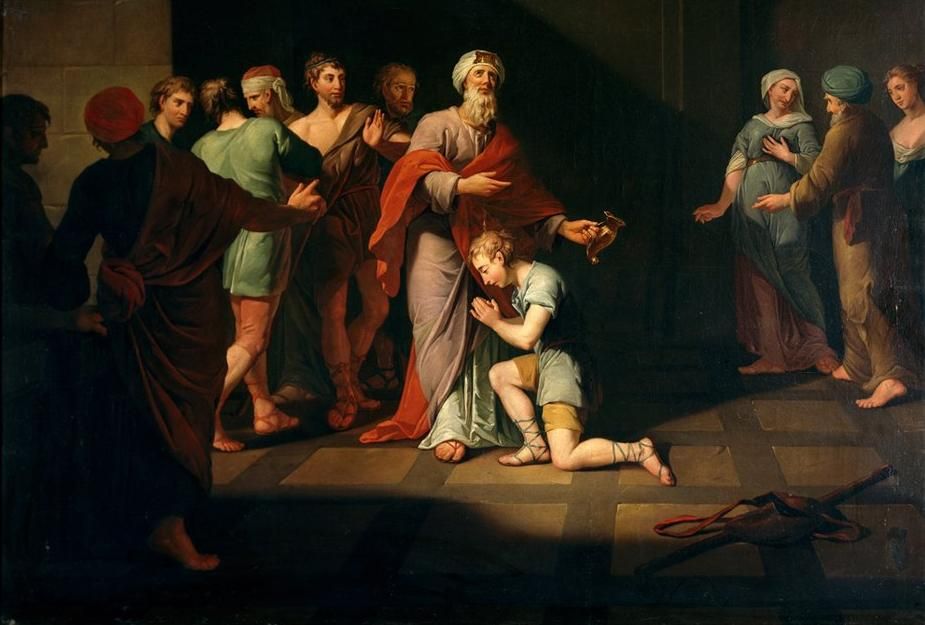
This is where we first meet David, as he is summoned from herding the sheep to have Samuel anoint him as God’s chosen King. Samuel’s coming meant that something important was afoot, and surely David wanted to be part of it. As the youngest son, the task of tending the sheep fell to him, while his brothers could stay home to greet the great man. I can almost hear him saying “It’s not fair!” just like any other teenager.
Was he wondering about Samuel’s purpose in visiting his father? He might have had an idea about what was up: King Saul had fallen from God’s favour, and Samuel’s visit likely had something to do with that. Did he have any idea of what God intended that day? Had he heard some kind of call? We’re not told. What we are told is that none of his older brothers passed muster as they paraded by, while Samuel listened for God’s voice. None of them were called to be King.
The rest of the family was surprised when Samuel told them to bring David to him. The youngest? A mere boy? Directed by God, Samuel saw otherwise, and called David out of his family to become King. Samuel named David’s vocation. Had David already heard it? We don’t know, but later events show him growing into the realization and fulfillment of his divinely-ordained role in life.
I have twice been an assessor for ACPO3, a major part of the process our church uses for discernment of vocations to the priesthood. Candidates are interviewed in a variety of settings, looking at the “3 C’s”: Character, Charism, and Call. Dealing with the first two is a bit like a conventional job interview, but the third presents some special issues. “Call” means both the candidate’s personal sense, and the affirmation of their community. I met some who said strongly that they knew that God needed them for the priesthood, but whose recommendations from others were more equivocal. Contrariwise, I met one young man, immensely gifted, by all accounts a really fine person – charism and character in spades! – but who simply could not articulate any kind of personal call. When we asked, “Why do you want to be a priest?” his only response was “Everyone says I should be.” When we asked him what he would do otherwise, he was able to map out a clear direction in academic work – he almost had his Ph.D. dissertation written in his head. We recommended that he continue with that work, and if at some time he was able to say, “I believe God is calling me to be a priest,” he should once more present himself as a candidate.
Vocations to Christian ministry come from both within the person (the “inner call”), and from the community (the “outer call”). Both must be present. Samuel gave David his outer call in dramatic fashion. We will hear more over the summer how David’s inner call developed, but we may be sure that he heard it.
Church folks most often use the word “vocation” in the context of ordained ministry. But please remember this: Christian ministry is not confined to the three-fold ministry of Deacons, Priests, and Bishops – not by a very long shot! The Catechism of the Episcopal Church of the USA teaches that there are four orders of ministry, naming the ministry of all the baptized (laypeople) as primary. I wish our Church had adopted this Catechism.
The ministry of the laity does include the various roles people assume in the church: lay readers and assistants, sides people, sanctuary guild, lectors, intercessors, musicians, teachers, wardens and vestry members, to name some of the most obvious. More importantly, it means the ministries that lay people exercise in the wider world, in all the many and varied ways they follow their calling as disciples of Christ. Every baptized person is called to a new life, dedicated to living into the promises found in the Baptismal Covenant. There is a good reason why this covenant is renewed by the whole congregation at every celebration of Baptism: the newly baptized are welcomed into a community of people who are striving to be God’s ministers in the world – people with many and varied vocations.
What’s your vocation? Some of us – a very few – can say “I’m called to be a priest or deacon in the Church.” But others might say something like “I’m called to be a (_______), the best one that I can be, so that people around me can see Christ at work through my life.”
When an ordination candidate is presented to the Bishop, the Bishop describes the nature of the ministry in question, and then asks, “Do you believe you are called to this ministry?” The Baptismal Covenant is the counterpart of ordination for the ministry of the laity. Any Baptized person can ask the call question for themselves, and then seek the affirmation of the wider Church when they believe they have heard a special call. Just like David, just like that gifted young man, we all need to hear both inner and outer call. We need to listen for the voice of God. And then we need to test our insight with others who are similarly striving to follow Jesus.
And let us never assume that a calling once heard is once and for all time. I once thought I wanted to be a railroad engineer – that didn’t last long! Things change over time, and God may lead us in ways that we hadn’t previously imagined or couldn’t imagine. No-one in my school years could have articulated a desire to design video games! And the kind of job I had with the Provincial government in the ‘70’s and ‘80’s has been almost totally changed by the internet.
We need to keep on listening for God’s call, because it can and does change. But make no mistake about it: God is calling you, and you, and you, and me. God is calling every one of us. We may not always hear clearly, but we may be assured that God will in God’s time send us our own Samuel or Samuels to help us hear better.
God is calling. Listen, pray, test, and respond.
God is calling. Live into that call, and rejoice!
God is calling. In Jesus’s name, may we hear and follow.
Amen.
- Video of the sermon and the full service may be found at https://www.facebook.com/holytrinityanglican ↩︎
- “Yes Indeed“, Tommy Banks, solo piano, Royalty Records RRI-300-9647, 1997 ↩︎
- Advisory Committee on Postulants for Ordination ↩︎
 This is a working draft of a sermon which I decided not to use. Comments are welcome!
 Into the blue...