I Thirst—for What?

Text for a sermon given at Holy Trinity Anglican Church, Edmonton
March 23, 2014
Lent 3, Year A
Lectionary Texts: John 4:5-42; Exodus 17:1-7

I hunger and I thirst;
   Jesus, my manna be:
ye living waters, burst
   out of the rock for me.[i]

The American author Gertrude Stein was dying. As she was being wheeled into the operating room for surgery, she asked her life partner Alice B. Toklas, “What is the answer?” When Toklas did not reply, Stein said, “In that case, what is the question?”[ii]

Some of you may have seen signs in various places proclaiming “Jesus is the answer.” It’s a saying that has been much used by some churches in recent years, and it is now the official slogan of one para-church organization.[iii] The first time I remember noticing it, the same thought came to me as to Gertrude Stein: “What is the question?”

Image
Today’s Gospel reading shows us Jesus asserting a similar idea: he is the answer to all our thirst.

“…those who drink of the water that I will give them will never be thirsty.”[iv]

If Jesus is the answer to our thirst, then we may ask, “For what do (or should) we thirst?”

The woman in the Gospel story interprets Jesus’ offer very literally and physically. Her response shows that she is thinking of the kind of water she draws daily from Jacob’s well, the same ordinary stuff we expect to come out of our taps whenever we need it. You can almost hear her thinking, “Oh, great! Now I won’t have to come out in the scorching sun to carry this heavy water jug home…” Even today, there are millions of women around the world who would welcome such relief from this burdensome but essential labour.

Water: plain, old everyday water—the most basic necessity of life. That’s what she thought Jesus was talking about. But just as in Jesus’ dialogue with Nicodemus, heard last Sunday, Jesus is using this word in a metaphorical or spiritual sense. Nicodemus heard “born from above” and thought of the physical impossibilities that phrase seems to suggest. The woman hears “living water” and thinks of cold running water from a never-ending spring.

In both cases, Jesus is pointing beyond the physical reality to something eternal and spiritual. We will continue to thirst for ordinary H2O – without dealing with that thirst we will die physically. The people of Israel knew that when they asked Moses,

Why did you bring us out of Egypt, to kill us and our children and livestock with thirst?[v]

Likewise, without responding to hunger we will die physically, if somewhat more slowly than from thirst. Hunger and thirst are necessary to life, but we can have too much of a good thing: it is possible to die from over-consumption of water[vi], and severe over-eating can also be life-threatening.[vii]

We can be sure about this: Jesus is talking about something beyond physical thirst. Typically in John’s Gospel, the text does not spell out the full implications, but rather it points towards a deeper meaning. Jesus’ encounter with the woman at the well leads us out of the ordinary and trusted into the realm of the sacramental and the risk of faith. We begin with Jesus in “enemy territory,” the land of the Samaritans, traditional religious antagonists of the Jewish people. Jesus shouldn’t even have been there, and then he goes on to break more boundaries, first by approaching a woman in public, violating social customs, then by asking her for a drink, violating religious imperatives.

The dialogue moves beyond the physical thirst into what the theologian Paul Tillich called “the dimension of depth.”[viii] The woman’s concerns progress from dealing with ordinary daily needs to making a declaration of faith and giving witness that brings many others to Christ – in this case both physically and in faith.

At the story’s start, the woman is dealing with ordinary physical thirst – she is getting water for her household. By story’s end, she is addressing the deep eternal thirst for salvation – however she and her people may understand it. Both thirsts are real and vital. Thirst is the awareness of the need for something essential to life.

Life becomes difficult, complicated, even unmanageable or dangerous, when we try to slake our thirst with that which will not—cannot!—satisfy. We can find this happening in addictions, in our personal and economic lives, and even (alas!) in politics, both locally and on the world stage.

No substance can ever satisfy—there’s never enough.

No possessions can satisfy—there’s never enough.

No amount of money can satisfy—there’s never enough.

No exercise of power can satisfy—there’s never enough.

There really is no area of life immune from this urge to slake our thirsts at the wrong wells.

There’s nothing new about this all-too-human tendency. As we read in Isaiah:

Ho, everyone who thirsts,
   come to the waters;
and you that have no money,
   come, buy and eat!
Come, buy wine and milk
   without money and without price. 
Why do you spend your money
   for that which is not bread,
   and your labour for that which does not satisfy?[ix]

Jesus blesses only one thirst: the thirst for a life lived in relationship with God through him. We hear later in John:

Jesus said…, ‘I am the bread of life. Whoever comes to me will never be hungry, and whoever believes in me will never be thirsty.’[x]

And in Matthew:

‘Blessed are those who hunger and thirst for righteousness, for they will be filled.’[xi]

Lenten disciplines help us to re-direct our hungers and thirsts, to turn again to the one who can satisfy all the yearnings of our souls. And so we shall enter eternal life:

The water that I will give will become in them a spring of water gushing up to eternal life.[xii]

Ask the right question, and the answer shall be given.

For still the desert lies
   my thirsting soul before;
O living waters, rise
   within me evermore.[xiii]

Amen.


[i] “I hunger and I thirst,” John Samuel Bewley Monsell, Jr., 1866, vs. 1

[iv] John 4:14a (NRSV)

[v] Exodus 17:3b (NRSV)

[vii] As in Prader-Will Syndrome: Characteristic of PWS is … a chronic feeling of hunger that can lead to excessive eating and life-threatening obesity. http://en.wikipedia.org/wiki/Prader%E2%80%93Willi_syndrome

[viii] Tillich, Paul, “The Lost Dimension in Religion,” in “The Essential Tillich,” University of Chicago Press 1999

[ix] Isaiah 55:1-2a (NRSV)

[x] John 6:35 (NRSV)

[xi] Matthew 5:6 (NRSV)

[xii] John 4:14b (NRSV)

[xiii] “I hunger and I thirst,” vs. 5
Back to the future?

When I was in full-time parish ministry, I had a regular routine of preaching preparation. I preached most Sundays, and my week was structured around my discipline of sermon-writing. It began on Tuesday morning, when I would read the scripture selections for the coming Sunday and jot a few notes. On Wednesday afternoon, I would return to the notes, and do whatever exegetical work seemed to be called for — consulting commentaries and other references, in recent years more on the Web than through books. (Thank you, textweek.com!) Sometime on Thursday, I would try to sketch some general ideas for the actual sermon. On Friday afternoon, I would close the door and begin writing. I usually had a working copy done by 4:30 PM. I would do a final set-up of my stuff for Sunday, and go home to enjoy my Saturday day off with my spouse. On Sunday, I would re-read the text before services, correcting any obvious egregious errors, and then I was ready.

That was the essential structure of my week, something that became not just a way of organizing my vocational life, but the heart and soul of my spiritual life. I believe the essential discipline of preaching is “engaging the scriptures,” to use Thomas G. Long’s felicitous phrase. If the preacher has been immersed in the text, and has been seriously engaged in exploring its depths, it can not help but show in the pulpit.

Because I no longer have that scriptural framework for my week, I have been forced to re-discipline my spiritual life. That’s another story for another time — it’s actually still in formation.

The change in the rhythm of life has changed how I prepare for preaching. When I was a pastoral intern at St. John’s Cathedral, Saskatoon in 1986, my supervisor gave me preaching dates long in advance. I had the luxury of extended preparation time, and each of the sermons I gave there was pretty polished — perhaps too much so! I became aware that it was a little too easy to edit out spontaneity and feeling.

When I entered into full-time parish ministry the next year, the shock of weekly preaching forced me to develop the disciplined approach I already described. No-one told me how hard that would be at first… and no-one told me how much I would come to rely on it.

I’m preaching again, three times in the next two and a half months. I began working on the first of the three this morning, a date more than two weeks away. The long horizon reminded me of my internship, and the careful prep. that I did then. I pray that I will not be over-prepared for these dates, but will be free to speak spontaneously from the structure that my written text will give me. We shall see.

My internship was 27 years ago. I am certainly not the same person today as the rather nervous student who first stood in that pulpit in Saskatoon, Pentecost, 1986. And I’m not the same as I was on June 23 last year, when I last preached at St. Matthew’s in Brandon.

Things come in circles. I have the luxury of preparation time, and I also have the advantage of years of experience. All I pray is that I will be given the grace to be an effective minister of the word for the people of Holy Trinity.

My friend’s questions

It seemed appropriate to post the questions which occasioned my previous post. Here they are, in his words:

  1. Tell me about God: Is He a he? Is He in any way like a person? Is He conscious? Does He interact with humans? Does He hear and answer specific prayers? Does He have a plan? Is He all-loving? All-knowing? All-powerful? How do you know He’s real?
  2.  Tell me about the Bible: Is it the word of God? Was it written by men inspired by the God you told me about? Is it history? Is it mythology? Is it perfect? Are there errors?
  3.  Tell me about Worship and Prayer: What is it? What is it for? Does God need it in some sense? Is it a kind of meditation? Is it an art form? Why are some prayers answered and others ignored? Are 10 people praying for something better than one?
  4.  Tell me about Heaven and Hell: Is there literal life after death? Will I be aware and conscious? Will I remember anything of my life on earth? Are Heaven and Hell metaphors for what we do and experience in the here and now?

Believing: What or How?

A friend posted some questions on Facebook a few weeks ago, wanting to know what modern Christians believe. As I told him in my reply, the questions point to some of the most basic and profound theological issues. It would take a library to address them in any comprehensive way that would make sense to my very intelligent friend. At one time he would have described himself as a Christian, but now… I’m not sure what label he would accept, if anything other than “sceptic.”

Facebook is certainly not the venue to address his questions, and neither is this blog. Matters of God’s being, of how we know that being, of the nature of the Bible, of prayer, of heaven and hell — all these require more words than most people would have the patience to digest. Of course, I would end up answering the questions more in a sense of my own beliefs rather than others’. No-one can escape their own point of view, and even a sociological analysis of “what people believe” will inevitably be coloured by the analyst’s perspective.

I won’t try to answer “what?” for myself or for anyone else. You can read the various books of theology and religious studies for those answers. Suffice it to say that Christian belief today has a huge multidimensional spectrum. Even in my last parish, I could introduce you to people who held an almost fundamentalist view of scripture and theology, sitting in the same pew as others who regarded it all as one big metaphor.

What I want to address is a different question: “How do modern Christians believe?” I am indebted to Diana Butler Bass, whose book Christianity After Religion has helped me to understand some of the most important  tensions in modern Christianity, and what the future might look like. The book is an extended look at the question of what it means to be “spiritual but not religious,” a phrase often heard in contemporary  In its central section, Butler Bass re-frames the traditional central religious questions in spiritual terms. (Broadly speaking, “religion” pertains to matters of structure and institution, while “spiritual” pertains to more fluid aspects of living in relationship to the divine.

The traditional religious approach to forming new members follows this sequence: first we’ll teach you what to believe, then we’ll teach you how to behave, then we’ll let you belong. Butler Bass first re-frames the questions at each step:

  1. Believing:
    The religious question “What do I believe?” becomes the spiritual question “How do I believe?”
  2. Behaving:
    The religious question “How do I do that?” becomes the spiritual question “What do I do?”
  3. Belonging:
    The religious question “Who am I?” becomes the spiritual question “Where am I?”

But it doesn’t’ stop there. Butler Bass turns the whole process on its head, by suggesting that people do not enter at the question of belief, but at the other end, with a community that attracts people, who then learn what it is that the community does by being among the community. Intentionally doing what others doing leads us to share an understanding of what they are doing, and what lies at its roots.

Belief in this sense grows out of doing rather than the reverse. As Butler Bass, points out, the word has a German root “beliebt,” related more to loving than to knowing and understanding.

So…
To understand what Christians believe, you should look at how they believe.

  • What drives them?
  • What passions energize their lives?
  • What does that look like?
  • How they behave?
  • What’s their mission?

Re mission:
A retired bishop told a clergy conference some years ago that everyone has a mission and a mission statement. “Just look at a person’s chequebook. That will tell you what their mission in life is.”

Or as Jesus put it:

For where your treasure is, there your heart will be also.
(Matthew 6:21)

Both Fish and Fowl

After four Sundays taking services at St. George’s, Devon, I will be back to the choir at Holy Trinity Anglican Church (HTAC, for short) this weekend. I really enjoyed doing the services, but I also missed being part of the HTAC community for those weeks. The folks at Devon were kind enough to say they wished I could stay, but other arrangements have been made, and I really want to be able to worship with my wife during Advent and Christmas.

Will I take another such assignment? Very likely, if it is feasible. We shall see what the future brings.

Last Thursday I attended a diocesan clergy day, led by the Rev. Dr. Eric Law, founder of the Kaleidoscope Institute. For the most part I enjoyed the presentation, but I came away from the day feeling a bit down and anxious. That may have been partly because I was dog-tired, but there had to be something else. After a few days’ reflection, I have come to the realization that events like this used to stimulate me because I was always looking for something to take home to my parish — and I no longer have that focus. Future ministry in the Diocese may give an outlet, God willing.

While in parish ministry, I was constantly looking for ways to improve things. I am an incurable reviser, never fully satisfied with a piece of work. That’s how things get better, I do believe. Learn from your failures and shortcomings — it’s the best school going! [check this out!] I would do (e.g.) an Advent Lessons and Carols service one year, and then ask myself “how could it have gone better?” If I had received the material from Eric’s presentation two years ago, I know that it would have shown up in some way in my ministry.

So what do I do with it now? In my current situation, it’s an interesting concept, but of no immediate utility. Time was, that would not have bothered me. Much of my early educational career was taken up with studying pure mathematics, which is subject to the same assessment. But more recently… let’s just say I found the need to focus myself on my part in God’s mission, and I have tended therefore to study things which seemed to be leading somewhere practical.

The other thing that happened last week was that I didn’t go the parish conference at HTAC, also led by Eric Law. It would have been interesting, I’m sure, but I was very much of two minds about attending. When we first started there, most folks accepted me just as another body in the pews, but as I have met more people, and they have found out I am ordained, I have sensed them responding to me differently. To be sure, that may be from my wearing a clergy shirt when I came to pick up J. from HTAC. Nonetheless, it has made me conscious of being in a liminal state: neither fully one thing nor the other, but on the threshold.

Am I a person in the pew, or am I clergy? Or is it both/and?
Am I …

Neither Fish nor fowl?
Or
Both Fish and fowl?

Stay tuned.

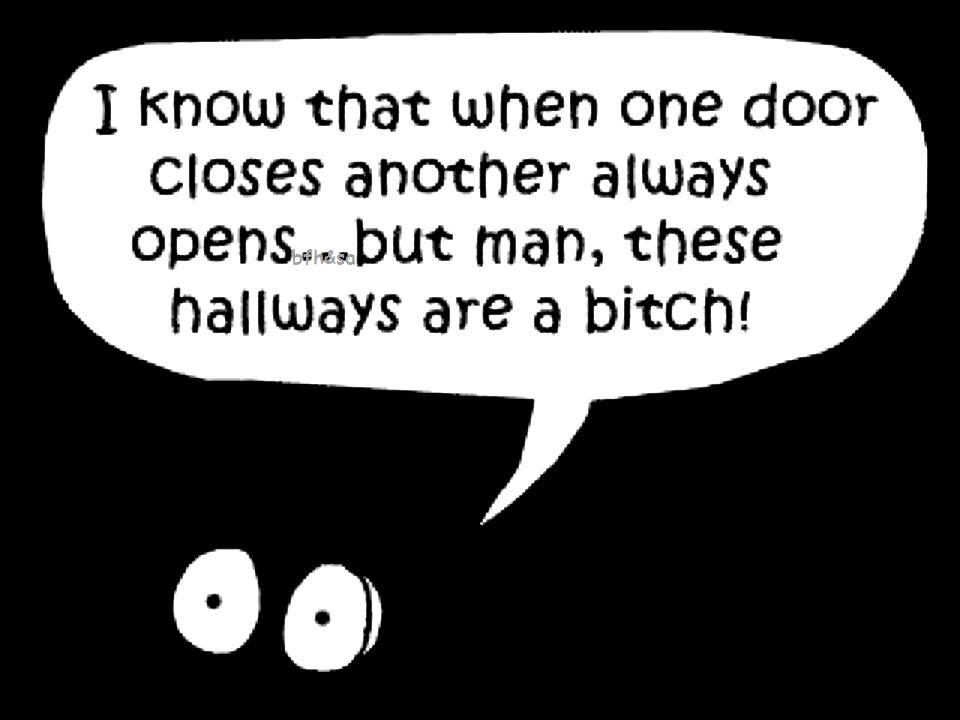
A hallway not of my choosing

hallways are a bitch

Last Sunday I took the first of four Sunday services at a small church in a commuter suburb. It was the first time I had functioned as clergy since my last Sunday at St. Matthew’s Cathedral. I wasn’t at first sure I wanted to do this, because I was really beginning to enjoy being a person in the pew. However, in order to find out if this kind of work is what I may be called to do in the future, it seemed reasonable to take the gig — it’s the only way to find out!

Well, as it happens, things went well, although I had to contend with the first real snowfall of the year. The weather meant that a substantial number of parishioners stayed home, including both pianists. So we sang a cappella, which was mostly OK, except I nixed singing the service music, because I was unfamiliar with it. At any rate… I had fun. It was good to preside and preach, once again doing the things that have dominated my life for the previous 26 years. I don’t believe I lost my edge in four months, and things were well-received by the folks.

But that got me to thinking: I left full-time ministry on a high note. I believe that my work in my last year was the strongest in my career. And then I hit the magic 6-5, and it was all over — more or less arbitrarily. The fairness of mandatory retirement has somewhat unexpectedly come back to me as a major question. There have been court cases challenging the practice in several fields of work, most of which I believe have upheld it as a reasonable limitation on freedom. In general, I tend to agree with it, but in specific, it is not so easy to live through. I wouldn’t want to work until I dropped, but in some ways I would have preferred to have the option of working longer if conditions warranted it. “Are you still able to fulfill the role?” would be a reasonable question.

There’s a sense in which I am repeating history. When I was seeking ordination, the Bishop of Edmonton at the time asked me if I would go “wherever God called me.” How could I say no to that, even when I knew that it would probably mean going to a small town. I grew up in a smaller place (Drumheller AB), and I well knew what small-town life was like — that was one of the reasons we had settled in the city! At any rate, my first charge was in a town smaller than my home town, a place that I had real trouble adapting to. My mentoring priest challenged me on this: “You knew you would have to do something like this. Why are you complaining now?” My response, not unlike my present feelings, was that it is one thing to know something in your head, and quite another to live through it.

Am I complaining now? I don’t think so. There’s much about my present existence that I like, and there’s much about my prior life that I don’t miss. (Please don’t ever ask me to manage a heritage building!) But I really found last Sunday that I felt good about what I was doing — leading worship is for me fundamentally life-giving and life-affirming, and I had been missing it. So I am left wondering if we couldn’t somehow manage this business a bit better, not just in the Church, but in society as a whole.

I’m still in the hallway, but I know that there are doors opening ahead. And that’s good.