What kind of king? What kind of people?

Notes for a sermon at Holy Trinity Anglican Church (Strathcona), Edmonton
Reign of Christ Sunday, Nov. 21, 2021
Texts: John 18:33-37; 2 Samuel 23:1-7; Revelation 1:4b-8

Are you the King of the Jews?” may at first seem like a straightforward yes/no question. The Jewish authorities have turned Jesus over to Pilate, demanding his death. At first glance, Pilate is just seeking a quick resolution to the charge. However, I find myself hearing Pilate’s question on another level. Jesus has been accused of claiming kingship, and Pilate can’t quite believe it.

Are you the King of the Jews?” “Really?”

Whatever answer Jesus may give, he does not present as any kind of king that Pilate can recognize. What does a king look like? Certainly nothing like a Galilean peasant. Pilate knew kings – people who lived in palaces, dressed richly, surrounded by servants. Most kings in the ancient world got their positions through force or violence, whether an ancestor’s or their own, and they held on to those positions through force. Pilate can see none of this in Jesus, who is no kind of king that Pilate (or almost anyone else) understands. “My kingdom is not of this world,” as Jesus says. Living under Jesus’ reign is different from living under the rule of an earthly king. So…

       What kind of king is he?
       What kind of kingdom does he reign over?
       What kind of people inhabit this kingdom?

The Bible is ambivalent about human government, especially kingship.[1] There are texts that affirm its positive value, others that caution about it, and still others that are profoundly negative. Our reading from 2 Samuel points to this tension: someone who rules over people should do so “in the fear of God,” meaning that the ruler’s purposes should be God’s purposes. History has too many examples of rulers whose purposes were not aimed at the good of God’s people, but rather driven by self-interest, aggrandizement, and aggression.

Moves to limit the power of kings play an important role in our history. In 1215, Magna Carta sought to protect the rights of the church and the barons, but real steps in establishing rights for the wider populace came later, notably with the British Bill of Rights Act of 1689. In Canada, human rights, as enshrined in the first section of our constitution in 1982, have become a major factor in our lives, notably as part of some rancorous disputes around pandemic protection.[2]

The language of human rights has become commonplace, even finding its way into church life. At General Synod in 1998, we were asked to vote on a declaration of human rights for the church. The measure was narrowly defeated, but I found the debate instructive. I particularly recall one of the bishops saying something like “Human rights are a good thing to promote, but we in the church should remember that this is not our ‘heart language.’ Our heart language as followers of Christ is the language of responsibility, which is found in the Baptismal Covenant.”[3]

That one short speech has stayed with me ever since.

We are celebrating baptism today, affirming with the candidate and her parents and sponsors our own commitment to following Jesus. We are declaring ourselves to be citizens of Jesus’ Kingdom. Following Jesus is never about asserting rights and privileges, but rather about acknowledging and accepting our responsibilities as Jesus’ people. One of those responsibilities is related to human rights – we pledge to respect the dignity of every human being, but that has little to do with our own rights. It’s more about acknowledging others’ equal standing in God’s eyes.

Jesus could have claimed kingship for himself, with all the rights and privileges pertaining to that office. As the incarnate Word of God – the Truth walking among us – he was certainly entitled to due respect. But he never claimed it.

Instead, as Paul wrote in Philippians 2:5-8

Let the same mind be in you that was in Christ Jesus,
who, though he was in the form of God,
   did not regard equality with God
   as something to be exploited,
but emptied himself,
   taking the form of a slave,
   being born in human likeness.
And being found in human form,
   he humbled himself
   and became obedient to the point of death—
   even death on a cross.

Jesus’ kingship is not about him – not like Louis XIV of France, who famously said “L’état – c’est moi.” For Louis and many other monarchs, it is all about them. For Jesus, it is all about God and God’s people, and his self-giving love for all that led him to stand before Pilate, and soon after to die on the cross.

Christian life – the life expressed in promise form in the Baptismal Covenant – is not about us. It’s about our participation in the Reign of Christ, a Kingdom built on justice, mercy, and love.

Christian life is about us being and becoming a kingdom of “priests serving [Jesus’] God and Father.” We are not all priests in the ecclesiastical sense, but as a people we are called to “proclaim by word and example the good news of God,” presenting God to the world in all that we say and do – the essential nature of priestly ministry. This message will not always be received in joy by people, not least because it confronts all our self-driven agendas.

I once asked a young man who was considering Baptism as part of his preparation for marriage what he understood to be the purpose of life. His response startled me: “I guess to get power over other people,” a dramatic contrast to seeking others’ good, entailed in following Jesus. I don’t think he is unique – far from it! – but I had never heard this stance expressed quite so candidly.

Being part of the people of God can sometimes be difficult, as that conversation showed. But the good news is that we are not alone.

We stand with Jesus, who stands with us, together accepting and sharing all the risks of proclaiming the Truth in a world that sometimes seems to despise it.

We are empowered by the Holy Spirit, who moves in our midst and in our hearts, driving out fear, and sowing within us the seeds of love.

We are all children of God, who created us in love, calls us to live in love, and welcomes us into the Kingdom in love.

Thanks be to God!


[1]Excursus: Biblical Ambivalence to Government”, in The New Interpreter’s Study Bible, Abingdon 2003, p.407

[2] A considerable body of jurisprudence has emerged in Canada, using the principle of “reasonable accommodation” in cases of competing rights.

[3] Book of Alternative Services, Anglican Church of Canada, 1985, p. 158

What do you do with anger?

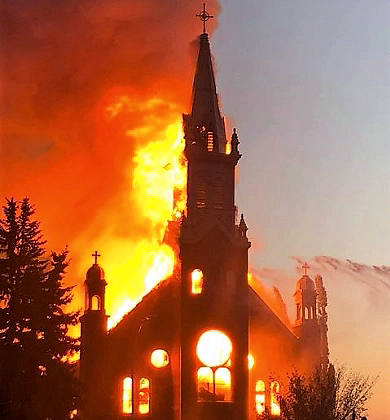
Several churches across Canada, mostly Roman Catholic, have been the target in recent days of acts of vandalism and arson. While no one has been identified as responsible for any of these acts, quite a few people, including the Premier of Alberta, have labelled them as hate crimes. That may be true, but it is also true that if it is hate behind what has happened, it is very specifically targeted.

Hate crimes have been much at the fore in Edmonton for the last year or so, with several deliberate attacks on visibly Muslim women, all wearing hijab, and several of them Black. Our Muslim community is understandably nervous these days. I have no difficulty calling these attacks hate crimes, even when our police force is reluctant to do so — no credit to them!

The attacks on Roman Catholic churches are of a different nature, because they are targeted not at individuals but at an institution. Some of these churches were close to derelict, but at least one, St. Jean Baptiste Church in Morinville, had ongoing vital ties to their communities. The Morinville church had strong ties to the local Métis and First Nations people, some of whom have decried what happened. We don’t yet know for certain that the fire was caused by arson, but many people have assumed that it was.

Was this a hate crime? I don’t know for certain. What I do know is that if it was arson, it was almost certainly an act of anger. And I get that. The Roman Catholic Church, operating under various “Catholic entities”, ran about seventy per cent of the Residential “Schools” in Canada. The recent discoveries of unmarked graves on former school properties has laid bare some of the awful history of how children were treated in these institutions. It has raised public awareness of the Roman Catholic Church’s way of dealing with our indigenous brothers and sisters. It has brought to the fore that church’s failure to meet its obligations under the Residential Schools settlement negotiated by the Federal Government.

I have felt anger after hearing these stories again over the past several weeks. But I am a settler –literally. I was born in England, and came to Canada as a child. I started to feel this anger over the past almost 30 years, as the history of the schools, previously unknown to me and to many, became more and more clear. The whole story makes me weep, and it makes me angry.

It’s one thing for a settler boy like me to feel anger. It’s totally another thing for our indigenous brothers and sisters to feel anger. The school stories are the stories of their mothers and fathers, grandmothers and grandfathers, sisters, brothers, cousins, aunts and uncles. It is THEIR STORY, and I have total empathy for their anger and sorrow, which dwarfs anything I might feel.

I understand that anger. And I understand how someone’s anger might lead them to deface a public monument, or to torch a beautiful century-old church. I might wish they did not feel that anger, but that’s not my call. What I do wish is that their anger might be expressed constructively, not destructively.

I have found myself in the past in situations where I had cause for anger. In one notable instance, some friends suggested that I repay the indignities I had suffered in kind. Others suggested that I go away for a while. The second suggestion seemed to me that it would imply that I could not deal with what had happened. The first suggestion seemed to me to be asking me to stoop to the level of the attacks against me.

I chose neither. Rather, I chose to move ahead, finding a way to continue in the face of some serious opposition, showing them that they could neither scare me nor force me to retaliate. I turned my anger to positive purposes, and the result (after some time, admittedly) was a stronger and more positive relationship among almost all who were involved.

That’s my story in a nutshell. It’s not anyone else’s story, and it’s certainly not the story of our indigenous brothers and sisters. But what I learned in that episode in my life is that anger is best dealt with not by repaying in kind or by running away, but by holding up one’s head and acting in the most positive manner possible.

When Jesus talked about turning the other cheek in the Gospels of Matthew and Luke, he was not saying we should lie down and let someone kick us all over again. Offering the other cheek tells our attacker that they cannot treat us as less than human, that we are as worthy as they of respect. It is an assertion of equality.

For me, this is the best way to deal with anger: not to repay in kind, bringing ourselves down to the level of our attackers; not to run away, effectively surrendering our power to them; but to stand before them, declaring in all things, “I am human. I deserve your respect. And I will not stoop to disrespecting you,”

It’s a tall order. I understnad the visceral nature of the anger that probably led to the recent acts against churches and public monuments. Nonetheless, I remain committed to finding a way forward that is committed to non-violence. The violence of the past can not be undone, but neither does it have to be repeated.

I believe that reconciliation must include the mutual recognition of each other’s humanity, it must include the clear repentance of some parties for past wrongs, and it absolutely must include the desire to move forward together, helping each other.

My settler brothers and sisters — and I! — have much to learn. We can only learn if we allow others to teach us.

I love my country

It’s Canada Day, July 1, when we commemorate the British North America Act, which brought Canada into being as a country. Often in the past it’s been a day to wave flags, set off fireworks, and just generally celebrate. The last few years have given it a different flavour (see my Canada Day post from 2017), and this year more than ever. We have been hearing of the finding of unmarked graves on the grounds of former residential institutions (let’s not call them”schools”) set up to de-indigenize our indigenous peoples. Children died at those places, and weren’t considered important enough for the authorities to send their bodies back to their families. Many of the deaths do not seem to have been properly recorded, and the graves were never registered.

Some have been calling for Canada Day celebrations to be cancelled, and some places have done that. I have some sympathy for that move, except that it takes away the opportunity to use the day for some collective reflection on one of the most shameful aspects of Canadian history.

I love my country. I have always seen it as a land of great opportunity, a land with the space to make many people welcome, a land of huge promise. However, much of that promise has been deliberately withheld from some people. The most obvious is the case of the indigenous people, but Canada has also abused the rights and freedoms of other groups, notably Japanese Canadians during WWII. There was also systematic discrimination against people of various ethnicity seeking to immigrate here.

When I say I love my country, it is not with the “My country right or wrong” kind of sentiment I recall from some U.S. voices during the Vietnam war. That’s not real love, but a kind of wilful blindness to what the country could be. Canada is in many ways a good country, populated for the most part by good people, but that does not mean everything about it is good. To truly love a country, just like truly loving another person, means for me to be ready to work to make things better when they need to be better. To love my country means to have the courage to call for and work for the righting of wrongs wherever they may be. If I love my country, I have to accept that it can break my heart.

It’s love with the eyes fully open, the brain fully engaged, and the heartfelt conviction that we can always do better.

Canada, I love you, but it’s time to do better, acknowledging and dealing with past wrongs, and seeking to build a country where all may enjoy the blessings of freedom and peace.

Are you saved?

Notes for a sermon at Holy Trinity Anglican Church, Edmonton, March 14. 2021
Texts: Ephesians 2:1-10; John 3:14-21 (Lent 4, Year B)

When I was seeking ordination, the bishop “suggested”[i] that I would benefit from some depth counselling to explore some personal issues. I took his direction, reluctantly at first, but the experience ended up being one of the milestones of my life. I have never regretted it.

Some time into the process, my counsellor said I might benefit from time in a group setting. At my first session in the group, the leader asked me as a newcomer to introduce myself and tell them why I was there. I started with my perceived calling to become an Anglican priest. When I said that, a person across the circle from me said “Are Anglican priests saved?” It stopped me dead in my tracks. Pulling myself together, I gave the only answer that I thought would make sense: “Yes.” The other person looked a bit startled, and then said “OK, then. Go on.”

“Are you saved?” is a question often heard in some other church communities, but not so much among Anglicans. My response was a simple answer to what is really a very deep question. I suspected that my questioner thought in very black-and-white terms,[ii] and a nuanced response would likely only lead to confusion, anger, or outright rejection.

As I see it, one of the problems with this question is that it does not address the issue of what is meant by “salvation,” “saved,” or “being saved.” It treats salvation as a once-and-done event, which we may pass through or not, and can become just a way of sorting out the people we meet. However…

When Paul uses salvation words, it is most frequently in a future or a progressive sense. The two instances of “you have been saved” in today’s reading from Ephesians are unusual.[iii] Salvation is a gift from God through Christ, but it’s not like a plaque we can hang on the wall but is rather an invitation into a process in which we are called to participate – an invitation into a relationship beginning when we first become aware of it to when we pass from this life to the next. Think of a High School senior who gets an acceptance letter from the University of their choice, which does not confirm them as having “made it” but invites them into a longer and more arduous process – a closer relationship with the institution. Just so with salvation.

Claiming Jesus as Saviour is not so much extolling him as the great lifeguard who has saved us from death, but as the one who continues to walk with us on our journey thereafter. The rescue is important to be sure, but the more important question is “What were you saved for?”[iv] You’re back on dry land: now what?

When we hear the word “saved,” we often add one of two words: “from” or “for.” Both have scriptural support, and we need to pay attention to both. But I believe that the “for” is more important than the “from.” The one is all about the past, which we can recall, but which we can never change. The other is all about the future, which we can only dimly anticipate, but over which we can have influence. We are participants in our own lives, with the gift of free will. As we are being saved, we have choices to make every minute of every day – and every choice may matter.[v] As Paul writes in his letter to the Philippians:

Therefore, my beloved, just as you have always obeyed me, not only in my presence, but much more now in my absence, work out your own salvation with fear and trembling; for it is God who is at work in you, enabling you both to will and to work for his good pleasure. (Phil 2:12-13)

We who have come to believe in Jesus have entered into eternal life. Note the past tense: eternal life, especially as proclaimed in John’s gospel, is not some future “pie in the sky” kind of promise, but a life lived in conscious relationship to our Creator – a life lived here and now, and wherever we are led in the days ahead. God’s promise to us is that God will be with us every step of the way!

And take note: people are very fond of quoting John 3:16, holding up placards at football games, and putting it on bumper stickers. But they often forget that vs. 3:17 follows immediately, proclaiming God’s intentions not just for us as individuals, but for the world:

Indeed, God did not send the Son into the world to condemn the world, but in order that the world might be saved through him. (John 3:17)

If we lay claim to eternal life, we do so only as members of the whole human race, for whose good we are called to work. As we heard in Ephesians:

For we are what he has made us, created in Christ Jesus for good works, which God prepared beforehand to be our way of life. (Eph. 2:10)

Created for Good Works - Come to Christ

And who did God love? No individuals need be named, no groups singled out, no distinctions made. God loved the world – everything in creation, every speck of dust and every soaring mountain, every microbe and every human being, every atom and every galaxy. Nothing we can think of is beyond the scope of divine love.

Well, so what? God loves everything, so what is left for each of us to do?

Plenty, my friends! Plenty!

To live in relationship with another is to reflect the other’s being. To live in relationship with God is to reflect God’s being. And God – the God who made us and formed us for good works – God is love!

To be saved is to participate in and to reflect God’s being, to daily seek to do good in this world, not accepting it as it is, but helping to make it in every way we can just a little more like God intended.

God … loved the world. It all begins there.

Let us go forth and do likewise.
For this is what God has saved us for:
            To go and love;
            To go and serve;
            To go and live with God.

May it be so.


[i] Bishops’ suggestions may be just that, but rarely are,

[ii] I saw more evidence of this kind of thinking in the following weeks.

[iii] Some scholars question the Paul authorship of Ephesians. This usage may serve to point in that direction.

[iv] I’ve been asked similar questions by bank advisors, but with respect to money.

[v] The so-called “butterfly effect” comes to mind.

Heartsick

I am not a citizen of the US, nor have I lived there. I am a Canadian, born in the UK, naturalized as a child, and thoroughly a child of the country my parents adopted.When I was in school, I recall a number of lessons about systems of government, some of which compared and contrasted the US and Canadian modes of governance. One of the things I learned there was a hearty respect for the system established by the American Constitution. It’s not perfect, but it has stood for over two centuries as a shining light — an icon, if you will — for the principle of democracy.

I can get frustrated by our Canadian parliamentary system, which has centuries of custom behind it, but I would not want to choose between them — as long as they both work as intended.

Today, I am heartsick at the way the wheels are falling off the bus of American democracy. The events at the US Capitol building reveal the system’s most grievous weaknesses. The “American Dream” is founded on the idea that everyone should be able to dream big — and to realistically aspire to the realization of those dreams. It hits the wall when some people find others’ aspirations to be radically opposed to theirs, and then radically oppose those people as they seek to live into their dreams. Yes, I’m talking about white privilege, or racism to use a less-palatable term.

The insurrection at the Capitol today — an attempting to stop a time-honoured Constitutional process, seeking to keep in office a President who had clearly lost the election — very plainly reflects the division the outgoing President had encouraged. He did not sow it, because it was already there, but he cultivated it assiduously for the past four years.

Armed conflict at the US Capitol simply makes me heartsick. The system which I had so admired has been sorely compromised, and the state of the democratic world to which I belong has been damaged.

If the icon falls, what happens to those who revere the icon?

To my friends south of ’49: my prayers are with you, as you move through these very difficult times.

The economy of Grace

Some years ago I spent a few weeks volunteering full-time at Edmonton’s Bissell Centre, an agency which exists to help the city’s underprivileged people. One of the programs they had was a work exchange program. People could call the Centre looking for day laborers, and the Centre would send workers out as they were available. On occasional days there was more work than people, but mostly there were people left behind after all the jobs had been allotted. Some worked, others did not.

The Gospel reading from the Revised Common Lectionary for September 20 always reminds me of this program. The parable of the workers in the vineyard begins with a farmer needing to bring in his crops. He goes to the town square and finds people available for a day’s work. He hires some and leaves the others behind. Perhaps he grew fearful that the work would not all be done that day, so he returns to the square three times to get more workers, even recruiting some unlucky folk who had hung around until five o’clock because no-one else would hire them. It’s a pretty simple and predictable story — so far!

The twist (there’s always a twist in a parable) comes at the end of work when he doles out payment to the workers. To the astonishment of all and the anger of the early birds, he pays everyone the same amount – one denarius, a normal day’s wage.

The Workers in the Vineyard | The Catholic Word

Now, as my grandson would say, “How is that fair?” Surely there should be equal pay for equal work, and the late comers should not get the same as the first hired. But no, the farmer pays a day’s wage to everyone.

Here’s the rub, as I see it: the pay of one denarius would allow the worker to feed the family for the day. In this economy everyone gets to eat. There’s a parallel here to the story of the feeding of the 5,000: Jesus shows up, and people get fed. It doesn’t matter what we might have done to earn it, how much labour we might have put in, or anything. God is generous to all, even to those whom we may not believe deserve God’s generosity.

The economy of grace is not nice and neat. It can’t be reduced to an input/output table, or the law of supply and demand. God’s grace is poured out on all. Our economy doesn’t usually work that way. Instead, we put limits on how God’s generosity is apportioned among the populace and are often outraged when someone seems to get what they don’t deserve. Are we similarly outraged when someone doesn’t get what they do deserve? It seems to me that such responses tend to be more muted.

In God’s economy, all are fed, all are treated as deserving of respect, all contribute what they can as they are able.

How should we respond to this divine generosity? Surely not by grumbling about someone else’s good fortune. God has provided for them. Who are we to complain? I am reminded of a verse from “The Servant Song,” one of my favorite hymns:

I will weep when you are weeping,
when you laugh I’ll laugh with you.
I will share your joy and sorrow
till we’ve seen this journey through.

Richard Gillard © Scripture in Song

The journey in and with Christ is not a race with the winner taking home the medal. Rather, it is a journey of fellow-travelers, all seeking each other’s good.

Jesus shows up, and people are fed. Hallelujah!

Masks, and the G-G

Some reflections on the Golden Rule

I live in a city (Edmonton, Alberta, Canada) which has recently instituted a by-law requiring everyone to wear a non-medical face covering in buildings which are accessible to the public, unless they have medical or psychological reasons. Not surprisingly, there has been vocal resistance from some people. I’m not going to rehearse all the arguments I’ve heard, but they do seem to fall into two main categories. One tries to make it a matter of personal rights. The other asserts that they don’t need to wear a mask to protect themselves, and they don’t care if others become sick as a result.

It seems to me that both of these arguments fly in the face of one of the pillars of ethics. Almost every religion has a version of what Christians call the “Golden Rule.”

In the New Testament, we hear Jesus saying:

 ‘In everything do to others as you would have them do to you; for this is the law and the prophets.’

(Matthew 7:12 NRSV)

A poster available through various on-line sources sets this quote with with similar quotes from seventeen other faith traditions. They sound remarkably similar. (Search for “Golden Rule Poster” to find it.) The seeming ubiquity of this rule suggests that it is in some way integral to much of human ethics. What the Golden Rule does is show that ethical behaviour is reflexive. My actions affect your life, just as your actions affect my life. As John Donne wrote, “No (hu)man is an island.”

Understanding that my needs and desires are interwoven with the desires and need of all other people, acknowledging that other people’s needs and desires are as valid and important as our own, are the key to building true community. We call this ability “empathy.” Many people confuse empathy with sympathy, which expresses a feeling about another person’s situation without real involvement in that situation.

The Golden Rule elevates our striving for empathy to an ethical principle.

Wearing a mask may protect me from the COVID-19 virus, but that’s not the point. If we all want to be protected, we must ask each to protect each other — to do to others what we would want done for ourselves. It’s a reflexive benefit, working best when we undertake it for the good of other people before ourselves.

I have also had occasion to reflect on the Golden Rule in a very different context. Canada’s Governor-General has been accused of running a toxic workplace, in which staff often feel belittled and abused. The matter is under public scrutiny, and I have no knowledge of it other than what I have read in the news media. Thus I will refrain from any judgement of Mme. Payette here.

What this reminded me of was my own history as both employee and boss. I had one really bad boss in my early work life, who knew just how to make me feel inadequate and incompetent. His replacement was a revelation to me — the first supervisor I had ever had who made me feel a valued part of the team, building me up where I needed help, and letting me do my job where I was fully capable. When I started supervising others, I resolved to emulate him, by trying to be the kind of boss I would like to have myself.

That’s the “Golden Rule of Management” for me. It sounds simple, but it can be very hard to put into practice, especially if you have a tendency to perfectionism like me! What it means in practice is to listen to the people you are working with, treat them as humans, accept and help to correct their failures when they happen, and rejoice with them when they succeed.

What it means is to have empathy.

We could on at length about places the Golden Rule can be applied. I’m not sure we would ever exhaust the list. For me today it remains one of the central guiding principles of my life. Jesus taught it, and that’s where I first heard it, but it cuts across human life in a wonderfully powerful way.

So, my friends, let us strive to do for each other as we would wish done for ourselves — and the world will be a better place

The struggle of my life

I went through several changes before settling on the calling that would define my life. In high school, I fell in love with mathematics, at which I excelled, and so I determined to pursue that love in higher education. Two years in an Honors B.Sc. program went very well, but I hit the wall in year three. The nature of the discipline was very different, and I found myself struggling with academic work for the first time in my life. During that year, a friend challenged me: “Are you going to work with people or things?” Good question! Higher mathematics is perhaps the most “thingy” discipline anyone could imagine, far removed from the ordinary lives of almost everyone — including me at the time, truth be told.

I made a change: I would walk away from the world of mathematicians, and embrace the teaching profession, where I would be dealing with people. I got my B.Sc. (a general degree with double math. major), and then enrolled in teacher training. Much of what I had to endure in that one year needed for certification was ridiculous and ultimately useless, but I did well at it.

I had financed my year of teacher ed. with a bursary from my home school district. They gave me $1200 (a princely sum in 1969) for my year of training, in return for two years guaranteed service in their employ. If I left before the end of the two years, the whole bursary became repayable immediately.

The first while there went reasonably well, but I soon found that I really could not connect with most of my students. I had spent 5 years away from my home town, and it seemed to me to have changed dramatically in that time. What had actually happened was that I had changed: my politics had become firmly left-wing, I was deeply committed to the movement for peace, and I had found a reason for this in the Gospel as I had come to perceive it through my various connections at University.

Long story made short: the move back to my home town was a disaster. I had changed a great deal, but the town was still stuck in its historical dysfunction, and too many people remembered me from before. Added to the problem was my parents’ prominence in the community, which gave me more visibility than I wanted.

My time in the classroom had some real high points. I loved it when a student’s eyes lit up as they “got it!” On the other hand, I struggled with those students who just couldn’t get it. I was teaching Grade 9 math., with a curriculum of algebra and geometry that I found exciting. One of my students handed in an assignment which was so full of nonsense that I had to work hard to give him 15% on his work. What was wrong? I went to the office and pulled his file, and found that he had received a final grade of 40% in Grade 7 math., and 30% in Grade 8. Why was he in a Grade 9 class? Answer: he had been identified early on as headed for the “pre-vocational” program in our High School, and the Jr. High was simply moving him along.

I protested to the higher-ups, the Principal, Vice-Principal, and the Deputy Superintendent, and received the consistent answer: “You have a curriculum to teach. Teach it. Some will fail.” All I wanted was some remedial workbooks for this boy and others like him to use, so that they could succeed at something.

I got discouraged, and I began to lose control of my class. My avowedly peace-making ways became the laughing-stock of some of my students, who understood violence as the only way of settling differences. By the spring of my first year, I knew that this was a disaster, and I could not go on, even though I could not afford to leave before the end of my second year.

As things fell apart, I had several sessions with the V-P and the Deputy. At one point, one of them (I’m not sure which one) said, “Robin, your problem is that you are a very reasonable person, and you expect everyone else to be the same.”

Truer words were never spoken. It took quite a while for me to accept their truth, but I’ve been living with it ever since. I made sojourns back in the math. world, from which I eventually received a Master’s degree, and then into the world of government bureaucracy, where I learned a whole lot of important life skills. Finally, I changed course, entered seminary, was ordained, and spent 26 years in the service of the church.

Shortly before graduating from seminary, all prospective graduates had an interview with the college faculty. The basic question was “Are you ready and equipped to be ordained?” We agreed that I was, and then went on to a session of helpful observations from the faculty. I don’t remember what else they said, but one thing has stuck with me: “We have observed that you do not suffer fools gladly. We believe this may be a problem for you in your future ministry.” Their observations were based on aspects of life within the college community, but their assessment was correct.

The two assessments from school and seminary authorities were separated by almost 20 years. Both groups had seen the same thing in me, and as predicted I have struggled with them ever since, even seven years into retirement.

Life is a struggle at times, and sometimes the struggle is almost more than we can bear. Last Sunday’s lectionary reading from Genesis is perhaps the archetypical story of struggle in the Bible. Jacob struggles all night with “a man,” who is obliquely revealed to be God in person, and who ultimately blesses Jacob and gives him a new name — Israel.

Jacob learned and was changed by his struggle. I have had my own struggles, whether or not I have understood them at the time as struggles with God, and I hope I have learned from them.

We all struggle in our own way with people who do not see things as we do. For some of us (ME!) this can be a huge obstacle in life. May we all learn to live with others as they are and as we receive them.

Living in the gap

We’re in the middle of a pandemic. That’s not really news, but the various things happening around this event are getting more troubling for me every day. Our city government has decreed that face coverings will be mandatory as of August 1, at the same time that our Provincial government has decided to move ahead with schools re-opening in September without any real extra protection (or funds) for students and staff.

If people are confused and trouble, there’s good reason. Our leaders at various levels are starting to work against each other, in contrast to the early days (March and April) when everyone seemed to be on the same page. People are getting tired of the restrictions, even as most are starting accept them as the “new normal.”

Not an easy time to live in, to be sure. And it’s made even harder by the number of people at every level of society who are pushing back against the science. I’ve heard of people denying that there is a pandemic at all. At the other extreme, I’ve heard people who say that the doctors and scientists are covering up the real seriousness of the situation.

We are living in a peculiar kind of gap. The virus has changed many of our normal behaviors, perhaps permanently. Whatever happens, I think it’s fair to say that nothing will ever be quite the same after this is over. Will it ever be over? Will we be living with this virus for the foreseeable future? If an effective vaccine and/or a cure can’t be found, can we ever feel safe again?

So here we are, more than four months into the declaration of the pandemic, and we have few workable answers. It seems to me that we need to try to trust the people who are working in this area day by day, allowing them the space to exercise their expertise.

One of the things that really troubles me is the self-centred attitude many people are taking to simple precautions like wearing face-covering. It may be your right to risk getting a disease, but is it your right to put other people at risk?

Every right we might claim brings with it an attendant responsibility. Free speech? By all means, speak your mind, but please be aware that your speech may needlessly hurt someone else. Free assembly? Get together as you wish, but not at the expense of other people’s freedom and safety. Freedom of religion? I’m all for that — I don’t want anyone dictating my faith life. But that means that you have to respect other people’s religious freedom.

I will wear a mask in public places in my city. I will worship according to the church and health authority’s dictates. I will keep my distance from other people as much as possible. I will sanitize as possible.

And I will continue to hope and pray that the end of this “gap” in our corporate life will not be disaster, but rather a new and kinder way of living.

Mother’s Day

I’ve seen many posts on Facebook today, people honoring their mothers and motherhood in general. I don’t want to take away anything from the sentiments there expressed, but I do feel the need to say something about my own feelings.

My parents brought us to Canada from England in 1952, seeking a better life than they thought they would get at home at the time. In many ways, they found what they were looking for, but they still resisted many of the customs of the land they had come to. One of those was Mothers Day. Even in the 50’s, when I was in elementary school, we had some societal pressure to celebrate this day. My parents thought it was just “American stuff and nonsense,” and forbade us to observe the event. Nonetheless, my mother sometimes got a bit shirty with us on the day if we didn’t acknowledge it. Against her upbringing, it seems she had absorbed some of the local culture, and hoped that her children would have done the same.

Every Mothers Day reminds me of my mother, and the contradictions I experienced around it as a child. Every Mothers Day recalls for me a woman who helped to make me who I am today. Every Mothers Day fills me with both thanksgiving and regret.

I had an interesting relationship with both of my parents. Can we use the word “complicated?” I never had any doubt that they cared for me and wanted the best for me, but it sometimes seemed that they had an odd way of expressing it. I don’t remember ever hugging my mother, and my father only once, when I was installed as a Canon of the Diocese of Edmonton. He was never sure about my career as a priest, but becoming a Canon meant something important to him, and he showed it.

As for my mother (after all, this is Mothers Day), she was a person whose life had largely been determined by other people’s ideas. I’m not going to trot out a lot of family history here, but suffice it to say that if she had done what she felt called to do, I would probably not be here today. She met my father when he was a medical student and she a student nurse, something she never wanted to do, but it was “the family business.”

Life with my mother could be interesting. I recall many wonderful times with her, and I also recall other not so wonderful times. When other people post laudatory things about their mothers, it raises in me a welter of very mixed emotions.

My mother died almost 22 years ago, in June of 1998. I still think of her often, remembering especially how difficult her last years were. Even without the illness that claimed her, it is very unlikely that she would still be with us. After all, she was born in 1917. Nonetheless, I still miss her, with all the tensions that my memories of her bring to mind — the good, the loving, and all the other things.

One of the things that has helped to redeem this day for me is learning of its early history. The first Mothers Day was the result of the work of Julia Ward Howe, who wanted a day for mothers to pray for the day when mothers would not have to send their sons off to die, as had happened so much in the American Civil War. My mother was resolutely opposed to war (more family history here…). During the Viet Nam era, when many young American men were coming to Canada, she had told my father that if we had gone to the US (a possibility in 1952), she would have expected my brother and me to come to Canada. She wouldn’t ever have sacrificed her sons to the cause of war. It was a cause of deep disagreement between her and my father, but I celebrate her for her stand, which resonates with the original movement. It’s too bad that Mothers Day has become such a “Hallmark event.”

Thank you, my dear Mother. I remember you with deep love.
….. but it’s still complicated.