The struggle of my life

I went through several changes before settling on the calling that would define my life. In high school, I fell in love with mathematics, at which I excelled, and so I determined to pursue that love in higher education. Two years in an Honors B.Sc. program went very well, but I hit the wall in year three. The nature of the discipline was very different, and I found myself struggling with academic work for the first time in my life. During that year, a friend challenged me: “Are you going to work with people or things?” Good question! Higher mathematics is perhaps the most “thingy” discipline anyone could imagine, far removed from the ordinary lives of almost everyone — including me at the time, truth be told.

I made a change: I would walk away from the world of mathematicians, and embrace the teaching profession, where I would be dealing with people. I got my B.Sc. (a general degree with double math. major), and then enrolled in teacher training. Much of what I had to endure in that one year needed for certification was ridiculous and ultimately useless, but I did well at it.

I had financed my year of teacher ed. with a bursary from my home school district. They gave me $1200 (a princely sum in 1969) for my year of training, in return for two years guaranteed service in their employ. If I left before the end of the two years, the whole bursary became repayable immediately.

The first while there went reasonably well, but I soon found that I really could not connect with most of my students. I had spent 5 years away from my home town, and it seemed to me to have changed dramatically in that time. What had actually happened was that I had changed: my politics had become firmly left-wing, I was deeply committed to the movement for peace, and I had found a reason for this in the Gospel as I had come to perceive it through my various connections at University.

Long story made short: the move back to my home town was a disaster. I had changed a great deal, but the town was still stuck in its historical dysfunction, and too many people remembered me from before. Added to the problem was my parents’ prominence in the community, which gave me more visibility than I wanted.

My time in the classroom had some real high points. I loved it when a student’s eyes lit up as they “got it!” On the other hand, I struggled with those students who just couldn’t get it. I was teaching Grade 9 math., with a curriculum of algebra and geometry that I found exciting. One of my students handed in an assignment which was so full of nonsense that I had to work hard to give him 15% on his work. What was wrong? I went to the office and pulled his file, and found that he had received a final grade of 40% in Grade 7 math., and 30% in Grade 8. Why was he in a Grade 9 class? Answer: he had been identified early on as headed for the “pre-vocational” program in our High School, and the Jr. High was simply moving him along.

I protested to the higher-ups, the Principal, Vice-Principal, and the Deputy Superintendent, and received the consistent answer: “You have a curriculum to teach. Teach it. Some will fail.” All I wanted was some remedial workbooks for this boy and others like him to use, so that they could succeed at something.

I got discouraged, and I began to lose control of my class. My avowedly peace-making ways became the laughing-stock of some of my students, who understood violence as the only way of settling differences. By the spring of my first year, I knew that this was a disaster, and I could not go on, even though I could not afford to leave before the end of my second year.

As things fell apart, I had several sessions with the V-P and the Deputy. At one point, one of them (I’m not sure which one) said, “Robin, your problem is that you are a very reasonable person, and you expect everyone else to be the same.”

Truer words were never spoken. It took quite a while for me to accept their truth, but I’ve been living with it ever since. I made sojourns back in the math. world, from which I eventually received a Master’s degree, and then into the world of government bureaucracy, where I learned a whole lot of important life skills. Finally, I changed course, entered seminary, was ordained, and spent 26 years in the service of the church.

Shortly before graduating from seminary, all prospective graduates had an interview with the college faculty. The basic question was “Are you ready and equipped to be ordained?” We agreed that I was, and then went on to a session of helpful observations from the faculty. I don’t remember what else they said, but one thing has stuck with me: “We have observed that you do not suffer fools gladly. We believe this may be a problem for you in your future ministry.” Their observations were based on aspects of life within the college community, but their assessment was correct.

The two assessments from school and seminary authorities were separated by almost 20 years. Both groups had seen the same thing in me, and as predicted I have struggled with them ever since, even seven years into retirement.

Life is a struggle at times, and sometimes the struggle is almost more than we can bear. Last Sunday’s lectionary reading from Genesis is perhaps the archetypical story of struggle in the Bible. Jacob struggles all night with “a man,” who is obliquely revealed to be God in person, and who ultimately blesses Jacob and gives him a new name — Israel.

Jacob learned and was changed by his struggle. I have had my own struggles, whether or not I have understood them at the time as struggles with God, and I hope I have learned from them.

We all struggle in our own way with people who do not see things as we do. For some of us (ME!) this can be a huge obstacle in life. May we all learn to live with others as they are and as we receive them.
Living in the gap

We’re in the middle of a pandemic. That’s not really news, but the various things happening around this event are getting more troubling for me every day. Our city government has decreed that face coverings will be mandatory as of August 1, at the same time that our Provincial government has decided to move ahead with schools re-opening in September without any real extra protection (or funds) for students and staff.

If people are confused and trouble, there’s good reason. Our leaders at various levels are starting to work against each other, in contrast to the early days (March and April) when everyone seemed to be on the same page. People are getting tired of the restrictions, even as most are starting accept them as the “new normal.”

Not an easy time to live in, to be sure. And it’s made even harder by the number of people at every level of society who are pushing back against the science. I’ve heard of people denying that there is a pandemic at all. At the other extreme, I’ve heard people who say that the doctors and scientists are covering up the real seriousness of the situation.

We are living in a peculiar kind of gap. The virus has changed many of our normal behaviors, perhaps permanently. Whatever happens, I think it’s fair to say that nothing will ever be quite the same after this is over. Will it ever be over? Will we be living with this virus for the foreseeable future? If an effective vaccine and/or a cure can’t be found, can we ever feel safe again?

So here we are, more than four months into the declaration of the pandemic, and we have few workable answers. It seems to me that we need to try to trust the people who are working in this area day by day, allowing them the space to exercise their expertise.

One of the things that really troubles me is the self-centred attitude many people are taking to simple precautions like wearing face-covering. It may be your right to risk getting a disease, but is it your right to put other people at risk?

Every right we might claim brings with it an attendant responsibility. Free speech? By all means, speak your mind, but please be aware that your speech may needlessly hurt someone else. Free assembly? Get together as you wish, but not at the expense of other people’s freedom and safety. Freedom of religion? I’m all for that — I don’t want anyone dictating my faith life. But that means that you have to respect other people’s religious freedom.

I will wear a mask in public places in my city. I will worship according to the church and health authority’s dictates. I will keep my distance from other people as much as possible. I will sanitize as possible.

And I will continue to hope and pray that the end of this “gap” in our corporate life will not be disaster, but rather a new and kinder way of living.

Mother’s Day

I’ve seen many posts on Facebook today, people honoring their mothers and motherhood in general. I don’t want to take away anything from the sentiments there expressed, but I do feel the need to say something about my own feelings.

My parents brought us to Canada from England in 1952, seeking a better life than they thought they would get at home at the time. In many ways, they found what they were looking for, but they still resisted many of the customs of the land they had come to. One of those was Mothers Day. Even in the 50’s, when I was in elementary school, we had some societal pressure to celebrate this day. My parents thought it was just “American stuff and nonsense,” and forbade us to observe the event. Nonetheless, my mother sometimes got a bit shirty with us on the day if we didn’t acknowledge it. Against her upbringing, it seems she had absorbed some of the local culture, and hoped that her children would have done the same.

Every Mothers Day reminds me of my mother, and the contradictions I experienced around it as a child. Every Mothers Day recalls for me a woman who helped to make me who I am today. Every Mothers Day fills me with both thanksgiving and regret.

I had an interesting relationship with both of my parents. Can we use the word “complicated?” I never had any doubt that they cared for me and wanted the best for me, but it sometimes seemed that they had an odd way of expressing it. I don’t remember ever hugging my mother, and my father only once, when I was installed as a Canon of the Diocese of Edmonton. He was never sure about my career as a priest, but becoming a Canon meant something important to him, and he showed it.

As for my mother (after all, this is Mothers Day), she was a person whose life had largely been determined by other people’s ideas. I’m not going to trot out a lot of family history here, but suffice it to say that if she had done what she felt called to do, I would probably not be here today. She met my father when he was a medical student and she a student nurse, something she never wanted to do, but it was “the family business.”

Life with my mother could be interesting. I recall many wonderful times with her, and I also recall other not so wonderful times. When other people post laudatory things about their mothers, it raises in me a welter of very mixed emotions.

My mother died almost 22 years ago, in June of 1998. I still think of her often, remembering especially how difficult her last years were. Even without the illness that claimed her, it is very unlikely that she would still be with us. After all, she was born in 1917. Nonetheless, I still miss her, with all the tensions that my memories of her bring to mind — the good, the loving, and all the other things.

One of the things that has helped to redeem this day for me is learning of its early history. The first Mothers Day was the result of the work of Julia Ward Howe, who wanted a day for mothers to pray for the day when mothers would not have to send their sons off to die, as had happened so much in the American Civil War. My mother was resolutely opposed to war (more family history here…). During the Viet Nam era, when many young American men were coming to Canada, she had told my father that if we had gone to the US (a possibility in 1952), she would have expected my brother and me to come to Canada. She wouldn’t ever have sacrificed her sons to the cause of war. It was a cause of deep disagreement between her and my father, but I celebrate her for her stand, which resonates with the original movement. It’s too bad that Mothers Day has become such a “Hallmark event.”

Thank you, my dear Mother. I remember you with deep love.
….. but it’s still complicated.

Trying times…

We are in the midst of a global pandemic. The novel corona-virus known as COVID-19 has brought many people’s lives to a screeching halt. A lot of folks are self-isolating, quarantining themselves, sheltering in place — and whatever other term they may be using. I live in a condominium apartment where some of our residents have simply retreated into their units. I don’t know how they are managing.

In other places, with other people, things are proceeding almost unabated, even intensified. There are reports of people flocking to mountain resorts because they are off work and their kids’ schools are closed. Beaches in Florida are apparently full of partying students.

Two different responses to a public health emergency. One may be an over-reaction, seeing danger in every other person, and everything outside the confines of one’s own home. The other is certainly an under-reaction, scoffing at the warnings of the people who are charge with protecting the health of all.

I’m fortunate to live in a jurisdiction (Province of Alberta, Canada) whose public health personnel have taken a strong, clear, and appropriate response to the pandemic. Our rate of testing is one of the highest in the world, and the communications have been clear, without panic, and helpful. It is not so in some other places, as I understand it.

I am worried about the dichotomous response I noted above.

The over-reactors display a lack of trust about what they have been told, seeing everything as potentially harmful, regardless of the calm advice they have been given. It is not necessary to disinfect your whole house after every venture outside, as I have heard some people doing. It is also not necessary to avoid all contact with the outside world. Reasonable precautions have been advised, but panic has seized many people. Some of them probably now have enough toilet paper and pasta to last them well into 2021.

On the other hand, the under-reactors also show distrust of expertise. “Nothing to worry about here — so let’s party.” They don’t heed the message that they may be carrying the virus unknown to themselves and others. Social distancing is not so much intended to protect ourselves from disease, but to protect others from the disease that we may be carrying unaware.

In both cases, the issue is one of trust. Who do we trust? In the case of the over-reactors, they mostly trust the message, but feel it doesn’t go far enough. The result is a massive distrust of all other people, who become the enemy, the potential carriers of virulent disease. In the case of the under-reactors, they either don’t hear or don’t believe the message, out of a distrust of “experts.” It’s a huge problem in other areas of life today (just think of the climate change issue), but in this case, the distrust could lead fairly quickly to disease and death.

I want to look at this as a spiritual problem. Who can, or who should, we trust? When we can’t trust anyone around us, or when we won’t trust expertise, we are left with trusting only ourselves and those who think like us. That’s a pretty weak foundation for moving ahead in life. Relying only on oneself and one’s own insight leads almost inevitably to calamity. Human beings are fundamentally social creatures. We need community, in which we find both shared values and correction for false ideas. That said, we are not like lemmings rushing headlong together towards a cliff, but more like wolf-packs, where all members look out for each other.

We need to trust each other. We especially need to trust the “alphas” in our number, using their guidance to move ahead creatively and productively. God gave us minds to use, and gave some people special gifts to help us use our minds.

The great issue of this pandemic is an erosion of trust: in ourselves, in our fellow people, in our leaders, and in God.

I do not believe that this current pandemic is either a punishment from God or a sign of impending end-times. It is a part of creation, an unexpected and unwelcome part to be sure, but nonetheless an aspect of the world that God created. It may well be an aspect of the “shadow of death.” People are dying, after all. But does that mean God is absent or malevolent? I can not believe so.

The Revised Common Lectionary for today (Lent 4, Year A) appointed Psam 23 as one of the readings. Let’s stop her with one verse from that most famous and favourite of all psalms.

Even though I walk through the darkest valley,
   I fear no evil;
for you are with me;
   your rod and your staff—
   they comfort me.

I will trust, but I will not trust blindly.
God, give me eyes to see, a mind to understand,
and the will to follow what is right.

Thinking about journeying

I’m preaching next Sunday, on a day when we remember Jesus going up a mountain with his three closest associates, and how they saw him transfigured — shining with the light of the sun — and how they heard a voice from heaven saying that “This is my beloved Son.”

It’s a strange story, to be sure, but it got me to thinking about a time I went up a mountain.

I grew up in Drumheller, Alberta, Canada. Northeast of the town is a range known as the “Hand Hills.” It’s not well-traveled, because most of it is in private ownership. Today, there’s one small Provincial ecological reserve on its eastern slopes, and there is one privately-owned campground near its crest.

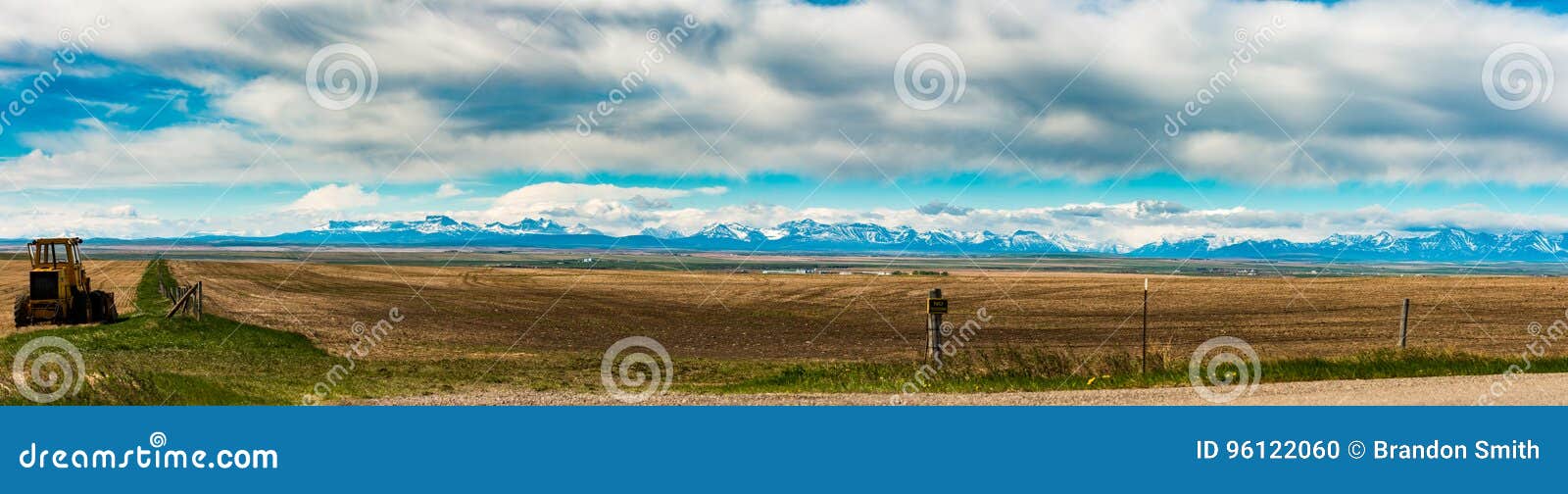
The Hand Hills are the second-highest range of hills on the Canadian Prairies. Their highest point is known locally as “Mother’s Mountain,” but you won’t find this name anywhere on Google Earth or Maps. To get to the top of this “mountain” you have to cross some private farm land, but if you get there, the sight from the top is quite incredible. The land drops away sharply to the prairie-land, not flat as some would imagine, but rolling away to the west. In the middle distance, the dark shadow of the valley of the Red Deer River cuts across the landscape. In the far distance, the land rolls away westward towards the Rocky Mountains.

Here’s the thing: on a clear day, you can see the top of the Rockies from Mother’s Mountain. The front range is about 200 km away, and you are only seeing the crest of the Rockies. (Clear evidence of the curvature of the earth, but that’s another topic for another day.)

Today, you can travel from the Hand Hills to the Rockies in less than 3 hours. The roads are mostly good, and most of the trip takes you through well-inhabited territory: farmland, ranch land, and urban areas eventually give way to the foothills and the “shining mountains.”

The first European to see the Canadian Rocky Mountains from the prairies was Anthony Henday, who entered what is now the province of Alberta in September 1754. Henday is now memorialized by the ring road around the city of Edmonton, and by a residence at the University of Alberta. His journey across central Alberta to somewhere west of modern Red Deer took him several weeks, as he negotiated the open terrain, and had difficult times with the Cree and Blackfoot people of the land.

A journey today from Mother’s Mountain to the Rockies won’t take you several weeks, as Henday’s journey did. But it will have some very interesting aspects.

From the top of the Hand Hills, the Rockies may be in view, but as you head towards them, they quickly disappear. It will be over an hour before you see them again. All you have is the memory of your destination. In between you have had to cross at least one deep valley, and often you won’t have been able to see more than a few km ahead. The land is crossed by hills and coulees, and it rolls in long waves.

There comes a point where our destination comes into view again. As we travel onward, the Rockies lie ahead, not always visible, but looming larger every time they reappear.

We get there eventually, but the journey has been full of interest in itself. We have seen broad rolling ranch land with scattered herds, valleys with rivers hidden at the bottom, urban areas with bustling people, farms with their carefully tended fields. Lots to see, lots to think about, lots to pass by as we travel on to the destination we have glimpsed from that high ground at our journey’s start.

Heading for a special destination is not just about the goal. Sometimes we lose sight of the goal. Sometimes we diverge from the path, attracted by something else. But the goal is always there, whether we see if or not.

Isn’t that what life is like?

Give this poem a rest?

What I am about to write will be seen by some as a “secular heresy.” I will no doubt outrage some of my readers, but please know that I am not trying to hurt anyone, simply to express my conflicted feelings, which I started to deal with in my previous post.

As a Christian with a theological training, I am well acquainted with the concept of heresy, which for most people means something akin to believing an untruth. The word comes from the Greek root meaning “to choose,” telling us that a heretic is someone who has chosen a different path from the so-called orthodox one.

The heresy I am proposing here is that we should give “In Flanders Fields” a decent funeral (or least an extended rest), and find another poem to read on November 11. John McCrae’s poem has been read at every Remembrance Day event I have ever attended. I have become used to hearing it read, often by a young person who has little connection to its roots, and even less understanding of the flow of the words. In particular, there should be no break between “we throw” and “the torch,” but because these usually lie on separate lines, the young readers break at the line change. If you’re going to read a poem in public, you could at least take pains to make sure that the language makes sense.

But that’s not my real point, and that’s not the heresy. My heresy (if you’ll allow the word in this context) is that I believe it’s time to stop reading this poem on this day. It has had its time. It has run its course. Its message is no longer appropriate for our times.

There are three verses in the poem. I have no argument with the first two, which are an elegy for those who have died in the course of war. As my previous post (I hope!) made clear, I have good reason to resonate with that sentiment. But then comes the third verse…

The elegiac tone gives way to the call to those who remain to “take up our quarrel with the foe.” The words were written in 1915, in the relatively early years of WWI, and the war may have seemed a good thing to pursue. The years to come would see the massive slaughters in the Somme, at Passchendaele, at many other places where so many people would die. For what? Who were the villains in this battle? WWI was fought for little reason, but it indelibly changed the face of Europe and much of the rest of the world. The armistice on 1918 ended the fighting, but the following years were times of huge upheaval and suffering in many places. It is safe to say that WWII, when civilians died in unprecedented numbers, was a direct consequence of the unresolved issues created by the first great war.

Back to the poem. Is it appropriate to reiterate a call to arms 114 years after it was written? To be sure, it reminds us of the reason for the deaths of the soldiers it recalls. But now we are in a different age, with a different set of issues, and a different sense of what must be done. The foes of 1915 have not been our foes for the past seventy or more years. They are our allies, co-creators of a future far different from what Col. McCrae could have imagined when he put pen to paper.

If we are going to remember the dead of past wars, as indeed we should, I would hope it would not be to remember in anger, and to continue the quarrel with the foes of yesteryear. I would rather hope that we could remember the dead both with sorrow and with the hope that the world of the future will be a world of peace.

Peace? I hold firm to the hope for peace on earth. But I struggle with the knowledge that the years since V-J Day in 1945 have rarely been blessed with peace. If anything, things seem to be getting worse.

When we gather on November 11 to remember those who gave their lives in the wars of the past century, I hope and pray that we may do so in the spirit of helping God to build that peace which is God’s desire for all people.

Can we still sound a call to arms? Or should we give “In Flanders Fields” a rest? What might we use instead? What poem expresses a call to build peace? The searing poetry of Wilfred Owen might be a place to start. Here is one of his most powerful poems, “The Parable of the Young Man and the Old,” a modern re-imagining of the story found in Genesis 22:1-14.

So Abram rose, and clave the wood, and went,
And took the fire with him, and a knife.
And as they sojourned, both of them together,
Isaac the first-born spake, and said, My Father,
Behold the preparations, fire and iron,
But where the lamb for this burnt-offering?
Then Abram bound the youth with belts and straps,
And builded parapets the trenches there,
And stretched forth the knife to slay his son.
When lo! an angel called him out of heaven,
Saying, Lay not thy hand upon the lad,
Neither do anything to him. Behold,
A ram, caught in a thicket by its horns;
Offer the Ram of Pride instead of him.
But the old man would not so, but slew his son,
And half the seed of Europe, one by one.

I read this poem once in a church service on the Sunday before Remembrance Day. I can still hear the collective gasp from the congregation as I read the last two lines. I have no regrets, but rather I continue to believe we should gasp at the horror of the inhumanity of war.

Remembering…

I was recently invited to take services at another parish on Nov. 10. For those of you outside Canada, this is the Sunday right before Remembrance Day, Nov. 11. It’s a major secular observance, recognized differently in various parts of our country, but nonetheless a significant annual event. As it happens, I won’t be taking these services, but that doesn’t change my feelings about the day.

The date goes back 101 years, to the declaring of the Armistice that ended World War I. It was known as Armistice Day for some years. After WWII, the new name was necessary, because the Nov. 11, 1918 Armistice was no longer the date when peace came to the world. The second world war had put paid to that notion, in spades.

The day became particularly known for remembering the “ultimate sacrifice” paid by men (and women) who had given their lives in the two wars. I will never disparage what that may mean to anyone. As I will relate later, one war death touched my family very greatly. What I have long felt about the day is that it tends to look backward, mourning what was, rather than looking forward, seeking to build the peaceable society for which our war dead died.

Why do people wage war? It seems to me that warfare and the things that make for warfare are signs of our fallen nature. I believe that God intended that people would live in peace and harmony. War is a sign that humankind has failed to live up to God’s wishes for creation. We arm ourselves against enemies, not because God desires it, but because we and our enemies have failed to live as we ought. War may sometimes be necessary, because evil sometimes seems to get the upper hand. But war is only a way of stemming the tide of evil, not of building the peace which is God’s plan for all humankind.

William Boyd Jack, M.C.

My grandfather went to war in the early years of WWI, a medical officer attached to the Royal Leicester Regiment. He was known for his good humor and his ability to bring hope to every situation. About six weeks before the 1918 Armistice, he went forward to help rescue a wounded soldier. He and another man were pinned down by machine gun fire, and he died in the field. For his heroism he was posthumously awarded the Military Cross. My grandmother wore the ribbon proudly for the rest of her life, but what a life that was! She was left with three young children, and one more born posthumously. She never remarried (which was a rare thing in those days, given the number of men who had had died in the war), and her children grew up with no father, overseen by uncles who tried to manage their lives.

The toll taken on our family is incalculable. My mother grew up with a horror of war and things military. After my father graduated from medical school in 1941, he did his duty, and enlisted in the army, going overseas while my mother was pregnant with my older sister. My mother lived the the rest of the war years in terror of being left alone as her own mother had been. I didn’t understand much of this until the sixties, when I was at university and the Viet Nam war was underway. I had been aware as a child that Remembrance Day was difficult in our house, but I had never realized why.

During the Viet Nam war, many draft-age men came to Canada from the US, because they could not or would not agree to fighting in that conflict. I learned around that time that my father had considered taking a medical position in the US when we were planning on emigrating from the UK. My mother told my father that if we had ended up in that country, she would have expected my brother and me to come to Canada. My father’s position, quite consistent with why he went overseas in 1942, was that he would have expected us to do our duty. It was not a happy time for them — or for me, once I realized what the story was.

I was involved in the ’60’s student peace movement. I became used to being attacked for being a Communist, a pacifist weakling, an enemy of our people. I reject all of those: what I am and what I remain is a follower of Jesus of Nazareth, the Prince of Peace. In the ensuing half-century, I haven’t changed my position in any material way. I still believe that peace is what God intends for God’s people. I still believe that peace is built through people acting peaceably, not in anger. I still believe that war, however necessary it may seem at times, is not part of God’s wishes for us.

We rightly remember on November 11. Many sacrifices were made in the wars of the last century, and we have much for which to give thanks in that regard. Nonetheless, this giving of thanks is done is sadness, remembering the loss of so much human life, the disordering of so many families, and the waste laid to so much human accomplishment.

When we remember on November 11, let it be with a ever-new commitment to building a society in which God’s peace is real and visible in all things.

We remember best by working for peace.

Thanks be to God for those who died to make this world a better place. We owe a great debt to them.

Thanks be to God for those who continue to work to keep that hope alive. Our children will be in their debt.

Old habits…

Six years into retirement, one might think that I had lost many of the habits of the full-time cleric. Last weekend proved me wrong. While holidaying, we took the time to attend church on Sunday morning. It was a lovely little church in a charming setting, with a small but friendly congregation. So far, so good!

I was puzzled to see that the liturgy as mapped out in the bulletin that day was to be a mash-up of two different rites. Trying to please everyone? Who knows, because what happened was a reasonably straightforward use of a single rite. The priest (who I assumed had put together the day’s liturgy) blithely ignored most of what was printed in the bulletin.

Without going into a lot of detail, let’s just say that I was disappointed in the service. My spouse heard me sigh several times during the long rambling sermon. The liturgy stopped and started several times, while the celebrant appeared to be either trying to find his place or deciding what to do next.  My “trainer mode” clicked into full ON, unasked and unwanted but apparently unavoidable.

I meant this post not to criticize someone else’s work (he might just have been having a bad day), but rather to reflect on my reaction to it. Being critical this way doesn’t help the experience of worshiping, but it seems that it doesn’t take much for my critic persona to emerge. When I was in full-time ministry, it served me in good stead at times, because I was the usual object of my own criticism.

At a course on clergy self-care some years ago, the leader told us that clergy need to find their own means for spiritual feeding. The traditional triad of prayer, bible reading, and worship work well for lay-people as spiritual disciplines, but less so for clergy, because they are too closely tied to our professional lives. Since retiring, I have spent most Sundays in the choir rather than pulpit and altar. In that time, I have found it increasingly easy to worship wholeheartedly in our parish church. Even so, at times I find myself worrying about liturgical details that are Not My Problem. Also, other people’s sermons can at times trigger “trainer mode”.

Those things came back in spades last Sunday. I am left wondering: will the “professional preacher and presider” in me ever go away? will I ever really be able to relax and just participate in a service of worship in the spirit in which it is offered? We’ll see.

In the meantime, even after six years out of the saddle, I know that I haven’t quite let go of the priest-persona. The other question is, of course, whether I want to do that. But that’s a question for another day.

Safe, legal, and rare

Much internet bandwidth has been taken up over the last few days on the matter of abortion, after some legislative initiatives in a couple of states in the USA. It’s a fraught issue, no matter on which side of the divide you find yourself. Do I dare wade into the issue? I have a feeling that whatever position I take, I risk losing the affection of some friends.

Nonetheless…

When abortion first became legal in Canada, my father was deeply distressed. He was a dedicated doctor and committed Christian, regarding abortion as murder. He could not at first reconcile himself to its legality in this country. A few years later, somewhat against his wishes, he found himself as a member of the local “Therapeutic Abortion Committee” charged with reviewing abortion requests, as was then required in Canada.

His time on that committee changed his position dramatically. He told me that he had never before really encountered women seeking to terminate pregnancies, but now he was required to hear their stories first-hand. What he learned was that in almost of all the cases they considered, the “applicants” had no good choices. Desperation was the rule, and if they could not get a legal abortion, many women intended to procure one by any other available means.

In other words, these abortions were going to happen, whether my father liked it or not. If the committee did not approve a request, the procedure would likely happen in unsafe and illegal circumstances, putting the mother’s life at dire risk.

This was in the 1970’s. Unsafe and illegal abortions had been happening for centuries (millennia?) before that. Untold numbers of women had died seeking to assert some control over their lives and what was happening in their bodies. The new legislation in Canada sought to make abortion safe and legal, reducing the death toll. Surely that was a good thing.

But (again) nonetheless…

Whatever the legislators of the world may decree, women will continue to assert their right to reproductive choice. The decision whether or not to terminate a pregnancy should be up to the woman in question — and to no-one else.

Every abortion is in some way the ending of a life, however we understand it. No abortion is a good thing, but it well may be the least bad outcome of a bad situation.

I believe that abortions should be safe and legal, and that women have the right to choose when and if they will bear a child. I also believe that abortions should be rare.

Current moves to re-criminalize abortion focus only on the act. In economic terms, they are supply-driven. The thinking seems to be that if you cut off the supply of the service, the act will disappear. History and human experience such as my father’s tell us that this is a vain hope. Sending an Alabama doctor to jail for 99 years will never eliminate the desperate need experienced by many women.

Speaking again in economic terms, to make abortions rare, we should address the demand. What kinds of situations lead to women needing to terminate pregnancies? Incest and rape have been widely adverted to as particular circumstances, but they are in fact the exceptions. There are many others: poverty, domestic violence, illness, unemployment, lack of appropriate housing — all of these factors and others contribute to the demand for abortion.

To make abortion rare, we must build a society in which every child is wanted, every child is cared for, every child is safe in his or her home, every child has an equal prospect of growing up in peace and happiness.

Banning abortion will do none of this.

To be truly “pro-life” means to me to promote quality of life for everyone. To be truly “pro-choice” means to me to give the possibility of a real choice for a decent life for everyone. I can see no real conflict between these two positions.

Abortion should be safe.
Abortion should be legal.
Abortion should be rare.

As a man, I relinquish all supposed authority over what choices any woman may make about her sexual and reproductive choices. That’s not my right.

Here I stand.
I can do no other.

The clay and the potter

In the fall of 2008 I was going through a vocational crisis. One of the ways I used to deal with it was to go on an week-long solitary retreat. I booked time at a retreat center that offered a hermitage, and began preparing myself. I got a lot of advice from friends about how to spend my time, some of it helpful, some not so much, but all were well-meant.

Perhaps the best advice I was given was from a friend who just handed me a book, with the words “I think you might find this helpful.” Truer words were never spoken. The book was “Let Your Life Speak,” by Parker J. Palmer. Over my time on retreat, I read and re-read this little book, devouring and meditating on every word. I wrote to Parker afterwards, thanking him for the book, and telling him that it might just have saved my life — at least in the vocational sense!

More than ten years have passed. The crisis came and went over the ensuing year or so, and in due time I retired. Retirement poses its own vocational issues, some of which I have written about previously on this blog. I have come to a place where I seem to have things more or less in place for a decently comfortable and engaging retirement. I like to tell people that “I am as busy as I want to be,” adding that sometimes I really don’t want to be busy. That’s really quite OK — for the most part I find myself content with life as it is now.

I decided recently to re-read Palmer’s book on vocation, for reasons that are not immediately apparent to me. I’m reading it slowly this time, perhaps because there’s not such a sense of crisis, and I’m finding things I either didn’t notice then or had forgotten. This morning this passage struck me:

Making pottery … involves more than telling the clay what to become. The clay presses back on the potter’s hand, telling her what it can and cannot do–and if she fails to listen, the outcome will be both frail and ungainly.

Let Your Life Speak, p. 16
48313072 – pottery.

The point he’s making here has to do with vocation being more a response to our true inborn nature than to an external call. If we are clay, we are called to be as “clayish” as we can be. What struck me today was the role of the potter, allowing the clay to live into its true nature, working with what is available, and not cursing the clay for not being something else.

I’ve been on both sides of the table in dealing with vocational issues. I’ve wrestled with my own sense of calling, and I’ve walked with others in the same process. I recall one young man seeking ordination who responded to the question “Why do you want to be a priest?” by saying “Everyone says I should be.” Well and good–he had great gifts. But he was unable to say with any clarity how he experienced this supposed call in terms of his own self-perception. When we asked him “What else could you do?” he came to life, describing some of the academic work he had been doing, and the possibility of a doctoral dissertation coming out of it. It was very clear where his “clayness” lay. As the potter in this situation, my colleagues and I had to try to point the candidate towards his true being, and to encourage him to live into it.

I have worked with more than one superior who had very clear ideas about what constituted a good subordinate. I found these relationships difficult, because sometimes I found myself devalued for not quite being what they wanted, and also for having gifts that they did not seem to value. To use the clay metaphor, I sometimes felt like a piece of wood that refused to become a pot.

As a retired priest, I am less accountable for my time and work than before. Even so, I hold my current license as an honorary assistant at the pleasure of both the parish Rector and my Bishop. There is more freedom in this situation to live into my own unique clayness than I experienced when in stipendiary ministry. I wish for all my colleagues in ministry, as well as for all people dealing with vocational questions, that they may find similar freedom in their life and work.