This article was first published in 1998 in the newsletter of Edmonton’s Richard Eaton Singers, with whom I sang from 1988 to 2002. I am reviving it in response to a conversation with a friend about Messiah, and its place in contemporary traditions, particularly as a fixture of the Christmas season.
 Although by far the best-known of Handel’s (or anyone’s) oratorios, Messiah is not typical of the form. Most of his other oratorios are more like operas, with dramatic scenes, and characters portrayed by soloists. The choir often takes a lesser role, in some cases substituting for the action of a fully staged opera. (Mendelsohn’s Elijah is a good example of this type of work.) Israel in Egypt, almost without solos, was Handel’s other notable departure from the norm—and it was unsuccessful in his time.
Messiah is different. Apart from the “angel” scene (from the “Pastoral Symphony” through “Glory to God”), there is neither character nor action. In the libretto he put together for Handel, Charles Jennings drew on Biblical texts reflecting on the life, death, and resurrection of Jesus of Nazareth, known as the Christ or the Messiah. (The two titles are the Greek and Hebrew words meaning “anointed one.”)
If there is no dramatic development in its layout, what then is the organizing idea behind its structure? In the middle of a performance of the work, it occurred to me that Jennings’ choice of texts has close parallels to the Nicene Creed. It draws our attention to the whole of the Creed’s second article and part of the third. On reflection, this should be no surprise: the Creed is simply a summary of the Christian faith, and Messiah aims to depict and reflect musically upon the “kernel” of that faith, particularly with respect to the person and work of Jesus.
Each of the Creed’s three articles corresponds to one of the three persons of the Trinity. The first expresses faith in the one God, the creator of all. While this belief of course underlies the entire work, Messiah makes no specific reference to it. The second article deals with Jesus, telling of his birth AND making theological statements about his divine and human nature, his death by crucifixion, and his resurrection. It ends with an expression of faith in his return to judge “the living and the dead.” The first two sections of Messiah deal with Jesus’ birth, his passion and resurrection, ending with “Hallelujah,” whose text exalts the eternal Lordship of Jesus the Messiah, closely paralleling the credal statement.
The theological heart of the Creed is the proclamation “on the third day he rose again.” (Lat. et resurrexit tertia die). Mass settings typically make much of this text. For example, a critical turning-point in Bach’s B-Minor Mass is the joyful outburst of “Et resurrexit” after the darkness and grief of the “Crucifixus.”
Although not perhaps presenting it as vividly as does Bach, Handel gives us a similar turning-point at the tenor solo “But thou didst not leave His soul in hell.” The oratorio’s first reference to the resurrection, this aria brings relief and lightness after the stress and drama of the passion section, breaking in on the somber recitative “He was cut off out of the land of the living.” The change of mood is immediate and notable, and the sense of joy increases as the section progresses. Even the somewhat stern selections from Psalm 2 (“Why do the nations,” “Let us break their bonds,” and “Thou shalt break them”) are properly seen as expressing thanks and praise in anticipation of God’s victory. “Hallelujah” is a fitting response to these pieces, releasing the tension in a way that does full justice to the Creed’s affirmation “He shall come again in glory to judge both the living and the dead.”
The third article of the Creed speaks of the Holy Spirit and the church, ending with the assertion of hope in the “life of the world to come.” (Lat. et vitam venturi saeculi. Amen, set especially dramatically in Beethoven’s Missa Solemnis) Rarely performed in its entirety, Messiah’s third section is an extended meditation on the promise of resurrection through Jesus Christ. The link to the Creed’s closing affirmation is clear. For Part III Jennings drew heavily on 1 Corinthians 15, arguably the New Testament’s most important statement about the hope of the resurrection.
The final chorus “Worthy is the Lamb … Amen.” sums up the promise of the first section, the drama of the second, and the hope of the third.
In Messiah, Handel and his librettist have brought theology and music together in an unparalleled and happy union.
 Some of my high school colleagues were “rushed” by fraternities at U. of A. Not wanting to be left out, I went with them to a couple of rush parties, and experienced something close to outright disdain, as in “Who the heck are you, and what are you doing here?” It wasn’t a lot of fun. Some of my friends ended up as frat members, and for a while I was deeply envious. Until…
 Which brings me to this past couple of weeks, watching the spectacle of the confirmation hearings for Brett Kavanaugh, now sworn in as a Justice of the Supreme Court of the USA. The process made me glad that I live in Canada, where the judiciary is far less politicized than in the U.S. The way the process worked out both astonished and appalled me: the duplicity evinced by partisans on both sides was almost beyond belief. But what struck me more than anything else was the attitude displayed by the nominee. He’s a frat boy, I realized. And in some ways that says it all. He is there because he’s entitled to be there, whether or not he has abused other people on the way to where he has arrived. For the record, I believe Dr. Christine Blasey Ford’s testimony to the Senate committee.
 Today I encountered a number which for me is very interesting, the number 70. What’s interesting about it? Only that age 70 sounds to me a lot older than age 69. Maybe it’s the change in the first digit, something that’s only happened to me 6 times before. Age is a physical reality, but it’s also a mental and emotional reality.
 I’ve now been retired for about 5 years (Since June 23 or July 31, 2013, depending on how you reckon it.) I’ve enjoyed most of those years, especially the last two or three. It’s good to be free to make your own decisions about what to do with your time, without too many occupational restrictions. I had some plans when I retired. Some have borne fruit, others have been deferred, still others have been put away permanently, and some new things have arisen. I’m not making many new plans at the moment, except for our 50th wedding anniversary celebrations in just over a year.
 Queen Elizabeth II is a remarkable woman, a person for whom I have great respect. She has negotiated the demands of a more-or-less impossible job with grace, dignity, and resolution. She will be greatly mourned by many, including this writer, when she dies.
 I congratulate Prince Harry and Meghan. Love has brought them together, and I pray that love will see them through the years ahead. It will probably not be easy for either of them, especially her, although she does seem to have her eyes wide open.
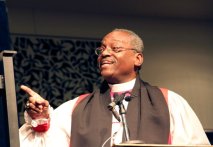 Bishop (no, Brother!) Michael preached the Gospel. He reminded us that love IS the answer, and that “If it’s not about love, it’s not about God.” He asked us to imagine a world where love rules. He mostly didn’t address the marriage couple directly, which some friends of mine have criticized, but his attention was very clearly on them at most times. What this implied to me was that their marriage was to be evidence of the love by which God created the world, by which God redeemed the world, and by which God continues to renew the world. I don’t think they are stupid people: I believe they got the point!
 t belie the goals with which we have been charged. We fail because we are human, but our failures are inevitably held up against the strong light of divine ideals. There’s nothing wrong, and everything right, about those ideals. Nonetheless, we should temper our expectations with the knowledge that people can and do fail.

 Tomorrow is the 4th anniversary of my retirement. I left my last parish on June 23, 2013, taking 5 weeks of accumulated vacation time before the mandated date: the first day of the month following one’s 65th birthday. So, August 1 is the date I left the employ of the church and began collecting the various pensions that continue to support me and my wife. Four years have gone by remarkably quickly, although as I look back, the first one seemed very long. I wasn’t really ready to quit, plus I had some “unfinished business.” Some time into the second year, I realized I had finally let go of the stuff that had been occupying my mind, and I was able to relax and enjoy my freedom.