Surprise!

Notes for a sermon preached at the Great Vigil of Easter, April 19, 2014, at Holy Trinity Anglican Church, Edmonton.

Texts: Matthew 28:1-10; Romans 6:3-11; Exodus 14:10-31, 15:20-21 
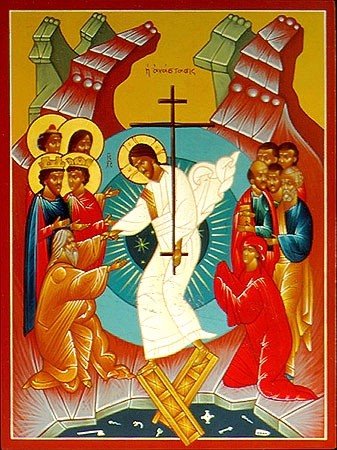

Resurrection Icon

When Fr. Chris asked me if I would preach at this service, I hardly waited a heartbeat before saying “Yes.” In my previous position in a different diocese I always had to relinquish the pulpit to the Bishop on major festivals, so it has been some years since I last preached at a main Easter service. Nonetheless, as I was preparing this sermon, I was reminded of the advice to be careful what you ask for, because you just might get it!

Major festivals can be major problems for preachers. Both Christmas and Easter pose the challenge of bringing something fresh to stories which “everyone knows.” There’s nothing very surprising for most church-goers in hearing the Easter Gospel.

Or is there? Can there be? I believe so…

I was once asked to help some people deal with a difficult situation. They had been close friends for many years, but the relationship was now under severe strain. In the course of a long conversation, one of them turned to another and said “I know our old friendship is dead, but I am hoping there may be a resurrection,” and started to muse about what that might look like. My heart instantly said, “Yes!” and I was about to jump in and start addressing that possibility—but something stopped me short. Instead of affirming that hope aloud, I said “Just a second. Let’s back up a bit.” Why? Because my head then told me was that resurrection is never, and can never be, something of our devising, but is rather an act of God. It is not up to us to tell God what God should do (and then be cheesed off at God when God doesn’t come through), but rather to give God space to let God do what God will do.

What is the space into which God can bring resurrection? In one word: death. We cannot fully comprehend resurrection unless we have fully grappled with the reality of death. There is no Resurrection without Crucifixion. There is no empty tomb without an occupied tomb. As the Apostles’ Creed says,

He descended to the dead.

Three times Jesus’ disciples had heard him foretell his passion and death, and then say “on the third day rise again,” but it seems very clear to me from the various accounts of the resurrection that what actually happened came as a total surprise. The women in today’s Gospel reading were not going there to wait for Jesus to rise again, but simply to “see the tomb.” It was an act of mourning and grief that led them there in the pre-dawn greyness. They had seen their Lord die on the cross. They had seen his body lain in the tomb. They had kept the Sabbath, and they returned to their graveside vigil as soon as it was possible to do so.

They went in grief, in full knowledge of the actual death of their master. What happened at the tomb is shrouded in mystery: the four Gospel writers all tell the story a bit differently, as they strive to bear witness to a unique event. What happened at the tomb was unlike anything anyone had seen before, or has seen since, so it should is hardly surprising that the four stories differ. Police today will tell you that eye-witness testimony is highly unreliable, even when reporting something as commonplace as a motor vehicle accident. There is nothing commonplace about the Resurrection!

In this one great act, God reached into our human history and reset everything. What humankind had accepted as normal and expected as our due—the eternal nature of death—suddenly becomes not so! The Resurrection makes everything new for all humanity, with the promise of a new creation, a new way of living, a whole new reason for being.

It is always and eternally new—even if the story is 2,000 years old! It says that what was is now over—including and especially the ultimate rule of death. As Paul wrote:

We know that Christ, being raised from the dead, will never die again; death no longer has dominion over him.

It is so tempting to leapfrog the tough stuff: the Gethsemanes and Calvarys and silent tombs of our lives, and get immediately to the bright daylight of Easter. However, if we truly wish to enter the light, and to experience it for what it really is, we must first embrace the darkness. Barbara Brown Taylor, the noted Episcopalian teacher, preacher, and author, has recently published a book called “Learning to Walk in the Dark,” which I intend to read very soon.

In an interview about the book, she said this.

The great hope in the Christian message is not that you will be rescued from the dark but if you are able to trust God all the way into the dark, you may be surprised. [1]

I believe that my friends who hoped for a resurrection of their friendship needed first to trust that God was with them in the darkness of the loss of that friendship—and then God could surprise them with what the truly new looked like.

Two young people come for baptism on this holy night. The waters of baptism are a sign of cleansing and rebirth, to be sure, but before that they remind us of danger and death, like the waters of the sea that overwhelmed Pharaoh’s armies. Amazingly, almost beyond surprise, the people of Israel found themselves on the farther shore, set forth into their new life as God’s chosen people. The risen life—the life of the baptized—is a holy life of wholly unexpected surprises. Let us pray that God will part the waters for these two, leading them into a life of seeking not their wishes but God’s.

Let our alleluia’s tonight and in the days to come be shouted with joy and thanksgiving—and with a renewed sense of surprise and wonder at how God has made all things new.

Alleluia! Christ is risen!
The Lord is risen indeed. Alleluia!

[1] http://jonathanmerritt.religionnews.com/2014/04/14/barbara-brown-taylor-encourages-christians-embrace-darkness/

Holy Week … rediscovered

daliFor many years, this week has been the most intense, the most emotional, and the most stressful time of the year. For clergy in Catholic tradition, the observance of Holy Week is at the same time the ultimate spiritual experience and professionally the most demanding few days one can imagine.

I used to be responsible for making sure that a whole week of services happened, from the “light into dark” of the Palm/Passion Sunday liturgy through the gathering darkness of the week to the blackness of Good Friday — and then to the new fire, and the glories of Easter Day. One of the secrets of clergy life is that Holy Week is never complete until the priest has completed the final act — the liturgy of the Holy Face Plant!

I rejoiced to be a part of this for many years, even as it was so exhausting physically, but spiritually fulfilling.

This year is different. I am not responsible for anything except for a few assigned roles. The pressure is off! That’s a good thing, to some extent. Except… I am feeling this lack of pressure rather keenly. Holy Week seems a little emptier this year, and I have to realize that this will be the case in the future. This year, for the first time in a quarter-century, I skipped the Maundy Thursday service in favour of family commitments. I am happy to be with my family, but I look at posts of pictures from services, and I know what I am missing.

Professional or vocational responsibilities are one thing. My spiritual life is another. The years ahead will help me find a new balance, when the one that is now so much less has probably outweighed the other in the years past.

I will be part of the rest of the paschal liturgies: Good Friday, the Great Vigil of Easter, and the glories of Easter Sunday. That will be good!

10 Things Pastors Hate To Admit Publicly

As a retired pastor who has had a lot of opportunity to reflect on the experience of being in parish ministry, I say a loud “Amen!” to this. The truth is that many clergy live out these things every day. Thanks to Pastor Matt for this.

Matt Boswell's avatarThe Everyday Missionary

MB Posts When Ellen and I were first married ministry was not our 20-year plan, the Navy was. We had it all planned out; we were to spend the next 20 years with me being gone for 15. The Navy explained to my sweet new bride how grueling it would be, that I would be gone often and that even when I was around my mind would be elsewhere. Knowing that my particular career path in the Navy would be a marriage destroyer I pursued a discharge for the pursuit of higher education. With the promise of a difficult future behind us we embarked upon an easier dream where everyone would love us and things would be calm: pastoral service.

Twenty plus years later I can tell you it has been a ride we never could have anticipated. So much so that only now do I feel equipped enough to share a…

View original post 1,944 more words

Respect, part 2

The primary goal of this blog has been to reflect on the experience of retirement. Some recent posts may have seemed to go off on tangents, but they were really about things that have grabbed this (retired) priest’s attention. When I was in full-time parish ministry, things that attracted my attention as a person tended to get noticed in my preaching. To be honest, I enjoyed having regular access to a pulpit from which to address matters that seemed to be to be important. There’s always some tension in the practice of preaching. There’s a constant challenge to the preacher to be fully engaged with the congregation, the text, and the world around, while at the same time refraining from being too personal in viewpoint. As a former colleague once said, “If my parish knew my real political and theological views, they’d run me out of town.”

But on with the topic of respect…

In my previous post (Respect, part 1), I offered some reflections on respect in the context of the residential schools issue, and the hearing of the Truth and Reconciliation Commission. As I was writing, I began recalling times in my ministry when I felt that I was not being treated with respect — and also times when I did not treat others respectfully. I have already blogged about one of themand I don’t feel any need for further comment on that event.

There’s no need to rehearse old hurts, especially when some of them go back 25 years or more. I have striven to forgive people who have hurt me, and have sought to seek forgiveness for hurts I have inflicted. The past is past: let it be. As it has been said,

Forgiveness is giving up all hope for a better past.

We can’t change the past, but we can learn from it. One of the things I have learned in parish ministry is that parishioners don’t all deal with clergy in the same way. Some see clergy as “the help,” there to do the parish’s bidding, endlessly available to do whatever people ask. At the other pole are the people who put clergy on a pedestal, deferring to them as holy people with hotline to heaven. Neither position is truly respectful, seeing the cleric only in terms of the office, without really seeing the person in that office.

Clergy who are seen as hired hands become dispensable in their people’s eyes. When things aren’t going well — toss the chump! I’ve seen this happen to a number of colleagues. Everyone gets hurt, church and cleric alike, because the motivation is power, not love and respect.

Clergy on pedestals can only do one thing, and that’s fall off. We are human, and no human can ever fully live up to the exalted standard that others project on him or her. Clergy who allow themselves to be thus exalted are only setting themselves up for a fall. The fall can be long and hard. Again, I’ve seen this with some colleagues, some of whose egos and forceful personalities did not allow them to see that they could do any wrong.

Can we say that clergy who persist in either of these behaviour patterns respect neither their congregations nor themselves?

respect yourselfA healthy congregation-cleric relationship is based on mutual respect: valuing everyone’s gifts, acknowledging legitimate authority, accepting each other for who and what they are. The church’s prime message is one of love, God’s “steadfast love” (hesed) as in the  Hebrew Scriptures, agapé as in the New Testament. We do best by each other, both lay and clergy, when we live what we preach.


Respect, part 1

respectIn the Spirit which draws us into honest engagement with one another, including those who may be very different from us in various ways, God calls us to wake up and learn how to love and respect one another, period.

 I. Carter Heyward

I spent two days listening at the Alberta National Event of the Truth and Reconciliation Commission (TRC). It was hard. I heard a number stories much like those I had heard from various people I encountered in Brandon, but the cumulative effect of the hearings was overpowering. It’s taken me almost two weeks to begin to process what I heard there, along with reactions from the media and a number of people I have spoken to personally.

One word sticks in my mind from the TRC: “respect.” I heard it used many times in a variety of ways by people speaking to the Commission. It is clear to me that the Residential Schools were born out of a lack of respect for our aboriginal peoples, and also that those peoples continue to struggle in our society with a continuing lack of respect. It is also clear to me that many of the survivors have struggled throughout their lives to regain some measure of self-respect. Perhaps the most moving stories for me were accounts of how individuals won that victory.

As I listened to the speakers, the thought kept going through my head that “Children learn what they live.” (That’s the title of a 1972  poem by Dorothy Law Nolte. Read it here.) Regardless of how well-intentioned some of the people working in it may have been (as I have heard some argue), the residential school system as a whole taught its students that their way of life, their languages, their very beings, were substandard, even evil. Churches participated in it out of a belief that they were doing the Lord’s work. By the standards of the day, that position might have been defensible, but in today’s post-Christendom world, I cannot see that it can be defended with any integrity.

For many centuries, the church was aligned implicitly and explicitly with the rulers of this world (See a good blog piece about that subject here.) Our involvement with the residential schools was a direct consequence of the assumption that preaching the Gospel necessarily entailed converting people from “savage” ways to something like European civilization.

It is — or should be — a matter of shame that Christian churches participated in a system that treated human beings as people undeserving of respect. At the heart of the Gospel is the assertion that we are all created in God’s image, all children of the same Creator, all equally deserving of one another’s love. The second great commandment, as Jesus taught it is “You shall love your neighbour as yourself,” which begs the question “And who is my neighbour?”

Jesus answered it by telling the story of the Good SamaritanThe story pushes the boundaries of the idea of neighbour. To be a neighbour has less to do with where we live or how we are related than it does with the recognition that all other people are worthy of our love and compassion — our respect.

Treating aboriginal people without respect has stained our country with a legacy of racism, discrimination, and social and physical ills. It took many years for us to get to this place in our history, and it will take many years to find our way to a healthy and positive relationship between our various peoples, aboriginal and settler alike, a relationship based on realistic and hopeful mutual respect, as beloved children of the living God.

For what should we hope? Surely for the peace which Jesus came to give. So let us pray for that peace:

O God, it is your will to hold both heaven and earth in a single peace. Let the design of your great love shine on the waste of our wraths and sorrows, and give peace to your Church, peace among nations, peace in our homes, and peace in our hearts; through your Son Jesus Christ our Lord.

(Book of Alternative Services, p. 677)

A Most Wonderful Weekend!

I have spend most of this weekend doing one of the things that I love best — singing. I often tell people that I joined my first choir at age 7, and have missed only about 5 years of my life since then singing in some choir or other. At the moment, I am a member of two choirs, Vocal Alchemy and the choir of Holy Trinity Anglican Church, Edmonton. I have lost count of the choirs I have belonged to in the intervening years, but it really doesn’t matter. What does matter is: I sing!

There is a famous saying, probably originating in Orthodox Christianity, that the one who sing, prays twice. I believe that with all my heart. Singing, especially choral singing, demands everything of a person. It involves the body, the mind, the emotions, and the spirit. If one is truly singing, the whole person is involved. If one is singing in community (i.e. in a choir), it also extends the person beyond the individual to become truly a part of a community.

A choir director once said that we needed to be able to hear the person next to us. If we couldn’t hear that person, we were either singing too loud, or we  (or the other person!) were dead. That’s a good metaphor for community in any setting, but it works really well in a choir. No individual voice should be heard, rather one should hear the voice of the choir. A truly fine choir sounds like one voice, but also sounds like no voice in particular. A real community is dominated by no one person, but finds its voice when individuals join in chorus, hearing each other, and responding to each other. The individual is not lost, but is part of thwhole, contributing to the voice of the whole.

So: this weekend…
I spent it singing! Vocal Alchemy’s spring retreat was held yesterday. The morning was for the women, and my spouse went to take part in that. I joined back in for lunch, and then we spent the afternoon singing as a full choir. After an evening of relaxation, we headed off this morning for the morning events at Holy Trinity, which for us means choir practice at 9:30 AM, followed by the the 10:30 AM service of Holy Eucharist. We usually stay for coffee hour, but not today, because I had to  be at the Vocal Alchemy men’s workshop by 1 PM.

It was great afternoon. I sang in a men’s choir for 10 years in Brandon MB, and came to love making music with other men. Today reminded me of the great times I had with Prairie Blend. I am so grateful for that experience, and so grateful that I can continue to sing in other contexts.

I sing.
I pray.
I live.
I cannot easily distinguish between these three facts.

Thanks be to God for a wonderful weekend! May there be many others.

I am an Anglican

I am an Anglican. It’s a historical faith, born out of the strife of the 16th century, committed by that strife to reach out to all people, bringing them into the reach of the love of God. We follow Jesus of Nazareth, who embraced the whole world by his death on the cross, and redeemed all humanity by that ultimate act of love.

In my early years in the church, I learned to love its ways — liturgy, scripture, prayer and service. In my latter years, I have come to question its historical identification of the Gospel with a particular cultural and ethnic orientation. Even though my forebears in this church have made errors, I stand with those today whose commitment to a new and Christ-like way of being are calling this Communion into God’s future.

We are a Church that has been in constant Reformation for almost 600 years, as we have striven to open our doors to all people in the name of Christ. Sometimes that has been successful, sometimes not. Sometimes the work we have done has borne appropriate witness to our Lord, sometimes not.

We are human, and like all humanity can only seek to follow Jesus in all or humanity.

This a warts-and-all church. Thanks be to God.


Another year come and gone

Today is March 25, 2014. In the calendar of my church and many others, this is the Feast of the Annunciation, celebrating the story of the angel Gabriel’s appearance to Mary, telling her that she would bear the Son of God. It’s 9 months before Christmas, hence the date. At one time, Europe observed the day as New Year’s Day: e.g., March 24, 1213 was followed by March 24, 1214. In traditions that emphasize her, it’s a day of special devotion to the Blessed Virgin Mary.

annunciationIt’s a special anniversary for me. Twenty-six years ago, on a Friday evening at All Saints’ Cathedral, Edmonton, two colleagues and I were ordained to the priesthood. It was an eventful weekend. The very next day the Synod of the Diocese of Edmonton met to elect a bishop — Ken Genge, who retired in 1996. Sunday was Palm Sunday, a big day in church life in any year, and the occasion of my first celebration of the Holy Eucharist. On Monday, I celebrated my first Requiem Eucharist, a service delayed by a week so that I could preside at the kind of rite that the deceased had requested.

I remember much of that weekend with almost startling clarity. Other events in my years in ordained ministry may have faded into the muddled mists of my memory, but not those four days. Something special happened then. All these years later, I believe I can honestly say that my ministry bore fruit, sometimes in the way I had hoped — and sometimes God surprised me! There are things I regret, of course. (Can anyone truthfully say that all we have done was to the good?) Nonetheless, the tumult of those days in March 1988 stands for me as a sign of what the rest of my ministry was to become: busy, committed, mostly fruitful, and always striving to be faithful to the promises I made that night.

Will you respect and be guided by the pastoral direction and leadership of your bishop?

Will you be diligent in the reading and study of the holy scriptures, and in seeking the knowledge of such things as may make you a stronger and more able minister of Christ?

Will you endeavour so to minister the word of God and the sacraments of the new covenant, that the reconciling love of Christ may be known and received?

Will you undertake to be a faithful pastor to all whom you are called to serve, labouring together with them and with your fellow ministers to build up the family of God?

Will you do your best to pattern your life (and that of your family) in accordance with the teachings of Christ, so that you may be a wholesome example to your people?

Will you persevere in prayer, both in public and in private, asking God’s grace, both for yourself and for others, and offering all your labours to God, through the mediation of Jesus Christ, and in the sanctification of the Holy Spirit?

Today I recall those promises, reviewed so many times in the succeeding years, and give thanks that God has given me the grace to keep them to the best of my ability. At times it was very hard — and those are the times I recall as giving the greatest growth. As I reflect on this day, I find in it a deep connection of Mary’s call to a unique ministry to my own call to ministry. I am also reminded that ministry is grounded in human life, as Mary’s ministry was grounded in the totally human activity of giving birth to Jesus — the Word made Flesh.

Thanks be to God!

Set free, in a way

When I retired and moved to Edmonton, I brought with me a file of documents relating to a pending court case. It was very likely that I would be called to testify at any future trial. The Crown Prosecutor had advised me to retain the file, and to make sure that they knew where to find me. I have been watching the agonizingly-slow progress of the case ever since, anticipating that some time this year I would have to return in response to a subpoena. It’s been rather a lead weight on my spirit ever since.

Things changed this week. The Crown withdrew the charges, to give them time to do some ground-work that really should have happened last year. It is very likely that the charges will be reinstated at some time, but the details of that eventuality depend on many things. The effect for me is to put everything back by a year or so (frustrating — I’d really like this to be over!), but probably changing the nature of my relationship to the case. If the ground-work pans out as expected, the kind of evidence I might be asked to give will be quite different, and the testimony less onerous.

All this means that I can keep the file in my bottom drawer, and only take it out to read it when and if I am required to. In the meantime — let’s get on with life, for the near future without this burden!