Notes for a sermon preached at Holy Trinity Anglican Church (Strathcona), Edmonton, August 11, 2024. Text: John 6:35, 41-51
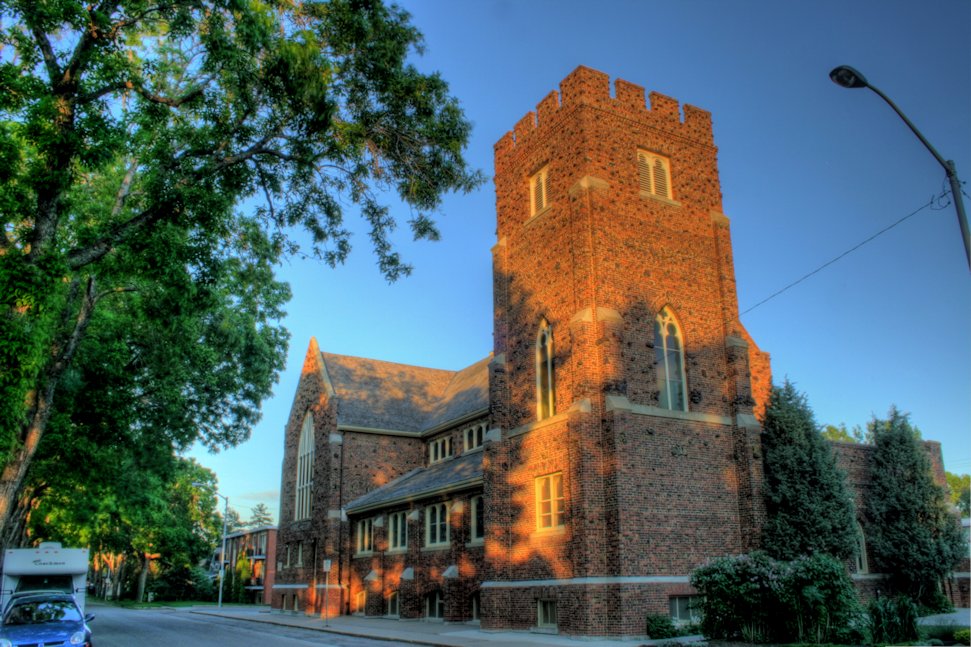
I invite you take a moment to look around this church, identifying some of the symbols around you, and perhaps considering what they stand for.
[Call for what people saw, and how they understand them.]
Symbols are important. We find them everywhere, ranging from the very commonplace to the profound.
Open a hymn book, and you find pages and pages of symbols, both musical notation and printed text. The hymns they represent come to life only when we sing them. There is no one right or wrong way to interpret these symbols, which depend on the readers’ and performers’ points of view and abilities.
You will very often see an important symbol at public buildings—the Canadian flag. The flag represents our country, but its function is to point to the realities of place and people. The flag’s meaning depends on the viewer’s point of view—how we understand and relate to our country, its land, its people, and its history.
There are many crosses around this building, all pointing to the story of salvation as we learn it from the Gospels. Once again, we understand the Cross in many and varied ways, none of which are the ultimate answer.
Symbols are like sign posts by the road, pointing away from themselves to something else. But some symbols are more than that—they not only point to, but also embody the reality of the thing they are pointing to. In Church talk, we call these symbols “sacraments.”
We are gathered here today to participate in what for many is the central symbol of Christian life. We are here to celebrate the Eucharist, the sacrament in which believers share in the body and blood of our crucified saviour. We are here to partake of the Bread of Life, the very being of Jesus.
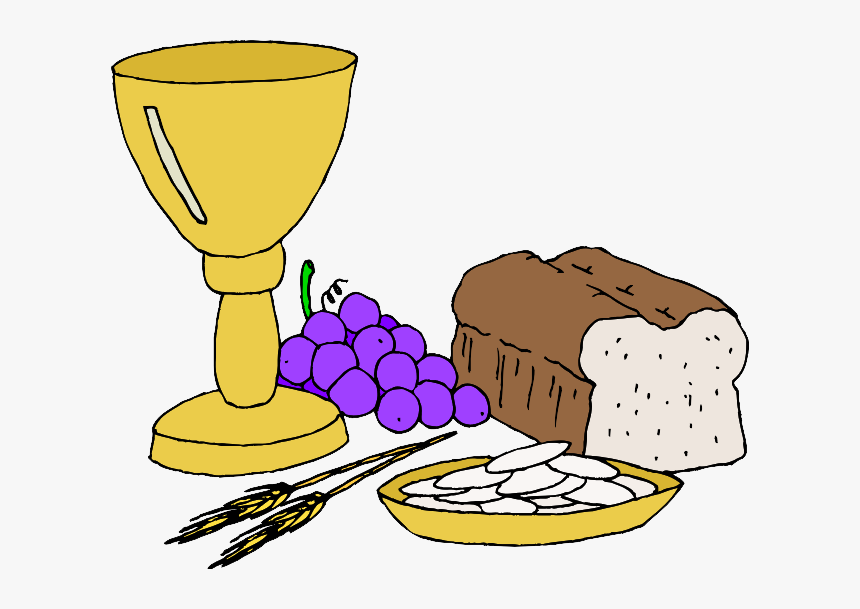
The language we hear throughout Chapter 6 of John’s Gospel, the so-called “Bread of Life Discourse,” is very clearly symbolic. Jesus is not bread in the ordinary sense. He does not give his physical body at every Eucharistic celebration, but what we share in this symbolic act, from the opening greeting to the dismissal, is the fullness of his life, the essence of the Holy, his loving sacrifice on the cross, and the glory of his Resurrection.
What we share at the altar is a bit of bread and a sip of wine, but it is far more than that to those who see with the eyes of the spirit. I can’t pretend to know what motivates anyone to come forward for Communion—the reasons are as many as there are recipients. But what I believe deeply is that the Holy Spirit draws every one of us to this place, enlivens our hearts and our minds and our spirits with the written and spoken word, and leads us to partake of the bread and wine of the Eucharist.
What we do is symbolic, but the reality behind it is far more than our rituals. The reality is that Jesus is truly present among us, giving of his very self, the Bread of [Eternal] Life.
John’s account of the Last Supper does not have an institution narrative like the other three, focusing instead of Jesus washing his disciples’ feet, given as one of the signs of participation in Jesus’ work in this world. Taking the place of an institution story we have the Bread of Life Discourse, an extended narrative on the meaning of bread as both physical and spiritual food. The language of feeding of the 5,000 is clearly Eucharistic: Jesus took the bread, gave thanks, broke it, and gave it—what Gregory Dix called the “four movements of the Eucharist.” The rest of the chapter is an extended reflection in a series of dialogues on the meaning of the bread, centering on the great claim we heard twice in today’s Gospel lesson: “I AM the Bread of Life.”
Unlike Matthew, Mark, and Luke, John’s Gospel has no parables. Instead, we find extended discourses and narratives which expand upon encounters with individuals or groups. In many of these, Jesus uses spiritual and symbolic language, and the hearer interprets it literally, not symbolically. In Chapter 3 Nicodemus responds to Jesus’ call to be born again with the question as whether a person can return to their mother’s womb. In Chapter 4 the Samaritan woman at the well responds to Jesus’ offer of living water with a declaration of simple thirst. And in John 6, Jesus’ assertion about bread and his identity is met with similar misunderstanding.
John’s Gospel probably took shape over at least 50 years. It contains some very early material alongside the results of extended reflection on the life of the Church, and how it seeks to live into being the Body of Christ. What we hear in John 6 is one of the prime examples. From early times, the Church’s life together centred on the Lord’s Supper, a symbolic and memorial act which must be taught to every succeeding generation of Christians.
The central assertion has always been that we do this in memory of Jesus, and that Jesus is truly present as we share in the sacrament. How that happens, how we do it, what rules we put on it, have been issues at least since the time of Paul, forty or so years before John’s Gospel was given its final form.
We come to the table as ordinary people. We share in something very simple. But if we come in faith, guided by the Spirit, what we are as we depart is something more than ordinary people who have shared a simple meal. I have long held that the most important point of the Eucharist is the dismissal, when the People of God, having gathered in faith, heard the Word proclaimed, and shared in the Bread of Life, are sent forth to be the Bread of Life for the world.
Gandhi said:
To a hungry [person], a piece of bread is the face of God.
May we go forth from this place today to show the face of God to all whom we meet, sharing the Bread of Life both physically and spiritually in the same love which Jesus showed to us on the cross.
Symbols? May we all be symbols of God’s love in the world. And more than that, may our presence with others be a sacrament, making God’s love more real in all that we do, all that we say, all that we are.
May it be so.
 Into the blue...