Abide in me

Notes for a sermon preached at Holy Trinity Anglican Church, Edmonton, April 28, 2024
Texts: John 15:1-11; 1 John 4:7-12 

I spent the summer of 1986 enrolled in Clinical Pastoral Education (C.P.E.) at the Royal Alexandra Hospital. C.P.E. is an intensive program of on-site practice, study, and group work, all under a trained supervisor. I learned a lot in those weeks, including that I was not well-suited to the job of hospital chaplain!

I spent much of my time in those 11 weeks on a long-term medical ward, where it was possible to develop relationships with some of the patients. On the other wards I was assigned, patients were typically only there for a few days. One patient was a man in late-stage cancer. He knew he was dying. During our visits, I came to see that he had accepted what his future held, and I was privileged to be an audience for some of his thoughts about his past life, both positive and negative. I experienced his hospital room as a place of great peace. He had one major regret: while he had come to terms with his prognosis, his wife had not. She was praying continually for his recovery, believing that Jesus would heal his affliction. I only met her once: she arrived during a visit, and told me to leave because I was not of the same faith. A few days later I learned from the staff that he had died. Not long after, I passed a nearby church, where I saw his wife prostrate over the steps, clearly in deep grief.

Why am I telling this story today?

The Gospels for the 5th, 6th and 7th Sundays of Easter are drawn from the Farewell Discourse of John’s Gospel, which runs from the end of the Last Supper in Chapter 13 through Chapters 14 – 17. It begins with Jesus giving the “New Commandment” – ‘Love one another’ – by which everyone will know that they are his disciples.

The commandment sets the tone for the rest of the discourse. The central issue is how the disciples are to live without Jesus physically present. Love is to be the rule of their lives, but they will not be on their own. Three times Jesus promises that he will send the Holy Spirit to be with them, to teach them and to be their guide. And three times he promises that he will give them whatever they ask for, if they “abide in [him],” or ask “in my name.” The repetition of these promises indicates just how important they are. The promise of the Spirit is a topic for another day: today we look at the second promise.

The promises in Chapters 14 & 16 refer to asking “in my name.” Quoting those verses out of context can make it sound like a kind of magic spell. Just say “Jesus” and you’ll get what you want! I have heard this kind of thinking from some very well-meaning people, who have said things like, “We didn’t get what we wanted. I guess we didn’t pray hard enough.” As we heard it, the promise in Chapter 15 uses the word “abide,” a word we don’t often hear in this sense in daily speech, but which is found repeatedly in the both the Gospel lection and the reading from 1 John. Other translations have words like “remain”, “live your life”, “joined,” “reside.” Put these alongside “in my name,” and we get some clues about what Jesus means by these promises.

The guiding principle is love. Remember that the first and great commandment is to love God with all your heart, and all your soul, and all your mind, and all your strength. Truly loving God will shape all that we do, all that we say, all that we are, and is reflected in the second: “Love your neighbour as yourself.” The New Commandment Jesus gave is both a repetition and a strengthening of these. Love is our rule because God is love.

Our prayers must always be in the context of love for God and God’s created order (which includes all human beings), under the guidance of the Holy Spirit. Prayer is not meant to bend God to our will, but to shape our will to reflect God’s.

One of my favorite sayings about prayer is:

Don’t pray to get what you want;  
pray to want what you get.

Another saying is paraphrased from a sermon by St. Augustine on today’s Epistle lesson :

Love God and do whatever you please: for the soul trained in love to God will do nothing to offend the One who is Beloved.

The first part of the quote is sometimes used a bit flippantly to justify the speaker in doing whatever they want, but the clause after the colon makes it clear that seeking to live life in Christ will serve to shape our wills to God’s. That doesn’t mean that every prayer of a faithful person will be answered just as we wish, for our finite human wills are subject to the temptations and trials of this life.
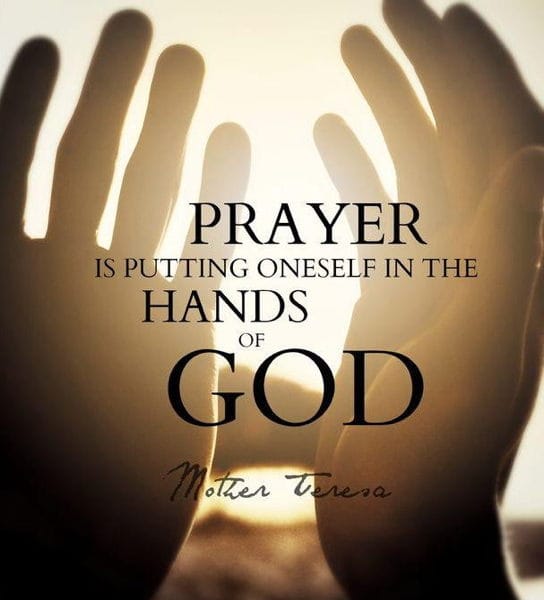
The couple in my story seem to me to point to these two different approaches to prayer. The husband’s prayers were more for those around him, including his wife, asking that they would find the same kind of peace he had found as he neared death. I do not wish to disparage his wife’s faith, but I believe her well-intentioned prayers were rooted more in her own desires and grief than in seeking to know and accept God’s will. I wish I knew how she fared in the time afterwards. I can only pray that she eventually worked through the agony of her grief to find some peace, some kind of acceptance of what had happened for her and her spouse.

Some of you may recall an acronym about prayer, which I first heard in confirmation class: ACTS.

A is for Adoration, spending time in God’s presence, usually without words.
C is for Confession or Contrition, facing our own shortcomings before God.
T is for thanksgiving, praising God for all that we have and all that we are.
S is for Supplication, holding up the needs of others to God, and (finally) for ourselves.

It’s easy to skip one or all of the first three before going on the last. The order is important, because the first three help us to pray as Agnes Sanford said:

The first thing to pray for is the wisdom to know what to pray for.

The first three also help us to put ourselves in a place where we can begin to perceive God’s will, to experience God’s love, and to be able to shape our supplications according to what gives glory to God.

When we pray – however we pray – let us remember that we are not there to dictate to God what God should do. God knows that well enough. Rather, we are called to approach God seeking first to know what God wills, confident in God’s love. And let us remember that hearing comes before speaking.

Let us pray then that through the power of the Holy Spirit, God will open our hearts and minds, that our lives may be shaped more into the likeness of the one who loved us into existence, who loves us today, and who will love us for all eternity.

May it be so.

The “Great Clean-up”

Notes for a sermon at St. Matthew’s Anglican Church, St. Albert, Alberta, May 22, 2022
Texts: Revelation 21:10, 22-22:5; John 14:23-29

I bought a new phone a few weeks ago. The old one was working reasonably well, but the manufacturer was no longer providing security support, and some newer apps required a more current operating system. Transferring all my stuff to the new phone was quite easy, and then I turned to the old one, first deleting all the personal stuff I could find, and then deleting the apps. I realized afterwards I didn’t need to bother with all those deletions, because doing a factory reset would clear everything identifiable. The factory reset took a few minutes, and by the time it was done the old phone was in the same state as when I took it out of the box several years ago — just as its builder intended.

Something like this is going on in today’s lesson from the Revelation to John, a part of the great vision which concludes the book in Chapters 21 and 22. Revelation is easily the most misunderstood book of the Bible, and it has unfortunately become one of the most often-cited texts by certain kinds of Christians. The error many people make is to treat it as prophecy for these times, connecting its images and scenes to events today. These things are then interpreted as “signs of the times,” an indication that God is about to step in and wipe everything out. It is commonly seen as foretelling the end of the world. Wrong!

Revelation is the New Testament’s only example of “apocalyptic,” a genre of literature common in Jewish circles in the centuries before and after the time of Jesus. The only other example that made it into the Bible is Daniel, from which Revelation draws much of its imagery and themes. Both books were written to people of faith suffering oppression from an oppressive power. In the case of Revelation, the intended audience was Christians under the Roman Empire. Both books are written in a kind of code which would be understood by the faithful, but not by the oppressors. Both have the same message: stand firm in the faith, and the conqueror will be vanquished.

Revelation’s message is really very simple: God wins!

One of the book’s images is the “Beast,” a metaphor for the Roman Empire. The city of Rome is never mentioned by name but is referred to in another metaphor as “Babylon the Great,” another oppressor of God’s people in times past. Much of the book makes horrifying reading, but the tone shifts dramatically in Chapters 21 and 22. Instead of doom, death, and destruction we are presented with a vision of a “new heaven and a new earth”. That word “new” is perhaps a bit misleading – it should better be read as “renewed” or “re-created.”

In some video lectures (“Victory and Peace or Justice and Peace?”) I watched recently, New Testament scholar John Dominic Crossan said that Revelation is not about the end of the world. Rather, he said, we should see it as God’s “Great Clean-up.” This is the reset to end all resets! At the end of this age, earth will be restored to God’s purpose, as Jesus taught us to pray:

Thy kingdom come, thy will be done,
on earth as it is in heaven.

The book does not end with a destroyed earth, but rather a redeemed earth. In the new age, on this reborn and renewed earth, all evils and sorrows will be gone, and everything will be according to God’s will, God’s holy purposes. As Genesis tells it, the world began being broken in one garden, around one tree. God will restore it to its original purpose in a second garden, with a new tree of life and a new river flowing from the throne of God.

But that’s in the future – sometime! It’s a wonderful promise, but it has not yet been fulfilled. Just look around you to see how things are not as God would wish them to be. War, mass shootings, civil unrest, famines, pandemics… Do I need to go on?

Almost everyone is aware in their own way that “Things just ain’t right!” And almost everyone seems to have their own recipe for making things right. Politicians of various stripes will give you a variety of remedies. Raise the question with five friends over coffee (or some other libation), and you’ll get at least six answers. If you’re so inclined, you can consult your horoscope or your tea leaves. But what I often hear is this: some people are ready to give up, and some others claim to know what will fix everything. I don’t accept either of these all-too-human views.

If we only listen to human voices, all we will get is human solutions to human messes. We must look elsewhere, finding a different sort of guidance from a different source for helping to bring this world closer to the reality expressed in the Great Clean-up. Another well-known New Testament scholar, N.T. Wright, calls this activity “building for the kingdom.” In the video companion to his book “Surprised by Hope,” (HarperOne 2008) he likens it to being like a stone mason carving individual stones for the building of a great cathedral. The mason knows his task, and he also knows that if he does not do it up to standard, the piece may not fit where it is intended, and part of the big enterprise may fail. The mason is guided by the master mason, who is guided by the architect, who is guided by a higher authority.

And that’s how it is with Jesus’ people in this in-between time while we await the Great Clean-up. We are not called to sit idly by as we wait for God to get in with the push broom and the Lysol. We have a role to play, working as if it has already begun. But how do we know that what we are doing is according to God’s will, and not ours? My friends, we have a guide for our work. Jesus promised this guide to his disciples before he went to his death:

the Holy Spirit, whom the Father will send in my name,
will teach you everything, and remind you of all that I have said to you.

The Great Clean-up will come in God’s own time. In the meantime, amid all the troubles of this present age, we are called to work for that coming, living into it, living as if it had already happened. It’s a tall order, I know, but we are not alone.

Jesus is with us always to the end of the age, and the Holy Spirit, the Advocate, is within us – individually, and (more importantly) corporately – at all times to guide us into the peace which Jesus left us. Our job is to listen – to pray! – and then, hearing, to work for what is good and holy and peaceful and loving.

We are not alone.

Thanks be to God!

Come and see … and then go

Notes for a sermon preached at St. Matthew’s Anglican Church, St. Albert, Alberta, January 19, 2020. Text: John 1:29-42

On a cold day in January, we might forgive someone for asking us why we are here, although I sometimes wonder the same thing on a beautiful summer day.

Every one of us has made the decision to be here today. If we started asking each other about our reasons, we might well be into a long discussion. Every one of us has a unique story, and every one of those stories is worth telling and sharing—but maybe not this morning!

I once had a conversation with a person who was bothered that other parishioners didn’t seem to share their level of commitment. As we talked, the person started to disparage others’ reasons for church attendance. “He only comes because his wife doesn’t drive.” “She’s only here to hang out with her friends.” … I managed to call a halt, and then I said something that I meant with all my heart, and which I firmly believe to this day.

No matter how they might articulate their reasons, every person who walks through the doors of this (or any other) church, has been led here by the Holy Spirit.

It’s not for us to judge their motivation, but rather to give thanks that they are here, and then to seek the Spirit’s guidance about how to minister to them and with them. The act of walking through a church door, whether for the first time or the ten-thousandth, is a decision to accept Jesus’ invitation to “Come and see,” as he gave to the first disciples, and which continues to come to people today.

When Jesus invited Andrew and his companion to come and see, it did not come out of the blue, but was a vital step in a longer process. The two were already disciples – of John the Baptist. They were seeking the Messiah. They had no doubt gone to John in the hope that he was the One, but John pointed away from himself, to the one on whom he had seen the Spirit descend and remain.

John’s testimony about Jesus presents us with a full-blown doctrine of Christ: pre-existence, the Spirit remaining on him, God’s Chosen One. John knows who he is, and when he sees Jesus passing by again, he points to him and says to his disciples “Look, here is the Lamb of God!” They leave John and follow Jesus, apparently without any question.

Jesus asks them a very simple question: “What are you looking for?” to which they answer, “Rabbi (‘Teacher’), where are you staying?

This response may seem odd to our ears, but it would not have been out of place from someone seeking to follow a new teacher. To follow a teacher meant to spend time with him, not in a formal school setting, but staying or traveling with him. Today we might call it “hanging out.”

Jesus said, “Come and see.” They went, and they stayed with him for the rest of the day. We are told that it was four o’clock in the afternoon, which might mean that they stayed only a few hours, or perhaps that they stayed into the next day. Either way, they were with Jesus long enough to become convinced that he was the One whom they had been seeking. They were convinced enough to find Simon and to take him to Jesus, who then gave him the name by which we remember him, Peter.

And that’s the beginning of the story of Jesus’ disciples, as it is described in this Gospel. The story of Jesus’ disciples continues today, not written in the Bible, but in the stories of billions of followers of Jesus over two millennia. It continues here in this church today, with people who in some way have heard Jesus say, “Come and see,” who have come, who have seen, and who have believed.

It is the work of the Holy Spirit – the same Spirit who descended upon Jesus at his baptism – that has brought us together today. We come. We see. We believe.

The work of the Church began with people seeking God and God’s salvation, going to John for baptism, hearing John testify about Jesus, and then following Jesus at his invitation.

The work of the Church continues today with people seeking God, entering the Church through baptism, learning by word and example how others have followed Jesus, and then following – each in our own way.

Every one of us has his or her own story of how we came to follow Christ and how we continue to do so day by day. Every one of us made the decision to be in this place on this day. Every one of those decisions is one more step in our story as individual disciples and as a small part of the Body of Christ, the Church.

It has been said that the most important point of the liturgy is the dismissal. “Go in peace to love and serve the Lord,” is not just someone telling us that it’s time to put on our coats and go home. Rather, it is a charge to go out from this place and BE the Church in the world, doing the work of God wherever it needs to be done and wherever we are able.

Andrew and his companion went out from their first time with Jesus and found Peter. They got to work spreading the news.

The Spirit of God called them to find and to follow Jesus, and then sent them out again.

The Spirit of God has led us to this place, to find Jesus once again in Word, Sacrament, and fellowship. Renewed, refreshed, and reinvigorated, may we be sent forth by the Spirit to do the work of God’s mission.

May we go in joy and peace and with love in our hearts.

Amen.