Notes for a sermon preached on August 2, 2026 at Holy Trinity Anglican Church, Edmonton; Texts: Genesis 32:22-31; Matthew 14:13-21
I belong to a denomination which follows the Revised Common Lectionary (RCL) in its semi-continuous version. The RCL is a descendant of the Lectionary introduced in the Roman Catholic church after Vatican II. That one, and all its various offspring, call for four Scripture selections to be read at a Sunday celebration of the Mass (usually called the Holy Eucharist in my church).
The first reading is taken from the Hebrew Scriptures, sometimes including Deuterocanonical (aka Apocryphal) selections. This is followed by a psalm or portions of one, usually chosen to reflect the theme of the first reading. Two readings from the New Testament follow. The first one is selected from one of the letters and other writings, and the second from one of the Gospels.
The Roman Lectionary was designed so that the first reading reflected in some way the theme of the Gospel lesson. Subsequent ecumenical versions of the Lectionary during “ordinary time” either followed this pattern or chose readings from the Hebrew Scriptures that followed various stories in a semi-continuous pattern. For instance, the readings in this summer (2026) have been excerpts from the lives of the patriarchs Abraham, Isaac, and Jacob. At the same time, the Gospel lessons have been from Matthew.
A good resource for the RCL in both versions is produced by the Divinity Library at Vanderbilt University. It can be found at https://lectionary.library.vanderbilt.edu/.
During ordinary time the RCL version we use can often present a big challenge for preachers. Because the Hebrew Scripture and Gospel readings are not chosen for similar themes, trying to find a single theme for a Sunday is very difficult. Some preachers opt to preach what are sometimes call “four-leaf clover” sermons, basically a short exposition of each of the four selections. Sermons like this are rarely memorable, and often confusing! The more common tactic is to choose one reading to focus on, and if possible, draw in an illustration or two from the others.
I was asked to preach on August 2, when the first reading was Genesis 32:22-31, and the Gospel was Matthew 14:13-21. Jacob wrestling a “man” who may be an angel or God is an eerie and enigmatic text, a difficult but potentially fertile text for the homilist. Jesus feeding the 5,000 is a well-know story that also deserves its time. I was attracted to both texts and couldn’t decide which one to focus on. They are so different that any attempt to find a single theme seemed pointless.
About a week before the scheduled sermon, I suddenly thought of a larger-scale, overriding theme for which I could use both texts together. What follows is the preaching text that came out of that insight. I hope the reader will find it helpful.
~~~~~~~~~~~~~~~~~~~~~~~~~~~~~~
My cousin Sue came from England to visit our family in the summer of 1969. She is the daughter of my mother’s older sister, who had died in a car crash about 10 years before. We had a great time getting to know her better, and she had an even better time, as I remember it.
Sue’s father had stopped talking about any family history after my aunt’s death. I suspect it was simply too painful for him, but the effect on her was devastating. She told my mother, “I don’t know who I am or where I came from. I have no stories.” My mother spent a lot of time with her, going through photo albums, talking about the various people pictured there, and sharing her memories of her family. It was truly transformative for Sue.
Families need their stories. Stories tell us who we are, rooting us in the past, and pointing the way to the future. Without our family stories, we are like people dropped in a trackless desert, with no memory of how we got there, and without any way of knowing how to get out of the wilderness.
The thing about family stories is that the ones that get retold most often are the unusual ones, the ones with surprises and twists that lead us to new ways of understanding. They also tend to get told in different ways by different people. The central stories of the family of God as we understand it are found in the Bible. Stories from both Testaments help us to understand who we are before God, how we got here, and how we might move forward into God’s unfolding future.
At this time of the church year, our Lectionary doesn’t give us a theme each week. Instead, it works through stories from both Testaments in a semi-continuous fashion. This summer, we have been hearing some of the highlights of the family of Abraham, and journeying through Matthew’s Gospel. Today we heard two stories from these series: Jacob wrestling with God, and Jesus feeding the 5,000. Both are surprising in their own way. They have no apparent connection, but both raise all sorts of questions when we hear them. And both are formative of the family of God.
I have heard many people try to explain the feeding story, but it seems to me that trying to figure out how it happened is a losing proposition. We have no way of knowing how the food was “multiplied,” except to understand that God was active in some way through Jesus’ ministry. The driving motive for the episode is Jesus’ compassion for the crowds, healing their sick, and feeding them with food.
I once heard a speaker say that asking if a Bible story happened exactly as told can only lead to division. Some will say, “It’s in the Bible, so it must be true exactly as written.” Others will say, “It doesn’t make sense in any modern understanding, so we can’t say that it’s true at all.” There is a way out of this dilemma: don’t ask if it happened as written, rather ask what the story means. That question can, and often does, lead us into action, based on a new understanding of God’s purpose in the story.
If I ask what the feeding of the 5,000 means, the short answer seems to me to be that Jesus shows up and people get fed. Jesus still shows up today among hungry people, people who turn up at places like the Mustard Seed and the Bissell Centre, to be fed in both body and soul. Compassionate action like this was formative in the early church (see the first few chapters of Acts) and continues to be formative today. We learn to be like Jesus by doing what Jesus did.
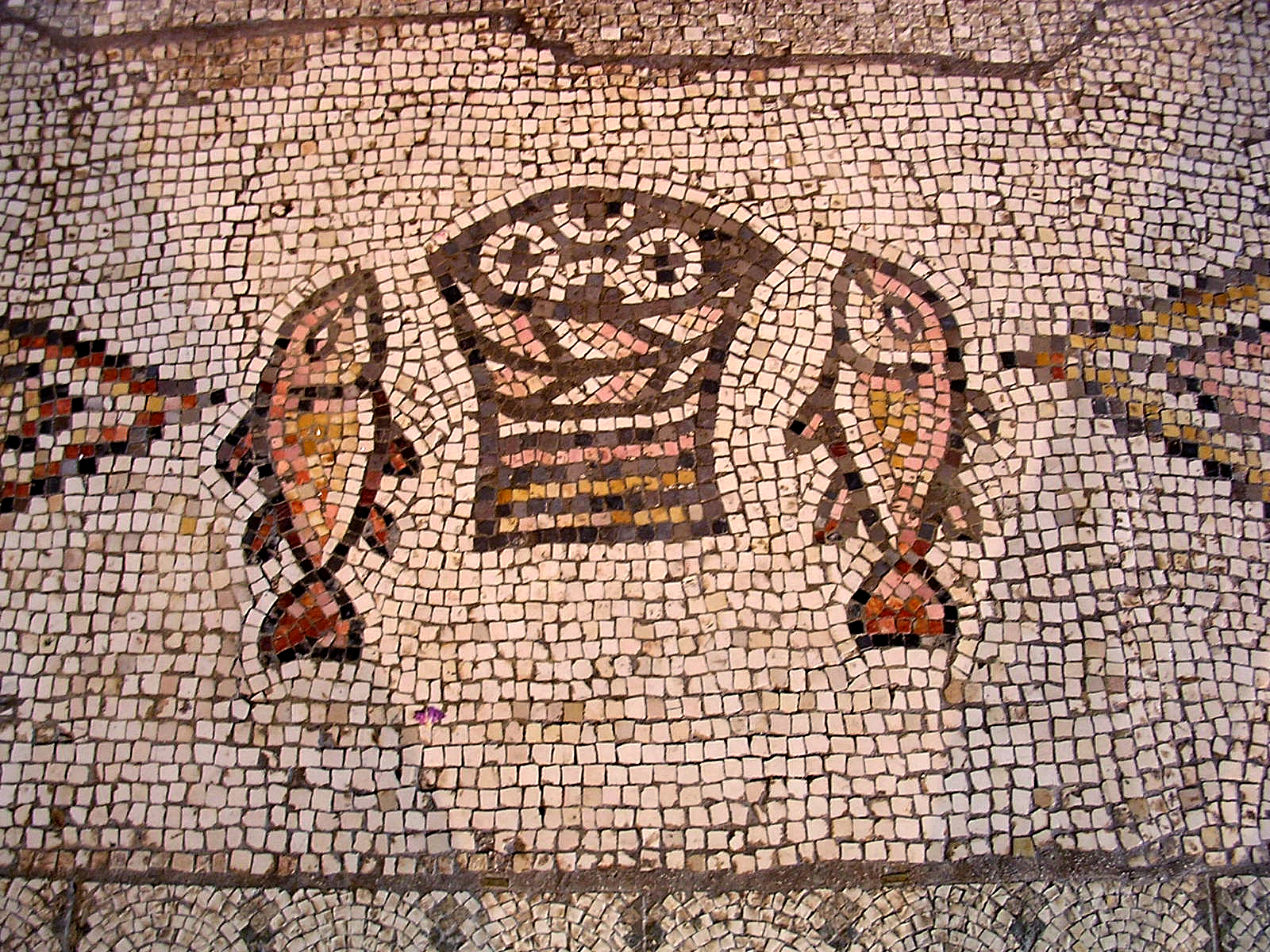
Mosaic in the Church of the Multiplication, Tabgha, Israel
We hear the call to do this every time we hear the story, and indeed every time we celebrate the Eucharist. You may have noticed the sentence, “Taking the five loaves and the two fish, he looked up to heaven and blessed and broke the loaves and gave them to the disciples, and the disciples gave them to the crowds.” He took bread, blessed it (gave thanks), broke it, and gave it (through the disciples’ ministry) to the crowds, the same four actions in every celebration of the Eucharist. Jesus shows up—and we are fed and sent forth to share the blessing.
What then of Jacob and his wrestling match? This story almost reads like an episode of “The Twilight Zone,” eerie and inexplicable. One study Bible says the story is the most enigmatic event among the stories of Jacob. No kidding! A night-long wrestling match with a “man” who turns out to be either an angel or God is certainly out of the ordinary. It doesn’t seem to point us toward positive action as does the other story, but recounts in third person an event which had only one human witness, Jacob, the story’s subject. No multitude here, just one lone man wrestling with “a man.”
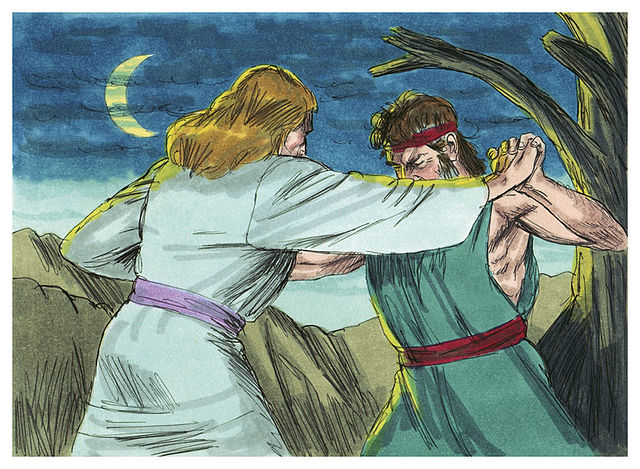
The setting is important. Jacob is heading for a meeting with his brother Esau, whom he had tricked out of his birthright and blessing. He sends his entourage ahead with all his possessions, leaving him utterly alone, just as Jesus was left utterly alone in Gethsemane. And in both stories, struggle ensues.
The wrestling match has two outcomes. First, Jacob’s hip is “put out of joint,” so that he ends up limping—bearing the marks of the struggle in his person. Second, Jacob receives a new name, Israel, the name by which his people are known to this day, a name meaning something like “the one who strives with God.”
The two outcomes do not have the same kind of positive appeal as the feeding of a multitude. A new people will emerge from this event, bearing the wounds of an ongoing struggle with God. You can read the rest of the Hebrew scriptures in this light, as the people of Israel continue their struggle to become more truly the people of God. This strange story is truly formative of the people of God.
Thus, we have two stories, both pointing us toward how people are shaped into being truly the family of God, limping like Jacob into a future where all are cared for.
We come to the Eucharist today bearing all the marks of being human, wounded and hungering in our own ways, seeking to follow Jesus into the future God has prepared for his family.
So may we learn from these stories.
May we learn who we are and whose children we are.
May we learn where we have come from and who we are called to be.
And finally, may we know that the journey is towards God’s future, a future built on love and love alone.
Amen

