God is With Us or “What’s Next?”

Notes for a sermon preached at Holy Trinity Anglican Church,
Edmonton, Alberta, November 9, 2025
Texts: Hag 1:15b-2:9; Ps 145:1-5, 18-; 2 Th. 2:1-5, 13-17; Luke 20:27-38

In twenty-six years as a parish priest, I was only once involved in prison ministry. The man I was called to visit had asked to see an Anglican minister, which suggested to me that he might have some church background. What I found was a person who had been dragged to church as a child by abusive parents. He said, “I guess I’m Anglican—that’s what I was baptized,” but he knew next to nothing of the Christian faith and wasn’t even sure he believed there was a God. He told me he had decided that he needed “a faith,” a statement that raised so many questions I hardly knew where to begin. In many ways, his life had been a battlefield for over thirty years. And he was wondering “What’s next?”

It seems to me that this question relates in various way to all of today’s readings, to observances of Remembrance Day, and to our parish’s current situation.

When the Sadducees came to Jesus with a trick question about marriage in the resurrected life, their interest was not so much in getting a legal opinion, but in continuing their ongoing argument with other Jews over whether there is life after death. They would answer “What’s next?” by saying “nothing.” Dead is dead, and that’s that—a position which Jesus demolishes with an appeal to scripture: the patriarchs remain alive to God, so the question is simply foolish. “What’s next?”—life in the nearer presence of God.

Paul wrote to the Thessalonians, who were sure they knew what was next—Jesus was coming back any day now, and the delay was shaking their faith. He urged them to stand firm, living as if the day of the Lord had already arrived, giving glory to God who has sanctified them by the Spirit. “What’s next?”—life lived in the awareness of God’s presence in all things.

The prophet Haggai exhorted the returned exiles to get on with re-building the temple. Work had started, but they were dispirited and disorganized, and the new temple was unfinished. Life in the ruins of Jerusalem was nothing like they had dreamed it would be, maybe even far inferior to their existence in Babylon. “What’s next?” Why bother rebuilding the temple? Things were bad, and it didn’t seem that they were going to get any better. But the prophet told them that God was with them, and would be with them, and would give them prosperity in this place.

“What’s next?” In every case, we are assured that God is present and at work among his people, always leading them into new life, in this world and the next. I think of in-between times like this as “Holy Saturday experiences,” recalling the day between Cross and the Resurrection when Jesus’ disciples waited in fear, grief, and confusion behind closed doors for a future they could not begin to comprehend or foresee. But God was with them even on that darkest of days! Another writer has called such times the “Sacred In-Between,” saying this:

…what’s next will come. It always does. But who you’ll be when it comes, that’s what the in-between is shaping right now.[i]

This week we remember those who died in the wars of the past century, conflicts which overshadowed and profoundly shaped our country’s history. We sent men and women overseas to fight for “King and country,” often to die. In retrospect some of those battles were questionable, and some of the so-called sacrifices almost meaningless.

Veterans of various combats often came home to a hero’s welcome, but all too often that home had changed almost beyond recognition. War changes people—on both the battlefront and the home front. Many veterans of both wars bore scars of the battle in their psyches for the rest of their lives. And both world wars changed our society profoundly, sometimes for the good and sometimes not.

The difficult memories and the challenges our country faced in post-war times were tempered by our being on the winning side. But what happens on the other side? The reading from Haggai may help us understand.

For many years, the exiles in Babylon had lived with the knowledge of defeat and destruction. They had been sustained by the dream of their homeland, and the memory of Jerusalem’s lost glory. When they returned, reality did not match their dreams. The temple lay in ruins, the city walls were piles of rubble, and the people of the land seemed to have given up. As a line in the hymn “Abide with Me” says, “Change and decay in all around I see.”[ii] Defeat had become the people’s mindset. Is it any wonder they could not find the energy to rebuild the temple?

And then the prophet said to them:

…take courage, all you people of the land, says the Lord; work, for I am with you, says the Lord of hosts, according to the promise that I made you when you came out of Egypt. My spirit abides among you; do not fear.[iii]

“What’s next?”—a new temple, a fresh start, and new prosperity, for God is with them. It may not have been what they had been dreaming of for half a century, but it was where God had been leading them.

It’s easy to perceive God’s spirit among us when things are going well. When things are not going so well, during the muddy hell of World War I, or on the return to a defeated land, we may have a different awareness of God. The man I met at the jail was not sure he could believe in God, because his life had been a personal hell. Nonetheless, he was wondering if he did in fact believe, because he sometimes found himself praying to God for help. I wish I could tell you that his story ended as he prayed, but what was next for him was a court appearance. He was sentenced to time served in that province, but police from another province were waiting for him at the back of the courtroom to re-arrest him for other offences.

We need to remember, to know our story, and to understand how we got here. On Remembrance Day, we give thanks for our war dead who helped bring this story to where we are today. Nonetheless, we do not live in the remembered past, but in the often-uncertain present, in hope for the future, always asking God “What’s next?” Always we know that God’s answer—for the people of ancient Israel, for the earliest Christians, and for us today—is “I am with you.”

Holy Trinity is facing challenges in the months ahead. Clergy changes are always difficult, and the community is justified in asking “What’s next?” But the prophet’s words continue to ring true:

…take courage…; for I am with you, says the Lord of hosts

And the hymn continues,

“O thou who changest not, abide with me.”[iv]

God abides with us, in war and in peace, in victory and in defeat, in hardship and in prosperity, in times of change and in times of stability. May we always remain aware of God’s presence, ready to hear God’s call into the future waiting for us.

“What’s next?”

God is with us always. That’s what’s next.

Thanks be to God.

Amen


[i] Shawn C. Branch, https://shawnbranch.substack.com/p/the-sacred-in-between?triedRedirect=true

[ii] Henry Francis Lyte, vs. 2, line 3

[iii] Haggai 2:4b-5

[iv] Henry Francis Lyte, vs. 2, line 4

Post scripts:

  1. Holy Trinity is about to enter into an interim period, after the resignations of our Rector and her Associate.
  2. I was introduced to the idea of “Holy Saturday” experiences through “Between Cross and Resurrection: a Theology of Holy Saturday,” by Alan E. Lewis, Eerdmans, 2001.
God is Calling

Notes for a sermon preached at Holy Trinity, Old Strathcona, Edmonton, June 16, 2024
Text: I Samuel 15:34 – 16:13.1

Adults often ask children what they want to be when they grow up, and often the responses are unrealistic. Someone once said that adults ask kids this question so that they can get some new ideas! When we put on one of our favourite CD’s,2 my wife often says “When I grow up, I want to be Tommy Banks.” My own history is one of changing direction several times, most recently from full-time to retired ministry, which took a while to figure out what it meant – it wasn’t totally by choice! The “churchy” word about discerning your path in life is “vocation”, about which our lesson from I Samuel has something to teach us.

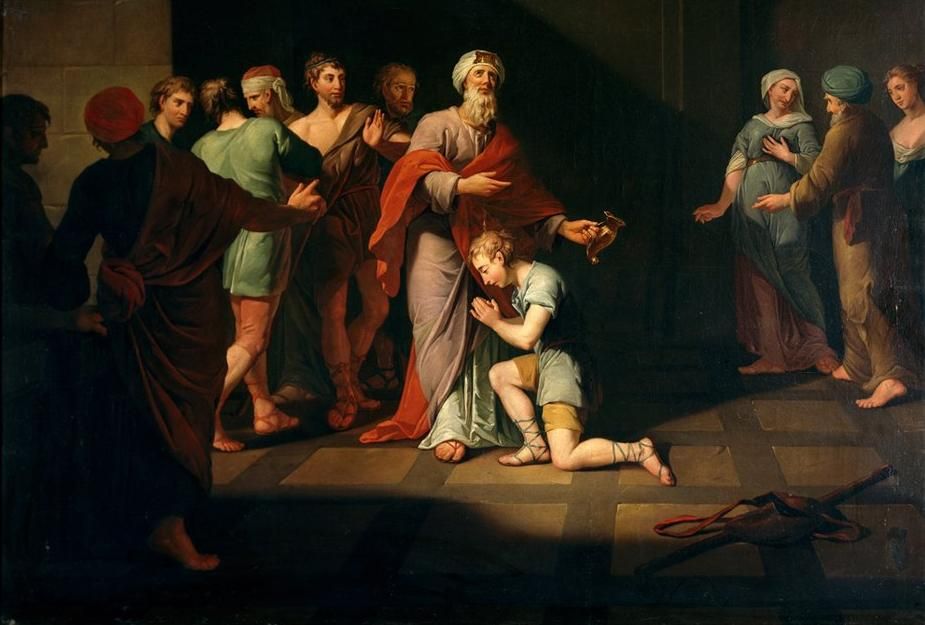
This is where we first meet David, as he is summoned from herding the sheep to have Samuel anoint him as God’s chosen King. Samuel’s coming meant that something important was afoot, and surely David wanted to be part of it. As the youngest son, the task of tending the sheep fell to him, while his brothers could stay home to greet the great man. I can almost hear him saying “It’s not fair!” just like any other teenager.

Was he wondering about Samuel’s purpose in visiting his father? He might have had an idea about what was up: King Saul had fallen from God’s favour, and Samuel’s visit likely had something to do with that. Did he have any idea of what God intended that day? Had he heard some kind of call? We’re not told. What we are told is that none of his older brothers passed muster as they paraded by, while Samuel listened for God’s voice. None of them were called to be King.

The rest of the family was surprised when Samuel told them to bring David to him. The youngest? A mere boy? Directed by God, Samuel saw otherwise, and called David out of his family to become King. Samuel named David’s vocation. Had David already heard it? We don’t know, but later events show him growing into the realization and fulfillment of his divinely-ordained role in life.

I have twice been an assessor for ACPO3, a major part of the process our church uses for discernment of vocations to the priesthood. Candidates are interviewed in a variety of settings, looking at the “3 C’s”: Character, Charism, and Call. Dealing with the first two is a bit like a conventional job interview, but the third presents some special issues. “Call” means both the candidate’s personal sense, and the affirmation of their community. I met some who said strongly that they knew that God needed them for the priesthood, but whose recommendations from others were more equivocal. Contrariwise, I met one young man, immensely gifted, by all accounts a really fine person – charism and character in spades! – but who simply could not articulate any kind of personal call. When we asked, “Why do you want to be a priest?” his only response was “Everyone says I should be.” When we asked him what he would do otherwise, he was able to map out a clear direction in academic work – he almost had his Ph.D. dissertation written in his head. We recommended that he continue with that work, and if at some time he was able to say, “I believe God is calling me to be a priest,” he should once more present himself as a candidate.

Vocations to Christian ministry come from both within the person (the “inner call”), and from the community (the “outer call”). Both must be present. Samuel gave David his outer call in dramatic fashion. We will hear more over the summer how David’s inner call developed, but we may be sure that he heard it.

Church folks most often use the word “vocation” in the context of ordained ministry. But please remember this: Christian ministry is not confined to the three-fold ministry of Deacons, Priests, and Bishops – not by a very long shot! The Catechism of the Episcopal Church of the USA teaches that there are four orders of ministry, naming the ministry of all the baptized (laypeople) as primary. I wish our Church had adopted this Catechism.

The ministry of the laity does include the various roles people assume in the church: lay readers and assistants, sides people, sanctuary guild, lectors, intercessors, musicians, teachers, wardens and vestry members, to name some of the most obvious. More importantly, it means the ministries that lay people exercise in the wider world, in all the many and varied ways they follow their calling as disciples of Christ. Every baptized person is called to a new life, dedicated to living into the promises found in the Baptismal Covenant. There is a good reason why this covenant is renewed by the whole congregation at every celebration of Baptism: the newly baptized are welcomed into a community of people who are striving to be God’s ministers in the world – people with many and varied vocations.

What’s your vocation? Some of us – a very few – can say “I’m called to be a priest or deacon in the Church.” But others might say something like “I’m called to be a (_______), the best one that I can be, so that people around me can see Christ at work through my life.”

When an ordination candidate is presented to the Bishop, the Bishop describes the nature of the ministry in question, and then asks, “Do you believe you are called to this ministry?” The Baptismal Covenant is the counterpart of ordination for the ministry of the laity. Any Baptized person can ask the call question for themselves, and then seek the affirmation of the wider Church when they believe they have heard a special call. Just like David, just like that gifted young man, we all need to hear both inner and outer call. We need to listen for the voice of God. And then we need to test our insight with others who are similarly striving to follow Jesus.

And let us never assume that a calling once heard is once and for all time. I once thought I wanted to be a railroad engineer – that didn’t last long! Things change over time, and God may lead us in ways that we hadn’t previously imagined or couldn’t imagine. No-one in my school years could have articulated a desire to design video games! And the kind of job I had with the Provincial government in the ‘70’s and ‘80’s has been almost totally changed by the internet.

We need to keep on listening for God’s call, because it can and does change. But make no mistake about it: God is calling you, and you, and you, and me. God is calling every one of us. We may not always hear clearly, but we may be assured that God will in God’s time send us our own Samuel or Samuels to help us hear better.

God is calling. Listen, pray, test, and respond.

God is calling. Live into that call, and rejoice!

God is calling. In Jesus’s name, may we hear and follow.

Amen.


  1. Video of the sermon and the full service may be found at https://www.facebook.com/holytrinityanglican ↩︎
  2. Yes Indeed“, Tommy Banks, solo piano, Royalty Records RRI-300-9647, 1997 ↩︎
  3. Advisory Committee on Postulants for Ordination ↩︎

A Call from the Edge

Notes for a sermon preached at Holy Trinity (Strathcona/Edmonton), Dec. 10, 2023
Texts: Mark 1:1-8; Isaiah 40:1-11  
  

I once saw a priest start a kid’s talk with the question, “What’s a prophet?” It’s great when the answers you get lead into what you want to talk about, but this time the response from one young person was “It’s when you make money.” The talk went sideways from there, because the kids really didn’t seem to know the biblical word, and just wanted to talk about money. They understood that! “Prophet” is a word that doesn’t turn up very often in daily speech, and when it does, its usual sense is a person who foretells the future.

Predicting the future can be part of the prophetic role, but it’s not the whole story – not by a long shot! This past fall I thought a lot about prophets, when our Wednesday morning Bible study group read the Book of Ezekiel. If you haven’t read Ezekiel, let me tell you that the group found it very challenging, often harsh and violent, with relatively few signs of hope, notably in the first half. People left some sessions saying things like “I sure hope things get better!” Not a fun read, but if a doom and gloom kind of guy like Ezekiel is considered a major prophet, we might well be excused for wondering why these people play such a large role in Scripture, especially in the Hebrew Bible.

Fr. Richard Rohr says that all the prophets speak from “the edge of the inside,”[i] and Ezekiel is a case in point. The book is set in the early years of the exile to Babylon. A member of the priestly class (an insider), Ezekiel is among the deportees, far removed from the centre of his people’s life – Jerusalem and the Temple. The big question is why this disaster has happened. The prophet condemns the people of Jerusalem, whose faithless ways have led to the departure of God’s glory from the holy city. From the edge of his people’s existence, the previous insider can speak God’s message clearly.

The latter part of the book is devoted to a vision of a restored Temple and land, which bears little resemblance to what actually happened some years later, when a new Temple was eventually built. Before that could happen, the people had to return, an event on the near horizon for the prophet whose words we heard in today’s first reading, so-called “Second Isaiah,” who proclaimed:

Comfort, O comfort my people, says your God.
Speak tenderly to Jerusalem, and cry to her
that she has served her term, that her penalty is paid,
that she has received from the Lord’s hand double for all her sins.

The exile in Babylon was drawing to its end. The deportees would be led home to the land of Israel, forging their way through the wilderness, protected by God’s hand as they journeyed through a place of great discomfort. God would give them comfort, which is not the same as making them comfortable. This would be no easy chair kind of existence, but a journey through a wilderness transformed and turned upside-down by the hand of God. Like Ezekiel, Isaiah also spoke “from the edge of the inside,” but now of a return to the centre.

Receiving comfort from God means to be strengthened by God for the days ahead. It means being empowered by God to work through and in places of discomfort. The message of all the prophets, including Ezekiel, Isaiah, and John, is not to “get comfortable”, but to seek God’s way, knowing that God’s way may well – may often! – involve discomfort.

Writing in the December 2023 issue of The Christian Century, Pastor Melissa Bills said this:

Discomfort is holy when it leads us to deeper love for God and neighbor. It is sacred when it spurs our hearts to love and good deeds. It is a blessing when it drives us to seek justice and liberation. It does not cut us off from God’s promises of comfort but rather makes space for us to receive them.[ii]

Chapter 40 of Isaiah ends this way:

[God] gives power to the faint, and strengthens the powerless.
Even youths will faint and be weary, and the young will fall exhausted;
but those who wait for the Lord shall renew their strength,
   they shall mount up with wings like eagles,
they shall run and not be weary, they shall walk and not faint.

This is the prophet whom John invoked in his call to prepare the way of the Lord. John stood in the heritage of Isaiah and all the Hebrew prophets, speaking and acting as God had directed. That’s what makes a prophet a prophet: they don’t speak for themselves, but for God!

John’s message was clear: the Kingdom of God was drawing near, soon to be fulfilled in the one to whom John pointed – Jesus!

John’s life was not comfortable – living in the wilderness, clothed roughly, eating what he could find on the land. But he surely took comfort from knowing that he was doing God’s work, speaking for God, proclaiming the one coming after him, pointing away from himself and his own desires to God’s wishes, pointing to what God would do among those who heeded the call.

I have sometimes heard people say things like “If you say, ‘yes’ to Jesus, your life will be great from then on.” If only that were true! Following Jesus has a cost. It demands much of us. But the good news is that God offers the same comfort – the same strength – that was offered to the Hebrew people in exile. John called the people to repent, and to accept baptism as a token of that repentance – and repentance is hard work. It takes strength and determination, and the courage to refuse the easy way – the comfortable way.

On this Sunday of John the baptizer, let us remember that the need for prophets like John did not end with the coming of Jesus. If anything, the world stands in greater need than ever of hearing the prophet’s call to repentance. We followers of Jesus have inherited the role of John: to point to Jesus, to call people out of their comfortable places, and to proclaim God’s desires for the world.

The great Biblical scholar Walter Brueggemann has said this:

The prophetic tasks of the church are
to tell the truth in a society that lives in an illusion,
grieve in a society that practices denial,
and express hope in a society that lives in despair.

Only by telling the truth, by grieving honestly, and living in hope can we ever begin to find the comfort promised by the prophet so many years ago. Like the prophets before us, we are not called to leave this world behind, but to challenge the world from “the edge of the inside,” as we see in the ministry of the prophets. We must be prepared to leave the comfortable places in the centre, seeking God’s strength as we live into our God-given mission – our prophetic tasks.

So… let’s go back to that first question: What is a prophet?
Better to ask “Who is a prophet?”
Look around you – anyone you see may be called to step out of their comfort zone, to rely on God’s comfort – and to speak God’s word in in a world that desperately needs to hear that Word!

In the name of the one who came to give us holy comfort,

Amen.


[i] https://cac.org/daily-meditations/the-true-center-2023-09-10/

[ii] https://www.christiancentury.org/article/lectionary/december-10-advent-2b-isaiah-40-1-11-mark-1-1-8


The Sower, the Seed, and the Soil

Notes for a sermon on Matthew 13:1-9, 18-23, July 16, 2023, Holy Trinity (Strathcona), Edmonton

The Gospel readings for today and next Sunday are taken from Chapter 13 of Matthew, sometimes referred to as “The Parabolic Discourse.” This doesn’t mean it’s about parabolas, but rather about parables. Same Greek root, different but related concepts – but you’re not here for a lecture on etymology, are you?

The Discourse comprises seven parables, most with an agricultural theme, plus explanations for the two we are hearing. These are the only parables for which Jesus gives explanations, and then only privately to his disciples. The rest of his listeners get that somewhat maddening exhortation: “Let anyone with ears listen!” In other words, some will understand, and others (maybe most?) will go away puzzled.

It seems that the disciples were among those who were puzzled. Otherwise, why would they ask Jesus for explanations? And why those two parables?

The answer to the first question (the desire for explanations) lies in the nature of parables. Some parables are very short and to the point, while others are longer stories, like the Good Samaritan and the Prodigal Son. Most parables use imagery from daily life, making them accessible to the hearers. What sets them apart from ordinary stories is that they usually have a twist, something unexpected in the telling, that opens the door to seeing reality in a new way. The standard reaction to this kind of story is “But what does it mean?” and Jesus’ response doesn’t help. Another notable feature of parables is that they are typically capable of different interpretations – in other words, there’s no “right answer.”

In today’s parable, the Sower, the image is of a farmer sowing seed, seemingly almost at random, not looking carefully at where he tosses it. The seed falls in various places, with various results. The seeds that fell on the path or on rocky ground or among thorns were wasted, bearing no fruit for the harvest. Only the seeds that fell on good soil brought forth grain. Sowing seed is a normal activity, but is it normal to strew the seed around quite so carelessly? Why not take care to make sure that the seed falls where it will do some good? Some have called this parable “The Wasteful Farmer,” which may say something about the disciples’ puzzlement. No-one stays in business long with such a careless attitude. This suggests a possible answer to the second question I posed: why these two parables? Perhaps because they seemed particularly troubling to them as compared to some of the others, and perhaps because Jesus wanted to point to some aspects of discipleship.

The explanation Jesus gives to them suggests to me two things to take from the parable:

First, the disciples are being trained to spread the Good News, the Word of God. They need to understand that picking and choosing with whom they share the Word is not their task. Rather, they are to share the Word with everyone, knowing that not all will bear fruit as they might wish.

That lesson still stands today. Spread the Word to everyone and let those with ears hear! God will take care of the rest.

Second, the disciples themselves are the soil upon which the seed is sowed. Jesus no doubt wished that they all might be good soil, bearing fruit a hundredfold, or sixty, or thirty. But Jesus also knew that they all had cares and worries and difficulties in their lives, and at various times they would be the path, the rocky ground, or the thorn-infested soil. The message: aim to be good fertile soil, understanding that your own lives can sometimes provide less than perfect growing conditions.

That lesson also still stands. No-one is a perfect disciple all the time. Things happen which make it hard to hear God’s Word, difficult to thrive, sometimes impossible to bear much fruit. That’s just the nature of ordinary human life. Strive to bear fruit, knowing that you will fail at times. Our Baptismal Covenant makes that clear, referring to “when you fall into sin,” not “if you fall into sin.” God will use us as we are able – and God is always there, welcoming us back again and again.

I found a piece on the internet this past week called “Rules for Doing Theology.” With a little tweaking, it could easily be re-titled “Rules for Being a Disciple.” The last rule needs no tweaking: “Make a mess. Fail. Try again. Grow in grace. Repent and forgive.” As a friend once said, the Gospel is like playing baseball, except you get to keep swinging until you hit a home run.

And here’s one more way of reading this parable, which played an important role in my early formation as a priest. I had never paid the Sower close attention until one day about a year and a half into my time in my first charge, when it turned up as the Gospel for the day in the Daily Office Lectionary. Life was getting a bit difficult, as some parishioners were expressing disappointment that the church wasn’t growing much, if at all. They believed that having their own priest after 20 years of being half of a shared ministry would result in the parish suddenly blossoming to look something like it did in the ‘50’s and ‘60’s. “We thought the Sunday School would be full again, like it was back then,” was one of the things I heard. In other words, they saw it as my responsibility to make the church grow. And I fell into the trap of beating myself up for not fulfilling their expectations.

When I read this parable that day, it suddenly dawned on me: if I put myself into the role of the Sower, I could see that my job was to spread the seed – to proclaim the Good News by word and example – and it was up to God to make the seed grow and bear fruit. Reflecting on both the Baptismal Covenant and the vows of ordination has shown me how important this distinction can be.

Friends, we are called to be the Sower, the Seed, and the Soil, remembering that people have different roles at various times, as Paul said in I Corinthians 3.6:

I planted, Apollos watered, but God gave the growth.

We are called to sow the seed freely, not choosing where but letting God deal with the seed wherever it may fall, giving thanks that growing the seed is not up to us alone. God will give the growth, and God will give fruit in due season.

We are called to seek to be fertile soil for the seed to grow. God the Holy Spirit will open our hearts and minds.

Finally, we are called to be the seed itself: to be and to bear the Word of God in person for others, seeking to let the Good News be visible in all that we say and do.

May it be so!

35 and counting…

Notes for a sermon preached at Holy Trinity Anglican Church, Edmonton, Alberta
May 29, 2020, the Seventh Sunday of Easter

When the Rector asked me to cover services this Sunday, I said “Sure”, and than looked at my calendar and realized it was the 7th Sunday of Easter, only two days before May 31. 35 years ago, the 7th Sunday of Easter fell on May 31, when I was ordained a Deacon. (It was also the night that the Edmonton Oilers won their 3rd Stanley Cup, so I can take no credit for the street party outside afterwards.) When I realized what the day was, I told the Rector that I wanted to take the opportunity to reflect on my time in ordained ministry, and she quickly agreed.

Then I looked at the readings and came up against the closing portion of Jesus’ “high-priestly prayer” from John’s Gospel. As John tells it, these are the last words Jesus spoke to his disciples before his death, praying for those who will come after “that they may be one.” That’s us!

When I was involved in campus ministry as an undergraduate (U. of Alberta, B.Sc. ’69), the big thing was the Ecumenical Movement, after Rome had started to open its doors through Vatican II. I recall starry-eyed students – yours truly included – running around proclaiming unity, singing “They’ll know we are Christians by our love,” and expecting organic unity among the churches – soon! By the time I was ordained, I knew that organic unity was a pipe dream, but I still had some hope for all Christians to be one. I still hold that hope after 35 years, but the history of these years has been very mixed in this respect, even within the Anglican Church.

There’s been a lot of change. For some people, the best change is no change at all. Others say we have not changed nearly enough. What I do know is that change is inevitable. The Greek philosopher Heraclitus held that “impermanence is the characteristic feature of the world,” which certainly rings true for me. It has certainly been true in the Anglican world in recent years.

It’s hard to proclaim unity among Christians when our own church has seen divisions, mostly arising from changes in the church which some people reject. One predates my ordination, the ordination of women to the priesthood and later to the episcopacy. The Anglican Church of Canada first ordained female priests in 1979, and some clergy and laity responded by moving to Roman Catholicism or Orthodoxy. It was an issue for some of my classmates during my time at seminary. It remains an issue for some today, even at Holy Trinity. For me, it has been one of the most positive changes in our church in the past half-century, bringing a new wholeness to our understanding of Christian ministry.

Another change which I regard as positive, but which has led to division in our ranks, is in gender and sexuality issues. As we have moved toward fuller inclusiveness in welcome, ordination, and marriage, some people who disagreed have gone elsewhere, including establishing a parallel Anglican Church. Some others stay, but reluctantly.

A big positive: the development of a closer relationship with the Evangelical Lutheran Church in Canada. Again, some saw this as negative, but for me, it was long overdue. When our two churches sat down to talk, we quickly discovered that we agreed on almost everything and had done for centuries. We used different theological languages, and came at church order from different directions, but these proved easy to deal with. I was privileged to be a delegate to General Synod 2001, and to take part in the great celebration of the signing of the Full Communion agreement. I doubt that I’ll ever forget seeing our Primate and the Lutheran National Bishop dancing together around the arena in Waterloo. Our two churches have been enriched by this relationship, a visible sign of being one as Christ prayed for us.

Shortly after my ordination, we began to be aware of the issues around Residential Schools, a subject about which I had been woefully ignorant. As lawsuits began to pile up, there was some real fear that our whole institutional structure would collapse if we didn’t properly address the matter. Our Primate gave an apology to the Anglican Council of Indigenous Peoples’ Sacred Circle in 1993, opening the door to the work of healing and reconciliation. Since that time, we have become more aware of our colonial history and its effects on indigenous people. Healing and reconciliation will take years – well beyond my lifetime! – but we are on the road towards being one with our indigenous brothers and sisters.

One place where change has been at best mixed is our response to sexual abuse and harassment within the church. In times past everything was left up to Bishops’ discretion, but it became clear that this was inadequate, at times leading to greater harm. (The pattern of moving offending clergy to other parishes is not solely the province of the Roman Catholic Church. It has happened in the ACC. Most dioceses now have policies and procedures in place, but they lack consistency across the church, and a tendency to protect the institution before the victims persists. The “#ACCToo” issue is the most recent and visible example, dealing with how our national office handled a draft story intended for the Anglican Journal, potentially identifying victims when confidentiality had been assured. An open letter circulated around the national church, gathering hundreds of signatures, calling for accountability and for care for the complainants. The Primate responded in an interview on CBC News. I found her words less than helpful, but I do understand that the situation is still unfolding. Assurances that steps are being taken to ensure that it won’t happen again are not enough when people have been hurt. We have made some positive changes here, but much remains to be done.

That’s a bit of a downer, but now let’s look at one of the most positive areas of change – the growing understanding of the church as “missional.”

I served in three parishes before retiring. Two of those had long histories, and their understanding of the church had been deeply shaped by history. One was characterized by the “chaplaincy model,” seeing their role as ministering to people like them – mostly of British heritage. The other had played a big role in local history, and people looked back to the glorious past when the church was full and there were 200 children in Sunday School. I’m not criticizing them, rather observing that their sense of mission had been formed through many years of ministry practises that seemed to me to no longer fit the societal situation.

What I have experienced in other places and very much at Holy Trinity is a growing sense of the church as missional – existing for the benefit of others, not just those who are “on the list.” There will always be echoes of our history, but I don’t find it driving our agenda. The agenda continues to evolve. In some ways, the pandemic has been a blessing, forcing us to find new ways to be the Church, but God’s mission is still the same, as Jesus handed it to his disciples on the night before his death.

The church of 2022 is facing some huge challenges. With the Holy Spirit as our guide, we may move forward contributing our share of God’s mission in this world. Things won’t ever again be the same – but that’s always been true.

It has been a joy and a privilege – and at times a great challenge – to be part of the changes of the past 35 years. I do not expect to see the next 35 to their completion. But I am certain they will happen, and I believe that God will be glorified in God’s people.

May we all be one.

Amen.

The struggle of my life

I went through several changes before settling on the calling that would define my life. In high school, I fell in love with mathematics, at which I excelled, and so I determined to pursue that love in higher education. Two years in an Honors B.Sc. program went very well, but I hit the wall in year three. The nature of the discipline was very different, and I found myself struggling with academic work for the first time in my life. During that year, a friend challenged me: “Are you going to work with people or things?” Good question! Higher mathematics is perhaps the most “thingy” discipline anyone could imagine, far removed from the ordinary lives of almost everyone — including me at the time, truth be told.

I made a change: I would walk away from the world of mathematicians, and embrace the teaching profession, where I would be dealing with people. I got my B.Sc. (a general degree with double math. major), and then enrolled in teacher training. Much of what I had to endure in that one year needed for certification was ridiculous and ultimately useless, but I did well at it.

I had financed my year of teacher ed. with a bursary from my home school district. They gave me $1200 (a princely sum in 1969) for my year of training, in return for two years guaranteed service in their employ. If I left before the end of the two years, the whole bursary became repayable immediately.

The first while there went reasonably well, but I soon found that I really could not connect with most of my students. I had spent 5 years away from my home town, and it seemed to me to have changed dramatically in that time. What had actually happened was that I had changed: my politics had become firmly left-wing, I was deeply committed to the movement for peace, and I had found a reason for this in the Gospel as I had come to perceive it through my various connections at University.

Long story made short: the move back to my home town was a disaster. I had changed a great deal, but the town was still stuck in its historical dysfunction, and too many people remembered me from before. Added to the problem was my parents’ prominence in the community, which gave me more visibility than I wanted.

My time in the classroom had some real high points. I loved it when a student’s eyes lit up as they “got it!” On the other hand, I struggled with those students who just couldn’t get it. I was teaching Grade 9 math., with a curriculum of algebra and geometry that I found exciting. One of my students handed in an assignment which was so full of nonsense that I had to work hard to give him 15% on his work. What was wrong? I went to the office and pulled his file, and found that he had received a final grade of 40% in Grade 7 math., and 30% in Grade 8. Why was he in a Grade 9 class? Answer: he had been identified early on as headed for the “pre-vocational” program in our High School, and the Jr. High was simply moving him along.

I protested to the higher-ups, the Principal, Vice-Principal, and the Deputy Superintendent, and received the consistent answer: “You have a curriculum to teach. Teach it. Some will fail.” All I wanted was some remedial workbooks for this boy and others like him to use, so that they could succeed at something.

I got discouraged, and I began to lose control of my class. My avowedly peace-making ways became the laughing-stock of some of my students, who understood violence as the only way of settling differences. By the spring of my first year, I knew that this was a disaster, and I could not go on, even though I could not afford to leave before the end of my second year.

As things fell apart, I had several sessions with the V-P and the Deputy. At one point, one of them (I’m not sure which one) said, “Robin, your problem is that you are a very reasonable person, and you expect everyone else to be the same.”

Truer words were never spoken. It took quite a while for me to accept their truth, but I’ve been living with it ever since. I made sojourns back in the math. world, from which I eventually received a Master’s degree, and then into the world of government bureaucracy, where I learned a whole lot of important life skills. Finally, I changed course, entered seminary, was ordained, and spent 26 years in the service of the church.

Shortly before graduating from seminary, all prospective graduates had an interview with the college faculty. The basic question was “Are you ready and equipped to be ordained?” We agreed that I was, and then went on to a session of helpful observations from the faculty. I don’t remember what else they said, but one thing has stuck with me: “We have observed that you do not suffer fools gladly. We believe this may be a problem for you in your future ministry.” Their observations were based on aspects of life within the college community, but their assessment was correct.

The two assessments from school and seminary authorities were separated by almost 20 years. Both groups had seen the same thing in me, and as predicted I have struggled with them ever since, even seven years into retirement.

Life is a struggle at times, and sometimes the struggle is almost more than we can bear. Last Sunday’s lectionary reading from Genesis is perhaps the archetypical story of struggle in the Bible. Jacob struggles all night with “a man,” who is obliquely revealed to be God in person, and who ultimately blesses Jacob and gives him a new name — Israel.

Jacob learned and was changed by his struggle. I have had my own struggles, whether or not I have understood them at the time as struggles with God, and I hope I have learned from them.

We all struggle in our own way with people who do not see things as we do. For some of us (ME!) this can be a huge obstacle in life. May we all learn to live with others as they are and as we receive them.

Stewardship and other spiritual disciplines

Notes for a sermon preached at Holy Trinity, Tofield AB, June 3, 2018
Texts: 1 Sam 3:1-20; Mark 2:23-3:6

How many of you remember Sunday January 17, 1982? Not too many? I didn’t remember the exact date, but I worked it out based on one scripture reading, which we heard this morning from I Samuel, the story of Samuel’s call. It turned up in the lectionary at a time when I was wrestling with my own sense of vocation.

Speak, for your servant is listening.”

These words spoke volumes to me then. They led me into the discipline of discernment through prayer: paying attention to God’s call, a practice that led eventually to seminary, ordination, and 26 years in parish ministry. Without hearing that scripture reading, I might well not be standing before you today.

Hearing the call is one thing. Following it is another. All of us are called to ministry through our baptisms, but not all follow that call. For the boy Samuel, his call was the beginning of a lifetime of serving the Lord, playing a pivotal role in the history of Israel. We remember him as the person who anointed first Saul and then David as King of Israel. We don’t know a lot about his life between hearing the call and the rise of the monarchy, except that

As Samuel grew up, the Lord was with him and let none of his words fall to the ground. And all Israel from Dan to Beer-sheba knew that Samuel was a trustworthy prophet of the Lord.

We are told that the demand for a king did not come until Samuel was old and his sons had proved unworthy. Samuel’s response to the people who wanted a king was to do what he had first begun to do so long ago: he prayed, seeking to listen to the Lord. It seems to me that this had to be the result a life-time of following the call, hearing and speaking the Word of the Lord. It was no accident, but the consequence of years of following the discipline of prayer. We can easily picture Samuel through long years of service in the holy place, attending to ritual day after day, and always taking the time to listen.

Speak, for your servant is listening.”

He listened!

Discipline bears fruit. How do great musicians achieve excellence at their art? They practice. [Old joke: A man gets off the subway in NYC carrying an instrument case. He asks a bystander, “How do I get to Carnegie Hall?” “Practice, man. Practice!”] How do great athletes become star players? Same answer! It does help if you have natural talent, but if you haven’t heard the call to disciplined exercise of your talent, your inborn gift will never flower fully. The more you practice, the more the exercise of the gift becomes second nature: it becomes truly a part of who we are.

Samuel’s calling led to years of disciplined service, and ultimately to the recognition that he was the one called to lead God’s people into a new way of being.

In our Gospel today, Jesus points to the spiritual discipline of sabbath-keeping, a practice commanded in the law. He is breaking the law, at least in the eyes of his opponents. They focus on the legalities, but Jesus’ interest is more on the underlying spirituality of keeping sabbath:

The sabbath was made for humankind,
 and not humankind for the sabbath.

Writing in The Christian Century, Thomas G. Long recalled how as a youth he heard this saying as permission to go and do all the things he liked doing on Sunday, freed from the restrictions imposed by his parents and his home church. He realized as he grew older that he was mistaken, coming to understand that sabbath-keeping should be undertaken not because you must do it, but because it’s good for you. The sabbath is a gift from God, calling us to take a day of out every seven to do things that draw us closer to God and each other. In her 1989 book “Keeping the Sabbath Wholly,” Marva J. Dawn identifies four key aspects of keeping the sabbath:

(1) ceasing—not only from work but also from productivity, anxiety, worry, possessiveness, and so on; (2) resting— of the body as well as the mind, emotions, and spirit—a wholistic rest; (3) embracing—deliberately taking hold of Christian values, of our calling in life, of the wholeness God offers us; (4) feasting—celebrating God and his goodness in individual and corporate worship as well as feasting with beauty, music, food, affection, and social interaction.
(excerpt of a review on Amazon.com)

What I want to emphasize here is that keeping the sabbath takes intention and discipline. To truly keep the sabbath, to get out of it what God intended for us, we need to keep practicing. That doesn’t mean just not doing stuff, like the old Sunday rules. It means taking the time every week to turn our lives over to God’s purposes: ceasing, resting, embracing, and feasting.

Finally, another spiritual discipline. I came here today because I claim to have some knowledge and experience in the matter of stewardship. Please don’t call me an “expert,” which just means someone with a briefcase more than 100 km from home!

I was glad to give your Rector some suggestions about how to approach the matter of stewardship. Will they bear fruit? I hope so, and the pledges that will be received today will begin to tell that story. But let’s be sure of this: stewardship of our possessions is not a matter of a “once and done” campaign, but rather a question of a life-long spiritual discipline.

Like Samuel’s discipline of listening to God, and Jesus’ call to sabbath-keeping among his disciples, the discipline of stewardship takes practice. Stewardship is born out of the insight that everything we have is gift, and that these gifts are stewardshipgiven for a purpose beyond our own needs. That means that stewardship is very much about money, but before it’s about money, it’s about how we use our treasure to move forward in our participation in God’s mission.
Spiritual disciplines are gifts from God, Spirit-led responses to God’s call.

We are called to discern God’s call. We respond in the Spirit by turning our hearts in prayer, seeking to know God’s desires for our lives.

We are called to turn our lives to God’s purposes. We respond in the Spirit by setting aside one day in seven to focus on those purposes—which then gives a Godly focus to the other six.

We are called to use our material gifts for the furtherance of God’s mission. We respond in the Spirit by dedicating a portion of our possessions, our time, talent, and treasure, to the work of God’s church—which then gives a holy focus on how we use what we retain.

May all our lives be lives of dedication to God’s purposes, lived out in the joy of holy discipline.

Amen.

Doing it again

Today I had the privilege of preaching and presiding at the Eucharist at Holy Trinity (aka “HTAC”). I had been scheduled to preach for a while, but other commitments took both our Rector and our Assistant Priest away from the parish. So…

Yours truly got to do what I used to do most Sundays for a quarter of a century. They say that riding a bike is easy once you learn how to do it, and once you have learned, doing it again is simple. You just get in the saddle and pedal.

That’s rather how today felt. HTAC is not “my” parish, at least not in the sense that St. Matthew’s Cathedral and St. Augustine’s-Parkland were. There, I was the Rector, expected to be present and available every day, and to do what had to be done at pulpit and altar most Sundays. Most Sundays at HTAC, I’m sitting in the back row of the bass section in the church choir, and happy to be there.

Today was different. I prayed with the choir before the service as usual, but today I led the prayers. I sang the psalm with the choir, but today from the presider’s desk. I proclaimed the Gospel and preached, and then went to the altar to preside at the sacrament.

These things happen every Sunday at HTAC. But today I assumed roles that other people usually take. And (I have to confess) it felt good.

Readers of this blog may have intuited that I wasn’t really ready to retire in 2013, but rather that the situation was forced on me. Today reminded me that I still feel most alive when I’m ministering in the pulpit and at the altar. I still believe that this I what God made me for, but I recognize that other people have similar calls, and that I have to let go as I am able.

I am truly grateful for today’s experience. I hope that my ministry today helped at least someone. That’s all I can expect, and all any ordained person can hope for.

Thanks be to God for this day. I have posted the text for today’s sermon under “Sermons and theological discussions.” Read it HERE.

Holy_Trinity_Anglican_Church_Edmonton_Alberta_Canada_01A
View from the Northwest – 100 Street and 84 Ave.

Is it about you?

Last night, at All Saints Anglican Cathedral in Edmonton, Bishop Jane Alexander ordained three people to the priesthood and seven (!) to the diaconate. If I’m not mistaken, it was the largest ordination in this Diocese since at least 1986. The Cathedral was almost full, and there was a large turnout of the diocesan clergy. Some of us had speculated about how long the liturgy would take, and we were agreeably surprised when it came in at about 2 1/4 hours. I didn’t hang around too long afterward.  Bun fights in tight spaces make me a bit anxious, and my hearing issues (hypersensitivity to crowd sound at voice range) make it difficult to function in that kind of noisy environment. Nonetheless, I did have time to greet one of the ordinands, a person with whom I have had a long and special relationship.

I don’t ever recall being at an ordination service for so many people. Most of the ordinations I participated in during my time in the Diocese of Brandon were for individuals. I have no problem with the church celebrating the new ministry of a person who has been raised up for ordination. What has often troubled me is that these celebrations often become about the individual. Ordination should not be about a person having “made it,” but about the church renewing its leadership.

Last night’s service filled me with joy. I knew three of the ten ordinands personally, one better than the other two, but that’s not really the point. I saw ten (count ’em – 10!) people being affirmed in ministries that we prayed would be of benefit to the church and the world. It wasn’t about any one of them, but about the church engaged in the continuous and joyful renewal of its leadership. It was wonderful! I give thanks for the privilege of being present for all ten, even if seven of them were previously totally unknown to me except as names on a list.

On Holy Cross Day, our preacher recalled for us the love displayed and exemplified by Christ’s death on the cross. It doesn’t make sense to some people, but that’s okay. The ten who were ordained last night will share in proclaiming that truth, in their lives and their ministries. (Is there really any difference?)

Today, I welcome three people to the fellowship of the Holy Priesthood and seven people to the company of Deacons. May they continue to proclaim the love of God at all times and all places.

Finally my question to anyone who may be considering ordination in the church. Is your call about what YOU want to do, or about what GOD needs in the world. Is it about the church (God’s people) or about you? I pray that you may be able to answer that question prayerfully and honestly.

Visiting: ministry for all

Clergy get guilted a lot.
“You did this…”
“You didn’t do that…”
“You said…”
“You didn’t say…”
“You weren’t there…”
“You were there…”

Whatever they do (or don’t do), clerics have to expect that someone will be  annoyed with it.

sell ice cream

When I was in parish ministry, the thing I was most often criticized about was visiting. The model of ministry which I grew up with, and that most of my parishioners expected, was that the clergy would spent the largest amount of their time visiting their flock, in times of need and in almost every time. Just dropping in was totally acceptable.

Except…

When I started out, there were some people for whom that model worked, but far more for whom it didn’t. The folks for whom it worked were mostly older, very settled, and accustomed to receiving guests at the drop of a hat. Others? Younger folk had busier lives, fuller schedules, and were often not open to just welcoming someone into their home, even if they had nothing else on.

There’s a generational divide at work here, of course, but also a divide in lifestyles. My first parish was largely farm folk, for whom hospitality was a way of life. My second parish was mostly double-income families, at least one of them commuting. Commuter-suburb ministry turned out to be hugely different from farm-town ministry.

I have clergy friends who still regard visitation as the heart and soul of their work. That ended for me over 25 years ago. The change in my situation forced me to begin asking what parish ministry was really all about. Did it still mean that the pastor had to spend most of his/her time running around trying to find someone at home? Or did it mean that more time was spend building up the community so they could care for each other. and so be better equipped for mission?

I hope by now it should be no surprise that I decided that the latter was the appropriate course.

A community which is dependent for its existence only one person is no community at all. On the other other hand, if that one person has worked to enable the community to thrive through all sorts of tribulations and joys through the graces it possesses, that person has done something truly wonderful.

I didn’t do much visiting at all in my third and last parish. Do I feel guilty about that? Not at all! But I do feel gratified that I worked to  build up a team of people who were committed to reaching “in” to care for the people within the community, building up the Body of Christ in ways that one person like me could never do.

Visiting people is important. Read what Jesus said about it in Matthew 25:31-40:

 When the Son of Man comes in his glory, and all the angels with him, then he will sit on the throne of his glory. All the nations will be gathered before him, and he will separate people one from another as a shepherd separates the sheep from the goats, and he will put the sheep at his right hand and the goats at the left. Then the king will say to those at his right hand, “Come, you that are blessed by my Father, inherit the kingdom prepared for you from the foundation of the world; for I was hungry and you gave me food, I was thirsty and you gave me something to drink, I was a stranger and you welcomed me, I was naked and you gave me clothing, I was sick and you took care of me, I was in prison and you visited me.” Then the righteous will answer him, “Lord, when was it that we saw you hungry and gave you food, or thirsty and gave you something to drink? And when was it that we saw you a stranger and welcomed you, or naked and gave you clothing? And when was it that we saw you sick or in prison and visited you?” And the king will answer them, “Truly I tell you, just as you did it to one of the least of these who are members of my family, you did it to me.

This is not a call to a specialized group of people, but to all of God’s people.Don’t guilt your clergy about who they haven’t visited. Rather, ask yourself who you have reached out to.