Believing is Seeing

Notes for a sermon at Holy Trinity Edmonton, April 28, 2019
Text: John 20:19-31

Many of us will be familiar with the adage “seeing is believing,” which may well originate in today’s Gospel story, and is sometimes taken to be the point of the story. I don’t think so. There’s a lot more happening in the story of Thomas’ encounter with the Risen Christ than how we often over-simplify it:

  1. Thomas hears the news from the other disciples and demands visual evidence before he believes.
  2. Jesus appears to Thomas and gives him the proof.
  3. Thomas believes. Seeing is believing. End of story.

Or is it? Has anyone else noticed that there’s a big gap in this story? There are two scenes, a whole week apart. A week can be a very long time: much can happen in seven short days, especially when something like the Resurrection has happened. The text is maddeningly silent about what went on between those two Sundays. We could speculate endlessly, but it seems to me the least likely answer is that “nothing happened”. Things surely happened—for Thomas, for the rest of the Twelve, and for all the disciples who received the Holy Spirit and were sent by Jesus on that first day. When he sent them, did they just sit there? Surely not—I have to believe that they went out from that room and told many people what they had seen and heard. In that week, there would have been time for Thomas to see what was going on, to talk to his companions, to ponder what was happening around him.

What happened when Jesus appeared again with Thomas present? Thomas saw and believed: that much is clear. But he would not have been there at all had he not believed on some level in his friends’ veracity. He knew something had happened, and he had not abandoned the group. He believed—and so he saw! Proof was offered, Thomas believed, and then he made the great acclamation that climaxes John’s Gospel: “My Lord and my God!” Belief in the reality of Jesus’s Resurrection led to this colossal insight. First among his companions, he now saw Jesus as he truly was and is.

Believing became seeing.

Something like this happened recently in the world of science. On April 10 an international team of scientists announced the first successful imaging of a black hole. The existence of these strange objects was first proposed over a century ago as a result of Einstein’s theory of general relativity. Half a century ago, when I was an undergraduate taking a course in astrophysics, they were believed to exist, but there was little evidence available. Succeeding years led to more and more evidence, almost to the level of complete proof. The announcement three weeks ago was the culmination of over a decade’s work, involving eight separate observatories and hundreds of people. Looking like a fuzzy yellow-orange doughnut, the image agrees almost exactly with theoretical predictions. Einstein was right!

I could go on at length about the science of black holes, but that’s not where we want to go.

What struck me about this achievement was the team’s dogged determination, and their clear belief that what they were seeking was truly there. If they had not trusted the theory and the mounting body of evidence, they would never had invested so much time and energy (not to say money!) in this arcane quest.

If they had not believed in black holes, they (and we) would never have seen one. Believing led to seeing!

The Risen Christ said, “Blessed are those who have not seen and yet have come to believe.” We can certainly include ourselves in this number.  The fact that we are gathered here today in this place testifies to our belief in the Resurrection – in a variety of ways and understandings, to be sure – and to the church’s continued faithfulness in proclaiming this central truth of the Gospel.

The contemporary Christian writer Diana Butler Bass (in “Christianity After Religion”) has suggested that the church needs to pay more attention to HOW we believe. We’ve been pretty good at enunciating WHAT we believe, in creeds and catechisms, but we have been less effective in putting wheels on the bus.

If we say we believe, what comes next?

What difference does it make in our lives?

Will our proclamation of the Resurrection be anything more than words?

Think of those scientists. They believed in the existence of black holes enough to devote over a decade’s work and many millions of dollars to produce the image they presented to the world. They believed, and so we see.

Friends, belief in the Resurrection can never be just a head game. It has consequences far beyond that upper room, consequences reaching into every aspect of our lives, consequences that give us a wholly new way of seeing the world.

We believe and proclaim that Christ rose from the dead. We affirm that this was not just a “one-off,” but as Paul wrote in 1 Cor 15:20, it is the “first fruits of those who have died.” The promise of the Resurrection is that death will never again have the last word.

Believing in the Resurrection of Jesus is a truly eye-opening event. To the believing eye, the world no longer needs to look like a medieval map, with “here be dragons” on its margins. Rather, we are enabled to see a world destined for renewal and resurrection – a world in which the forces of evil, while still present and active, are fighting a rearguard battle. As Fr. Chris said last Sunday, “We shall overcome,” and we can and should affirm that in our words and our actions.

Believing is seeing—seeing the world as the creation of a good and loving God, seeing death not as defeat but as the next step in God’s renewal of creation, seeing all others as heirs with us of God’s eternal kingdom.

As we believe, so may we see.

As we see, so may we act.

As we act, so may we proclaim.

And may our proclamation always be
“Alleluia! Christ is Risen!”

The Devil Quotes Scripture

Notes for a sermon preached at St. Matthew’s Cathedral, Brandon on February 21, 2010, the first Sunday in Lent. Texts: Luke 4:1-13; Ps 91:1-2, 9-16

As I worshiped this morning at Holy Trinity, Old Strathcona (Edmonton), I thought back to this sermon I preached nine years ago.
I believe it has continuing relevance to issues in the church today.

As many people are aware, there has been much turmoil in the Anglican Communion in recent years. If one only followed the secular press, the impression would likely be that the issues centered on sexuality, specifically same-gender relationships. While we should not ignore the significance of “the issue,” we in the church need to pay closer attention to the underlying questions that have served to make the presenting issue such a hot button. Among other issues, there are questions of “theological anthropology”—the doctrine of what it means to be human; questions of ecclesiology—the doctrine about the church; and very importantly, the matter that is my concern today, questions of our understanding and use of scripture.

As we begin the season of Lent, when the discipline of Bible reading and study is specially emphasized, we do well to take a careful look at how we approach the Bible. The first thing we need to observe is that there is no single right way to read scripture, and certainly no definitively Anglican one. The Anglican Communion has recently appointed an international commission to study Anglican use of the Bible. As one commentator noted, if we were all agreed everywhere on our use of the Bible, the commission would be unnecessary.

This morning we heard the traditional Gospel for the first Sunday of Lent, Jesus’ temptations. We could spend much time with the actual temptations. What I instead want to draw our attention to today is the manner of Jesus’ response to the devil—he quotes scripture, citing two texts from Deuteronomy. The devil presents the first two temptations in his own words, but in the third, he turns Jesus’ tactics back at him. The devil quotes scripture!—the very same psalm we used this morning.

Jesus’ response to the third temptation—another text from Deuteronomy—ends the debate. Using one text to counter another shows us very clearly that simply quoting a verse from the Bible never proves anything. If you search hard enough, you should be able to find a text supporting almost any position you want to take on any given issue. Texts taken out of context can be twisted into almost any interpretation we choose, and that is not an appropriate use of scripture. That’s what the devil does in the third temptation, and although Jesus counters the challenge with another verse, what he is really doing is pointing beyond the text to what came before it—God’s own purpose, God’s own ways.

In the temptation story, both Jesus and the devil appear to use scripture in a literal fashion, but Jesus’ final response goes beyond a literal reading to find the deeper reality behind the “plain sense” of the words.

As we open our Bibles seeking to receive God’s word, we should remember that God came before the book, which is written in human language and interpreted by human minds. No language can fully encompass the reality which is God and God’s ways. No written word can ever truly express the Living Word of God. Nonetheless, we rely on “The Good Book” to guide us into a deeper understanding of who God is, and who we are before God. This understanding comes as we live into the words, making them our own, seeking to model our lives on God’s ways, revealed through the pages of scripture, and in the life, work and person of Jesus.

The great 20th-century theologian Karl Barth said that the Bible is not the Word of God, but rather becomes the Word of God when it is interpreted in a community of believers. The interpretation—the meaning of the words—is found in the lives of those who seek by God’s grace to hear the truth within and beneath them. What do our words mean? We reveal the answer in and through our lives. What is the meaning of Jesus as the Word of God? The answer is revealed in his life, death and resurrection.

However we view the Bible, from a completely literal approach to the totally metaphorical, simply reading the words is not sufficient. As we together seek to live into the words we read and pray, we come together to embody the Word of God. We take the texts off the page, and into our lives, turning the words into the Living Word—the power of the Holy Spirit enlivening and mobilizing the People of God.

Even in its diversity. Anglican tradition does have a number of “fixed points.” One is that we use the Bible a lot. Our worship has much more actual scriptural content than you will find in some churches who proclaim themselves to be “Bible-based.” We read scripture in a disciplined and detailed fashion. Furthermore, our liturgies—both BCP and BAS—are full of scriptural quotations and allusions. The big differences within Anglicanism lie in manners of interpretation. Some read the Bible as literal words of God. Others receive scripture as a unique human response to hearing the word of God. The question that divides these two positions is “Did it actually happen that way?” Those who take the first viewpoint are inclined to say “Of course it did. The Bible (i.e. God) says so.” Those who take the second viewpoint will tend to give a less definitive answer, seeking to bring other evidence (science, history, archeology, etc.) to bear on the text. And the twain shall never agree.

A question which divides is not helpful in bringing people together and building up the Body of Christ. A question that can help us come together is “What does it mean for us today?” We seek to find meaning in action, in our lives together.

The devil can quote scripture, using the written word of God to tear down God’s people like someone bashing a wall with a hammer. Let us remember: a hammer may be used to tear down, but it can also be used to build up, just as the Word of God is intended to build up, to strengthen and empower God’s people.

Scripture was the fundamental tool of Jesus’ ministry, from his time in the desert to the time of his Ascension. So may we follow his example, using the written word to help us continue to become the Living Word, as we follow the Incarnate Word of God.


Against all expectations…

Notes for a sermon on John 6:1-21, July 29, 2018,
Holy Trinity Anglican Church (Strathcona), Edmonton

Some life-changing events come about almost by accident. I had an epiphany once at a clergy conference on Christian Education. The presenter was talking about how various kinds of educational events and programs attract people at various stages of spiritual development. In part of her talk, she said that one group of people were the sort who would always support certain programs, but we shouldn’t expect there to be very many of them.

Then she stopped, saying that she got very impatient with people who said things like “We had a mission event, and it was a total failure – only 6 people showed up!” “What do you mean, ONLY 6? You had 6 people who were moved to turn up. God sent you those people. Give thanks for that, and work with them!”

After that digression, she resumed her prepared talk, but I don’t recall taking much of it in. I had been totally blown away by what I had just heard. I sat and thought about it, realizing that it was just what Jesus did in the first part of our Gospel for today.

The feeding of the 5,000 was a major event in Jesus’ ministry. It’s one of the few stories that appears in all four Gospels, with the details nearly identical between them, and in all four it is followed immediately by Jesus walking on the water. We could spend a lot of time speculating on the “how” of the story; to do that seems to me rather to miss the point.

Jesus’ exchange with Phillip and Andrew shows how the disciples are thinking: there is not enough to feed the masses, and there’s no reasonable expectation that they could get enough together to do it. There’s just not enough! What Jesus does is not to ask if there’s enough, but rather to ask what they can put their hands on. Five loaves and two fish! A realist might say at that time “Better send them all home – there’s nothing we can do.” Jesus has a different idea: he takes what God has provided, gives thanks, and proceeds to work with what he has.

Against all expectations, the people were fed, with 12 baskets left over.

DSCN0370
Loaves and fishes mosaic, Church of the Multiplication, Tabgha, Israel

How it happened is unanswerable. What happened is clear: as the story has come to us, Jesus acted, and people were fed. He challenged his disciples’ scarcity mindset. He used what was at hand to show that God’s generosity will not be limited. Why it happened is the point: very simply, to demonstrate God’s unbounded love in action.

Against all expectations, God’s abundance will defeat our myth of scarcity – every time! But like Phillip and Andrew we need to learn to trust in it.

But isn’t the scarcity narrative powerful? Our society is built on the notion of shortages. People believe there is never enough, so we hoard our wealth and live in fear of running short. It becomes a dog-eat-dog world, dedicated to the survival of the fittest, as people compete for what we believe are increasingly scarce resources.

I believe the results are clear.

There are people going hungry all over the world, not just in far-flung places, but in homes in this wealthy province.

There are people without access to clean water, not just in far-flung places, but in areas of our country largely populated by Indigenous people.

There are people without adequate (or any) housing, not just in far-flung places, but within a few blocks of this church building.

Why does this happen? I believe it is because we become so focused on scarcity that we lose our trust in God’s abundance and God’s desire to share this bounty with all of God’s people.

The scarcity bug often infects the church. “We can’t do that, because we don’t have…” (fill in the blanks!)

Not long after that clergy conference I had the opportunity to put my epiphany into practice. The parish where I was then the Rector was joining a multi-church program called NeighborLink. The program pools volunteers from churches to provide helping services to people in the community. Each participating church recruits a coordinator and a roster of volunteers, who are then deployed through a central office. We had appointed a coordinator and put out a call for volunteers with a date set for commissioning them.

Three weeks before the date, the coordinator came into my office and said, “Robin, we’ve got to pull the plug. It won’t work. We have only three volunteers.” Thinking that we had no reasonable expectation of any more, I was about to agree, when I thought of that insight from the conference. “Wait a second,” I said, “we have three volunteers. Let’s give thanks for them, and then work with what God has given us.” She sat there for a moment looking stunned, and then said, “Maybe you’re right.”

Against all expectations, three weeks later we commissioned 10 volunteers.

It wasn’t quite 5 loaves and 2 fish feeding 5,000, but it certainly felt a bit like that. We trusted in God’s goodness, gave thanks, and worked with what we had.

My friends, let us strive never to live with a mindset of scarcity, but rather rejoice in the abundance of God’s creation, giving thanks for all things at all times.

Jesus came to show us God’s love in action.

Against all expectations, he fed people in their time of hunger.

Against all expectations, he brought peace to his disciples, terrified on the storm-tossed sea.

Against all expectations, he defeated the powers of sin and death by giving up his own life.

Against all expectations, he lived God’s love in a world which so desperately needed (and still needs) to know it.

Against all expectations, he showed that God’s love can never be exhausted.

Against all expectations, he loves us all.

May we live in that love, rejoicing in God’s inexhaustible abundance. Let us give thanks, and then let us work with what God has given us.

Thanks be to God. Amen.

Stewardship and other spiritual disciplines

Notes for a sermon preached at Holy Trinity, Tofield AB, June 3, 2018
Texts: 1 Sam 3:1-20; Mark 2:23-3:6

How many of you remember Sunday January 17, 1982? Not too many? I didn’t remember the exact date, but I worked it out based on one scripture reading, which we heard this morning from I Samuel, the story of Samuel’s call. It turned up in the lectionary at a time when I was wrestling with my own sense of vocation.

Speak, for your servant is listening.”

These words spoke volumes to me then. They led me into the discipline of discernment through prayer: paying attention to God’s call, a practice that led eventually to seminary, ordination, and 26 years in parish ministry. Without hearing that scripture reading, I might well not be standing before you today.

Hearing the call is one thing. Following it is another. All of us are called to ministry through our baptisms, but not all follow that call. For the boy Samuel, his call was the beginning of a lifetime of serving the Lord, playing a pivotal role in the history of Israel. We remember him as the person who anointed first Saul and then David as King of Israel. We don’t know a lot about his life between hearing the call and the rise of the monarchy, except that

As Samuel grew up, the Lord was with him and let none of his words fall to the ground. And all Israel from Dan to Beer-sheba knew that Samuel was a trustworthy prophet of the Lord.

We are told that the demand for a king did not come until Samuel was old and his sons had proved unworthy. Samuel’s response to the people who wanted a king was to do what he had first begun to do so long ago: he prayed, seeking to listen to the Lord. It seems to me that this had to be the result a life-time of following the call, hearing and speaking the Word of the Lord. It was no accident, but the consequence of years of following the discipline of prayer. We can easily picture Samuel through long years of service in the holy place, attending to ritual day after day, and always taking the time to listen.

Speak, for your servant is listening.”

He listened!

Discipline bears fruit. How do great musicians achieve excellence at their art? They practice. [Old joke: A man gets off the subway in NYC carrying an instrument case. He asks a bystander, “How do I get to Carnegie Hall?” “Practice, man. Practice!”] How do great athletes become star players? Same answer! It does help if you have natural talent, but if you haven’t heard the call to disciplined exercise of your talent, your inborn gift will never flower fully. The more you practice, the more the exercise of the gift becomes second nature: it becomes truly a part of who we are.

Samuel’s calling led to years of disciplined service, and ultimately to the recognition that he was the one called to lead God’s people into a new way of being.

In our Gospel today, Jesus points to the spiritual discipline of sabbath-keeping, a practice commanded in the law. He is breaking the law, at least in the eyes of his opponents. They focus on the legalities, but Jesus’ interest is more on the underlying spirituality of keeping sabbath:

The sabbath was made for humankind,
 and not humankind for the sabbath.

Writing in The Christian Century, Thomas G. Long recalled how as a youth he heard this saying as permission to go and do all the things he liked doing on Sunday, freed from the restrictions imposed by his parents and his home church. He realized as he grew older that he was mistaken, coming to understand that sabbath-keeping should be undertaken not because you must do it, but because it’s good for you. The sabbath is a gift from God, calling us to take a day of out every seven to do things that draw us closer to God and each other. In her 1989 book “Keeping the Sabbath Wholly,” Marva J. Dawn identifies four key aspects of keeping the sabbath:

(1) ceasing—not only from work but also from productivity, anxiety, worry, possessiveness, and so on; (2) resting— of the body as well as the mind, emotions, and spirit—a wholistic rest; (3) embracing—deliberately taking hold of Christian values, of our calling in life, of the wholeness God offers us; (4) feasting—celebrating God and his goodness in individual and corporate worship as well as feasting with beauty, music, food, affection, and social interaction.
(excerpt of a review on Amazon.com)

What I want to emphasize here is that keeping the sabbath takes intention and discipline. To truly keep the sabbath, to get out of it what God intended for us, we need to keep practicing. That doesn’t mean just not doing stuff, like the old Sunday rules. It means taking the time every week to turn our lives over to God’s purposes: ceasing, resting, embracing, and feasting.

Finally, another spiritual discipline. I came here today because I claim to have some knowledge and experience in the matter of stewardship. Please don’t call me an “expert,” which just means someone with a briefcase more than 100 km from home!

I was glad to give your Rector some suggestions about how to approach the matter of stewardship. Will they bear fruit? I hope so, and the pledges that will be received today will begin to tell that story. But let’s be sure of this: stewardship of our possessions is not a matter of a “once and done” campaign, but rather a question of a life-long spiritual discipline.

Like Samuel’s discipline of listening to God, and Jesus’ call to sabbath-keeping among his disciples, the discipline of stewardship takes practice. Stewardship is born out of the insight that everything we have is gift, and that these gifts are stewardshipgiven for a purpose beyond our own needs. That means that stewardship is very much about money, but before it’s about money, it’s about how we use our treasure to move forward in our participation in God’s mission.

Spiritual disciplines are gifts from God, Spirit-led responses to God’s call.

We are called to discern God’s call. We respond in the Spirit by turning our hearts in prayer, seeking to know God’s desires for our lives.

We are called to turn our lives to God’s purposes. We respond in the Spirit by setting aside one day in seven to focus on those purposes—which then gives a Godly focus to the other six.

We are called to use our material gifts for the furtherance of God’s mission. We respond in the Spirit by dedicating a portion of our possessions, our time, talent, and treasure, to the work of God’s church—which then gives a holy focus on how we use what we retain.

May all our lives be lives of dedication to God’s purposes, lived out in the joy of holy discipline.

Amen.

A Royal Wedding – and the Gospel

Disclaimer: I have not watched all of the wedding of the Duke & Duchess of Sussex. I have listened to some of the music, and I have paid close attention to the  homily. As with any couple setting out on the adventure we call marriage, I wish them well, and pray that their union will be long and fruitful, in many ways.

Nonetheless, I must declare myself as a non-Royalist. That’s not to say I want to get rid of the monarchy, but rather that I am mostly indifferent to the institution as we have received it in Canada. There’s a good argument that having a monarch helps to keep our politicians honest, and I’m OK with that. But the actual practice of constitutional monarchy in Canada is largely conventional. We nod to the Queen in many ways, but in reality, a nod is about all we do.

QEIIQueen Elizabeth II is a remarkable woman, a person for whom I have great respect. She has negotiated the demands of a more-or-less impossible job with grace, dignity, and resolution. She will be greatly mourned by many, including this writer, when she dies.

What will happen then? Will people and nations who have given their allegiance to QEII for more than 60 years immediately and unreservedly transfer it to her son? Some reports have suggested that Charles will have a great deal of work to do to win over the affection of many people. His time to do this will be limited: he is only 5 months younger than me, and I’ll be 70 in a couple of months.

What this is all about is the parlous state of the monarchy, both in the U.K. and the rest of the Commonwealth of Nations. I note that the Commonwealth was invented in QEII’s reign, so this grouping of former British dependencies has known no other head than the current one. Several Commonwealth nations have removed the Queen from being head of state, and others have had significant debates about it. It is unlikely that my country, Canada, will enter into such a debate, because that requires re-opening our Constitution, and that carries a whole mess of problems.

Anyway… this was supposed to be about a wedding. The groom is now 6th in line for the throne, which essentially means that he is in very little danger of ever having to move into Buckingham Palace. He can do what he likes, and he has done so, by marrying a woman he clearly loves, but whose background is so far removed from the traditional world of the Windsors that she might as well have been born on a different planet.

prince-harry-meghan-markle-engagementI congratulate Prince Harry and Meghan. Love has brought them together, and I pray that love will see them through the years ahead. It will probably not be easy for either of them, especially her, although she does seem to have her eyes wide open.
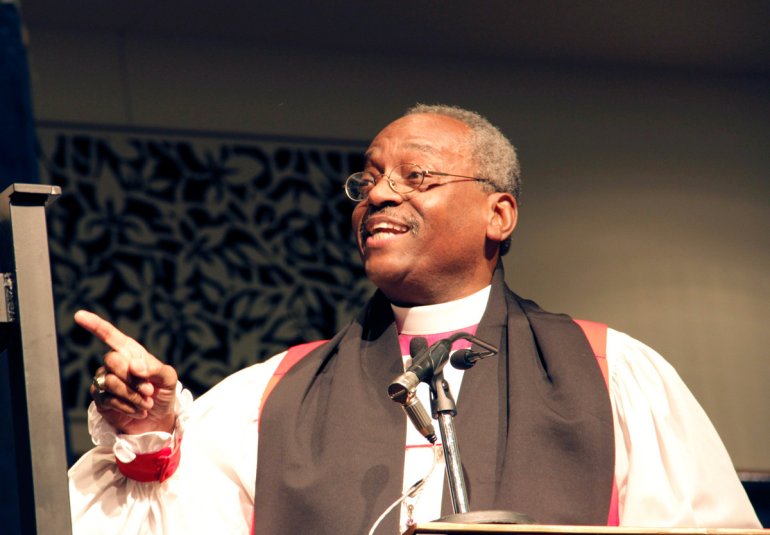
The part of the wedding that seems to have gained the most notice is the homily by the Most Rev. Michael Curry, Presiding Bishop of the Episcopal Church. I watched and listened as Bishop Michael preached. I rejoiced in the strength of his message of love and the centrality of love. I tried not to giggle as the camera panned over the assembled guests, revealing various levels of stiff upper lips, amusement, dismay, joy, and discomfort.

bishop-michael-curry-via-episcopal-digital-networkBishop (no, Brother!) Michael preached the Gospel. He reminded us that love IS the answer, and that “If it’s not about love, it’s not about God.” He asked us to imagine a world where love rules. He mostly didn’t address the marriage couple directly, which some friends of mine have criticized, but his attention was very clearly on them at most times. What this implied to me was that their marriage was to be evidence of the love by which God created the world, by which God redeemed the world, and by which God continues to renew the world. I don’t think they are stupid people: I believe they got the point!

Bishop Michael’s sermon got people’s attention, and that’s a very good thing. He preached the Gospel of Christ to at least a billion people, an opportunity which comes to very few preachers. He did his Church, his Country, his people, and his Lord proud. I am glad to call him a fellow priest of the Anglican Communion. He knows and lives and preaches true evangelism.

The traditions of royalty are not a bad thing. But we were reminded this past Saturday that they are not the whole thing, nor even the main thing. The main thing is the proclamation that “Jesus is Lord,” and that therefore no one else can claim that title. And as Michael Curry reminded us, Jesus’ lordship is not about power, it’s not about prestige, it’s not about titles and dignities. No, it’s all about love: love of God, and love of neighbour.

Best wishes to the newlyweds: may their marriage be to all us of a sign of God’s love.

Looking Through the Cross

Notes for a sermon on 1 Corinthians 1:18-25 at Holy Trinity Anglican Church (Strathcona) on Sunday, March 4, 2018.

What do we see when we look at the cross?

2000px-Coa_Illustration_Cross_Easter.svg.pngI am sure that everyone of us would answer this question in differing personal, theological, and spiritual terms. I am no less sure that we here today share something in how we behold the cross. After all, it has been the principal symbol of our faith since the 4th century. We know about Jesus’ death on the cross. We decorate many of our churches with crosses of all descriptions. Some of us make the sign of the cross. Many people wear crosses on their persons.

The cross is all around us. When a symbol is so all-pervasive, it can become a constant reminder of the reality behind it or … sad to say, it can become wallpaper. We live with it, but it rarely affects us.

When Paul came to Corinth, he did not come carrying a cross, but rather bearing “the message about the cross.” Some people received the message he proclaimed, but many others dismissed it.

Depending upon their background, they heard Paul’s message as a “stumbling block” or simply “foolishness.”

Foolishness? If you expect your God to be a mighty and victorious warrior, immortal and invincible, proclaiming the divinity of a person who died a shameful death is nonsensical. “Real” Gods don’t do that kind of thing!

Stumbling block? If you expect your Messiah to be visibly blessed and honored by God, the assertion that a victim of crucifixion is the Christ is outrageous. More than that, it is scandalous, in the Hebrew sense that it is heard as something that causes a person to sin. (Note that our word “scandal” comes from the Greek for “stumbling block” — skandalon.)

Whichever way people heard it, the actual story of the cross of Christ was clear and immediate to the people of Corinth—a city of the Roman Empire, a regime which kept the peace through violence and intimidation. Rome’s ultimate means of punishment was crucifixion, which was reserved for the worst enemies of the state. In 2018 it is an act about which we must remind ourselves, but in the year 50 in Corinth, it was a common presence in people’s lives. No one needed to be told what it meant.

And today? Can we still be scandalized by the cross? Do we ever see it as mere foolishness? I would suggest that the answer to both questions is “yes,” in the wider world to be sure, but also among folk who are seeking to follow Jesus.

Our Thursday morning study group has just read a book by the late Christopher Lind, entitled “Rumors of a Moral Economy.” Lind wrote of how contemporary society is dominated by a competition-driven economy, which when allowed to function without restraint leads to greater and greater concentration of wealth, and a diminution of the common good.

In pure competition, there are only winners and losers: a system at best indifferent to human needs. In a competition-driven world, proclaiming Christ crucified can easily be heard as exalting a loser.

Lind’s book also pointed to how a moral economy must be rooted in community and a sense of the common good. When community breaks down (as it easily does in a purely competitive situation), people become isolated, and spiritual needs often end up being expressed in questions about what God can do for us. When faith is all about meeting our own needs, nothing less than a totally divine saviour will do, and then we stumble over the idea that Jesus ended his life rejected by all. Some of them will say, “Well, Jesus really was God, so the crucifixion didn’t really matter.” This is an ancient heresy, called “Docetism,” the belief that Jesus only seemed to be human.

Make no mistake: Jesus was as human as you and me. He ate and drank, he slept, he wept, he felt all the things we do. And just as surely, he died as all of us will in our own time.

Jesus gave up his life on the cross to reveal the power and the wisdom of God—already embodied in his own person.

As Paul wrote:

… though he was in the form of God,
   (he) did not regard equality with God
   as something to be exploited,
but emptied himself,
   taking the form of a slave,
   being born in human likeness.
And being found in human form,
   he humbled himself
   and became obedient to the point of death—
   even death on a cross.                                       (Philippians 2:6-8)

The cross defies any ordinary human explanation. There’s no logical deduction, no “standard wisdom,” no simple text-book answer that leads us to the truth of the message Paul brought to Corinth.

God’s power and glory is revealed here, not in a mighty triumph, but in the death of one who was sinless, who gave up his life as a holy sacrifice on behalf of all of God’s people. It is the ultimate act of self-identification with us: all whom Jesus came to redeem.

So: what do we see when we look at the cross?

Let me rephrase the question: what do we see not when we look AT the cross, but when we look THROUGH it?

It is not so much the cross that should demand our attention, but the reality that lies behind and beyond it: the loving-kindness of the God who loved us into being, who loved us enough to send his Son, and who loves us and all humanity every day of our lives.

Let us then hold the cross before us.

Let us see in and through it how Jesus laid down his life for us, in the ultimate and defining act of love, in words from the 1st letter of John.

We know love by this, that he laid down his life for us—and we ought to lay down our lives for one another.                                                    (1 John 3:16)

And Jesus said

This is my commandment, that you love one another as I have loved you. (John 15:12)

The message of the cross is the power of God, and the power of God is love. May this be our proclamation in word and deed, today and always.

Amen.

A Community that Sends

Notes for a sermon preached at Holy Trinity (Strathcona) on August 27, 2017

Texts: Romans 12:1-8; Matthew 16:13-20

Last Sunday, Fr. Chris spoke of the challenge to the Church to “go out.” There is much more that can be said about this, including Archbishop William Temple’s dictum that the “Church is the only society on earth that exists for the benefit of non-members.” One way of stating our mission: We are to go out to be of benefit to the world around us.

Let’s back this up a step or two, and think about who is doing the sending. What kind of group is it that can send its members out in this way? I take my cue from Paul, and his appeal to the church in Rome, part of which we heard in today’s lesson. The lectionary does us a bit of a disservice, by splitting Chapter 12 between two Sundays, but let’s work with what we have been given.

Paul starts out by saying, “I appeal to you therefore…” That last word should alert us to the fact that what comes next is not some sayings plunked into the text in an arbitrary way. It has a context.

The preceding three chapters (9 – 11) deal with what some contemporary scholars consider to be the central issue of Romans, the question of the fate of Israel. Paul agonizes over the problem, lamenting the fact that most Jews have not accepted Jesus as the Messiah. He ultimately refuses to let go of his faith in God’s fidelity to his promises, concluding that in God’s great mercy, salvation would not be denied to the people of Israel. The section closes with an outburst of praise (curiously not in the Lectionary):

O the depth of the riches and wisdom and knowledge of God! How unsearchable are his judgments and how inscrutable his ways! ‘For who has known the mind of the Lord?
   Or who has been his counselor?’
 ‘Or who has given a gift to him,
   to receive a gift in return?’
For from him and through him and to him are all things. To him be the glory for ever. Amen.

And… therefore…

If God has been gracious to all, our response should then be to strive to live lives that reflect that grace, not merely as individuals, but in a company of the faithful whose corporate life displays God’s grace. Paul uses the image of the body, more concisely than in 1 Corinthians 12, to argue that we are interdependent—needing each other and rejoicing in each person’s unique gifts. Paul enjoins us “not to think of [ourselves] more highly than [we] ought to think,” but to regard ourselves with “sober judgment” as members of the Body of Christ. I might use “humility” here, remembering that that doesn’t mean self-abasement (“worm theology”), but being honest with ourselves, with our brothers and sisters, and with God, about who we are and what are our gifts.

It is easy to miss how counter-cultural is Paul’s concept of Christian community. He wrote:

Do not be conformed to this world, but be transformed by the renewing of your minds, so that you may discern what is the will of God…

The world in which Paul lived was the Roman Empire, one of the most successful regimes in history. This was a time of unprecedented peace and prosperity, enforced by Roman military might. However, the Empire relied on a rigidly structured society, in which everyone knew his or her place, and upward social mobility was almost unheard-of. The subjugated peoples of the Empire could enjoy the benefits of Roman rule so long as they kept to their places. Into this mix, Paul throws a huge measure of egalitarianism. When he calls on followers of Christ to see themselves as no better than they should, it implies that they should regard their companions on the way as their equals, just as Jews and Christians are equal in God’s economy of grace and mercy.

The point of the church, however, is not just to build a community where everyone loves each other. That’s a good thing by itself, of course, but the mission of proclaiming God’s love in the marketplace must be based in a people practicing what they preach. The life of the Christian community is a large part of its message.

Harold Percy, a well-known Canadian writer about mission, has outlined Christian mission in terms of the Kingdom of God. We are called
to proclaim the Kingdom,
to celebrate the Kingdom, and
to model the Kingdom.

When people look at us—a community of people who follow Jesus as the Messiah—they should see a body which strives to behave as if God’s reign is being fulfilled in our midst. Our calling is to be a model of the Kingdom. Of course, models never quite live up to the reality they are pointing to; every church community inevitably falls short of the Glory it is striving to proclaim. But that doesn’t mean we should quit trying!

It grieves me deeply to know that there are people who assert themselves over others by “who they are,” at times invoking the name of our Saviour. We saw some of the symptoms of that in Charlottesville two weeks ago. So-called “identity politics” have no place in God’s Kingdom. White supremacy, racism, anti-Semitism, misogynism, homophobia and their like are evils upon the body politic. When they find their way into Church life, they are toxic to the Gospel we are called to proclaim.

We are followers of Jesus of Nazareth, the one whom Peter confessed to be the Messiah. Jesus came to “draw all people to [himself].” As his Body, we are called to draw all people to him, inviting all to share in the grace, mercy, and unbounded love of the God who cannot let his people go.

God loves ALL his people—and so should we!

Let’s go and show it.

Living in the Middle

Notes for a sermon preached at St. George’s, Edmonton on July 16, 2017
Texts: Gen 25:19-34; Ps 119:105-112; Rom 8:1-11; Matt 13:1-9, 18-23

Some years ago, I attended a workshop entitled “Unresolvable but Unavoidable Problems in Church Life” led by the Rev. Roy Oswald of the Alban Institute. The title was a pretty good hook, attracting about 200 clergy and lay people from more than 15 denominations. I have since read Roy Oswald’s book, which expands on the workshop’s content. If he’d used the book’s title for the event, I don’t think he would have drawn nearly as many. “Managing Polarities in Congregations” doesn’t have the same buzz, does it? It’s also quite opaque, unless you’re hep to modern management-speak. (What’s a polarity anyway?)

Polarity_Map cropped

I could quite happily spend a couple of hours or more dealing with this topic and how it applies to church life, but since you didn’t bring bag lunches, I will go straight to the bottom line. There are many situations and issues in life – church, personal, business, government – which are unresolvable because they hold two positive things in tension, which work against each other. We can’t resolve issues like this, but we can learn to live with them.

After attending this workshop, I began to look at life a bit differently. It has been said that if the only tool you have is a hammer, every problem looks like a nail. In my case, finding polarity management very interesting, I started applying it everywhere. Sometimes it was even appropriate to do so!

Enough theory! Let’s look at the Scriptures. This is one of those Sundays when the prescribed lessons have no obvious linking theme. We heard a story of family conflict, an exhortation to “live in the Spirit,” and the best-known of Jesus’ agricultural parables. I suggest that there is something connecting them. Let’s look at them in turn:

First, Genesis, and the story of Esau selling his birthright for a bowl of lentil stew, or as the KJV puts it, “a mess of pottage.” This is quite a family: parents playing favourites, brothers competing for their parents’ approval, and with each other. Esau is a “manly man,” helping the family by hunting for food. His brother Jacob likes to hang out in the tent, helping his mother with the cooking. By traditional patriarchal standards, Esau should be preferred, but his sly brother tricks him into giving up his rights as elder son: this family’s story will continue through the younger brother. It’s not much of a model for family life. None of its members come off very well; all of them live somewhere on the edge of integrity. They live somewhere in the middle between the ordinary ways of the world and holy righteousness. Nonetheless, God’s chosen people will come from this family.

Second: From Romans, we hear Paul contrasting living according to the flesh with living in the Spirit. “To set the mind on the flesh is death, but to set the mind on the Spirit is life and peace.” He expands the contrast in Galatians:

Now the works of the flesh are obvious: fornication, impurity, licentiousness, idolatry, sorcery, enmities, strife, jealousy, anger, quarrels, dissensions, factions, envy, drunkenness, carousing, and things like these. By contrast, the fruit of the Spirit is love, joy, peace, patience, kindness, generosity, faithfulness, gentleness, and self-control.                                                                    Galatians 5:19-21a,22-23a

The choice seems clear: choose the Spirit over the flesh. However, Paul’s assertions that his readers are indeed “in the Spirit” seems to me to be more hopeful than factual. He is telling them what they should be, but surely the truth of most people’s lives is that we struggle with the competing pulls of flesh and Spirit, and live our lives somewhere in the middle, sometimes close to one side, sometimes to the other.

A note here: “flesh” doesn’t just mean things associated with sexual matters. Paul uses it as a generic term for the ways of the present age—the world in which we live. Living “in the flesh” is associating ourselves with things that ultimately do not bring life but death. In contrast, living in the Spirit is living according to the ways of the new age inaugurated through the Resurrection of our Lord. We may know well that this is how we are called to live, but as Paul said in the previous chapter (last Sunday’s lesson), it is all to easy to do the things we do not want, and not do the things we want. Our lives are lived in this ongoing tug-of-war between the ways of this world—the way things are—and the ways of the world to come—the way God wants them to be.

Finally, there’s the parable of the sower, which I have heard re-named “the wasteful farmer.” This man goes out and strews seed without apparent regard for the kind of soil at hand. Much of the seed is wasted, because the soil is beaten down, or rocky, or full of weeds. Only some soil is rich and fertile, bearing grain “some a hundredfold, some sixty, some thirty.” Unlike for other parables, Jesus gives an explanation to his disciples. We can almost hear them saying “We’re the good soil! We will give the good harvest.” Maybe so, but I suspect that those disciples were rather more like most of us. Sometimes we are good soil, and we give a good harvest for the Gospel of Christ, but at other times, we are hampered by the lack of understanding, by the cares of the world, by failing to feed our passion for the Word. The various kinds of soil live within each of us, and thus we live in a constant state of being “between.”

We are both good soil and rocky soil.
We live both in the Spirit and in the flesh.
We live both as people called out by God, and as people experiencing the complications of ordinary life.

We live in the middle.

And yet…

Like Jacob’s troubled family, we are called to build God’s people.
Like the earliest disciples, we are called to be fertile soil for the Word of God.
Like the early saints in Rome, we are called to live into God’s new age, living according to God’s ways.

God knows that we live in the middle—and God still calls us, ready to use us in God’s great mission. God has a purpose for every one of us. May we strive to be aware of our calling, and may we be dedicated to following it, in this world into the next.

Amen.

A theology of money?

Notes for a sermon preached at Holy Trinity Strathcona, Sept. 25, 2016

Texts: Jeremiah 32:1-3A, 6-15; 14-16; 1 Timothy 6:6-19; Luke 16:19-31

At one time I was deeply involved in Stewardship in this Diocese, including 1½ years as Stewardship and Planned Giving Officer. In that capacity, I received many preaching invitations, most often to parishes that perceived themselves as needing help in their finances.

“Stewardship” has become an important word in church life over the last few decades. We did various financial programs before that, but an apparent overemphasis on money per se led us to look for a more “theological” term. It’s not a bad word—it has both biblical and theological import—but it seems to me that it has become a code-word for how we fund the church. I believe most church people, if asked, would now say that stewardship is about getting more money out of church members.

In my last parish, I got a strong negative reaction if I raised the question of Stewardship programs. Previous programs had used some strong-armed tactics. It ended up putting them in a worse financial situation than they might otherwise have been.

A few years ago the church renamed our national office of Stewardship and Financial Development as “Resources for Mission,” emphasizing that the main thing is the Church’s mission, which requires a variety of resources, including, but not limited to, money.

dollar-signThe church sits uneasily with money. I read of a recent meeting of national staff in which they had concluded that we need a new theology of money. I would agree, but I would drop the word “new”—have we have had any really coherent teaching on this subject? Historical church attitudes to money have veered between the extremes of seeking either great wealth or intentional poverty.

In my various parish visits for Stewardship preaching, the clergy often said to me that they were grateful that the Diocese had someone to come and talk about these things, things which made them very uncomfortable. I understand that: a parish priest speaking about money from the pulpit cannot help but be aware that his or her own stipend is a major line item in the parish’s budget—in many cases the largest single expense. It can sound like you’re begging—even if your theology of stewardship is totally sound.

This brings me to today’s lessons, all of which have something to do with money. Maybe they will help us (and maybe also Church House!) get a handle on a theology of money.

First, I Timothy, the source of one of the commonest and most erroneous Bible quotes. People often say that “money is the root of all evil,” but note what is actually written:

…the love of money is a root of all kinds of evil.

It is not money that matters but what we do with it in our lives and in our hearts. Money per se is ethically neutral, a convenient means of exchange, a means to an end, whether good or evil. It has no real existence beyond that, but how we regard it and use it has immense spiritual significance.

…in their eagerness to be rich some have wandered away from the faith and pierced themselves with many pains.

And further on,

(The rich) are to do good, to be rich in good works, generous, and ready to share, thus storing up for themselves the treasure of a good foundation for the future, so that they may take hold of the life that really is life.

It’s what we do with it that counts. God’s Mission is the all-important thing. If we have wealth, we are charged to use it for God’s purposes before ours. Regardless of our own personal wealth or poverty, the challenge is to seek the good, to look to know what will help advance the Kingdom of God in this world, and to use our God-given resources towards that goal.

Sometimes it may be very unclear what will actually advance the Kingdom. The prophet Jeremiah lived in just such a time of great uncertainty and anxiety. The Babylonians were threatening the Kingdom of Judah, the kings were weak, and the people had retreated behind a triumphalist theology. (God had made a covenant with them and would not allow his holy city and temple to fall. All they had to do was invoke his name.) The prophet saw otherwise, understanding the reality of the threat, and the people’s confidence to be misplaced. So he does a prophetic action: he buys some land. This looks like madness when the invading hordes are at your gates, but he offers it as a sign of hope. This may not seem the right time to affirm God’s purposes (probably better to be getting all your stuff together in preparation), but Jeremiah asserts that now is the time to work for the Kingdom.

If not me, then who?
If not here, then where?
If not now, then when?

The answer he gives us is “Me, here, and now.” It is always the right time and place to do God’s work.

And do it we must, lest we end like the rich man in the Gospel. There’s much else that could be said about this story, but it seems that at least part of the message is the injunction to do good when the opportunity presents itself. The rich man had years in which he could have helped Lazarus, but he did nothing. As Jesus tells it, the consequences are clear.

Notwithstanding the current recession, we live in one of the most fortunate countries in the world. The vast majority of our people are well-fed, decently housed, educated, and in good health. We have been given great riches, as a people, and as individuals.

Let us then not fail to use what God has given us for the good of God’s people and God’s world.

Let us keep the eyes of our Spirits open, that we may see the need around us.

And let us keep all of our resources at the ready to do God’s work.

May it be so.

Under Authority

Notes for a sermon on Luke 7:1-10, preached on May 29, 2016 at Holy Trinity Anglican Church (early service)
and Trinity Evangelical Lutheran Church (English service).

ACofC logoELCiC logo

About 15 years ago, on a beautiful Sunday morning in July, I walked with the rest of the Diocese of Edmonton’s General Synod delegation from the Waterloo University residences to the university arena. There we joined with other Anglicans and Lutherans from every part of Canada, and many people from the area around. We joined in a grand and joyful celebration, during the course of which Archbishop Michael Peers and National Bishop Telmor Sartisan signed what is now known as the Waterloo Declaration. Since that time, the Anglican Church of Canada and the Evangelical Lutheran Church in Canada have been in Full Communion. [Pastor Jason’s] [My] presence here today is one of the fruits of that relationship. Trinity Lutheran and Holy Trinity Anglican have been working at building a relationship based on Waterloo.

The years leading up to that day were a time of dialogue between our churches, beginning with discussion among theologians, moving out into the dioceses and synods, and eventually into congregations. In my first charge, I was delighted to share a celebration of shared communion with the neighbouring Lutheran congregation. A few years later, in a different community, after the release of the proposed Waterloo Declaration, I participated with parishioners in a study of the proposed text, along with counterparts from the Lutheran congregation from just down the street.

We had very good discussions over four weeks, but things came to a head when a man from the Lutheran congregation said that this was all very interesting, but what difference would it make to their church? I told him that if their Pastor received another call, and they were in the call process, they would be free to call me if they so desired. “But… but… you are not Lutheran!” was his spluttered response. Aha!

So… what is this all about?

One several levels, it’s about authority, which is one of the underlying themes of today’s Gospel reading. It appears to be a simple story: Jesus is interrupted (something that happens all the time in his ministry) and asked to go to heal the slave of a centurion. Without actually meeting the slave or his master, Jesus effects the healing from a distance. A miracle!

We could leave it there, rejoicing in Jesus’ mastery over the forces of evil and disease. But let’s take a closer look at the story, and especially at the centurion, the second most important character, even though he never appears.

He’s quite a surprising character. The fact that he paid for the synagogue in Capernaum sets him apart immediately as a friend to the people whose land his army is occupying. He is a soldier with a heart, who cares deeply for his sick slave. He recognizes Jesus as a holy man who can help him. He knows enough about Jewish customs and beliefs not to risk defiling Jesus with his physical presence, or asking him into his house. What he has done has already pushed the boundaries of ordinary expectations.

Jesus’ response also pushes those boundaries. His ability to heal the sick is not constrained by space, ethnicity, or social status. Rather, he reaches out to someone beyond his community who recognizes Jesus’ authority, when the centurion declares:

For I also am a man set under authority…

Although he is set under authority, and wields it over others, the centurion’s power is limited. He can’t heal his slave without appealing to Jesus’ authority. Jesus likewise is “set under authority,” doing the will of his Father in heaven in bringing healing to this world.

“Authority” has a particular meaning in the New Testament. It is associated with power—the ability to do things—but it is more than that. Having authority implies the legal or moral right to exercise power, which means that the power and the right come from elsewhere. The centurion has authority under the rules of the Roman Empire and its army. Jesus’ authority comes from God alone.

After the Resurrection, Jesus committed his authority to proclaim and to build the Reign of God to his disciples. We read in John 20:21

Jesus said to them again, ‘Peace be with you. As the Father has sent me, so I send you.’

We are the inheritors of Jesus’ authority, and so we are called to exercise that authority in the knowledge of its source. It comes ultimately from God, through Jesus, through the apostles, down the ages in the Church with all its historical twists and turns, to us today, in this building in this city in this year.

Authority brings responsibility. Power can never be left idle. Having the ability to do good demands of us that we actually do good. Power must also be exercised rightly. The moral or legal right to do things does not mean that whatever we do is the right thing.

It is no accident that the Church has devoted a huge amount of energy over the centuries to the matter of authority. It goes back right into the New Testament, beginning in Acts, when the eleven remaining apostles added Matthias to their number, only after making certain that he had the right history. Later the Church in Jerusalem needed to check Paul’s credentials before agreeing that his mission could continue. First Timothy contains a detailed list of qualifications for a bishop.

In today’s Church, as both Lutherans and Anglicans have received it, we give great attention to authorizing people to the ministry of word and sacrament. For both communions, these are crucial matters. Article VII of the Augsburg Confession says this:

The Church is the congregation of saints, in which the Gospel is rightly taught and the Sacraments are rightly administered.

You can find almost the same words in Article XIX of the (Anglican) Articles of Religion.

We spend a huge amount of our institutional energy in trying to ensure that the people who lead our congregations—both lay and ordained—are properly authorized. Some people may view that at as a waste of time, but I would submit that it is of utmost importance. Jesus was “under authority.” He left his church under the same authority. We are under God’s authority, called to help build God’s kingdom in this world.

May all our doings, corporate and individual, display our commitment to doing our Lord’s will.

Amen.