Notes for a sermon on John 6:1-21, July 29, 2018,
Holy Trinity Anglican Church (Strathcona), Edmonton
Some life-changing events come about almost by accident. I had an epiphany once at a clergy conference on Christian Education. The presenter was talking about how various kinds of educational events and programs attract people at various stages of spiritual development. In part of her talk, she said that one group of people were the sort who would always support certain programs, but we shouldn’t expect there to be very many of them.
Then she stopped, saying that she got very impatient with people who said things like “We had a mission event, and it was a total failure – only 6 people showed up!” “What do you mean, ONLY 6? You had 6 people who were moved to turn up. God sent you those people. Give thanks for that, and work with them!”
After that digression, she resumed her prepared talk, but I don’t recall taking much of it in. I had been totally blown away by what I had just heard. I sat and thought about it, realizing that it was just what Jesus did in the first part of our Gospel for today.
The feeding of the 5,000 was a major event in Jesus’ ministry. It’s one of the few stories that appears in all four Gospels, with the details nearly identical between them, and in all four it is followed immediately by Jesus walking on the water. We could spend a lot of time speculating on the “how” of the story; to do that seems to me rather to miss the point.
Jesus’ exchange with Phillip and Andrew shows how the disciples are thinking: there is not enough to feed the masses, and there’s no reasonable expectation that they could get enough together to do it. There’s just not enough! What Jesus does is not to ask if there’s enough, but rather to ask what they can put their hands on. Five loaves and two fish! A realist might say at that time “Better send them all home – there’s nothing we can do.” Jesus has a different idea: he takes what God has provided, gives thanks, and proceeds to work with what he has.
Against all expectations, the people were fed, with 12 baskets left over.

How it happened is unanswerable. What happened is clear: as the story has come to us, Jesus acted, and people were fed. He challenged his disciples’ scarcity mindset. He used what was at hand to show that God’s generosity will not be limited. Why it happened is the point: very simply, to demonstrate God’s unbounded love in action.
Against all expectations, God’s abundance will defeat our myth of scarcity – every time! But like Phillip and Andrew we need to learn to trust in it.
But isn’t the scarcity narrative powerful? Our society is built on the notion of shortages. People believe there is never enough, so we hoard our wealth and live in fear of running short. It becomes a dog-eat-dog world, dedicated to the survival of the fittest, as people compete for what we believe are increasingly scarce resources.
I believe the results are clear.
There are people going hungry all over the world, not just in far-flung places, but in homes in this wealthy province.
There are people without access to clean water, not just in far-flung places, but in areas of our country largely populated by Indigenous people.
There are people without adequate (or any) housing, not just in far-flung places, but within a few blocks of this church building.
Why does this happen? I believe it is because we become so focused on scarcity that we lose our trust in God’s abundance and God’s desire to share this bounty with all of God’s people.
The scarcity bug often infects the church. “We can’t do that, because we don’t have…” (fill in the blanks!)
Not long after that clergy conference I had the opportunity to put my epiphany into practice. The parish where I was then the Rector was joining a multi-church program called NeighborLink. The program pools volunteers from churches to provide helping services to people in the community. Each participating church recruits a coordinator and a roster of volunteers, who are then deployed through a central office. We had appointed a coordinator and put out a call for volunteers with a date set for commissioning them.
Three weeks before the date, the coordinator came into my office and said, “Robin, we’ve got to pull the plug. It won’t work. We have only three volunteers.” Thinking that we had no reasonable expectation of any more, I was about to agree, when I thought of that insight from the conference. “Wait a second,” I said, “we have three volunteers. Let’s give thanks for them, and then work with what God has given us.” She sat there for a moment looking stunned, and then said, “Maybe you’re right.”
Against all expectations, three weeks later we commissioned 10 volunteers.
It wasn’t quite 5 loaves and 2 fish feeding 5,000, but it certainly felt a bit like that. We trusted in God’s goodness, gave thanks, and worked with what we had.
My friends, let us strive never to live with a mindset of scarcity, but rather rejoice in the abundance of God’s creation, giving thanks for all things at all times.
Jesus came to show us God’s love in action.
Against all expectations, he fed people in their time of hunger.
Against all expectations, he brought peace to his disciples, terrified on the storm-tossed sea.
Against all expectations, he defeated the powers of sin and death by giving up his own life.
Against all expectations, he lived God’s love in a world which so desperately needed (and still needs) to know it.
Against all expectations, he showed that God’s love can never be exhausted.
Against all expectations, he loves us all.
May we live in that love, rejoicing in God’s inexhaustible abundance. Let us give thanks, and then let us work with what God has given us.
Thanks be to God. Amen.
 Today I encountered a number which for me is very interesting, the number 70. What’s interesting about it? Only that age 70 sounds to me a lot older than age 69. Maybe it’s the change in the first digit, something that’s only happened to me 6 times before. Age is a physical reality, but it’s also a mental and emotional reality.
 I’ve now been retired for about 5 years (Since June 23 or July 31, 2013, depending on how you reckon it.) I’ve enjoyed most of those years, especially the last two or three. It’s good to be free to make your own decisions about what to do with your time, without too many occupational restrictions. I had some plans when I retired. Some have borne fruit, others have been deferred, still others have been put away permanently, and some new things have arisen. I’m not making many new plans at the moment, except for our 50th wedding anniversary celebrations in just over a year.
 given for a purpose beyond our own needs. That means that stewardship is very much about money, but before it’s about money, it’s about how we use our treasure to move forward in our participation in God’s mission.
 Queen Elizabeth II is a remarkable woman, a person for whom I have great respect. She has negotiated the demands of a more-or-less impossible job with grace, dignity, and resolution. She will be greatly mourned by many, including this writer, when she dies.
 I congratulate Prince Harry and Meghan. Love has brought them together, and I pray that love will see them through the years ahead. It will probably not be easy for either of them, especially her, although she does seem to have her eyes wide open.
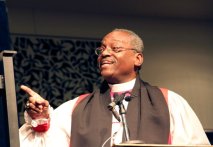 Bishop (no, Brother!) Michael preached the Gospel. He reminded us that love IS the answer, and that “If it’s not about love, it’s not about God.” He asked us to imagine a world where love rules. He mostly didn’t address the marriage couple directly, which some friends of mine have criticized, but his attention was very clearly on them at most times. What this implied to me was that their marriage was to be evidence of the love by which God created the world, by which God redeemed the world, and by which God continues to renew the world. I don’t think they are stupid people: I believe they got the point!
 s beginning, Anglicanism has placed a high value on the public reading of Scripture. Besides being written in English, the first Book of Common Prayer (1549) made some important innovations in worship. Cranmer reduced the multiple monastic daily services to two, the “daily offices” of Morning and Evening Prayer, with the implied expectation that people would participate daily. A system of reading the scriptures (a “lectionary”) was provided for these services, so that anyone who attended them regularly would hear the entire Old Testament every two years, the New Testament three times a year, and the Psalms monthly. While daily attendance at the offices was the exception, the Prayer Book established the centrality of the Scripture in our worship.
 I am sure that everyone of us would answer this question in differing personal, theological, and spiritual terms. I am no less sure that we here today share something in how we behold the cross. After all, it has been the principal symbol of our faith since the 4th century. We know about Jesus’ death on the cross. We decorate many of our churches with crosses of all descriptions. Some of us make the sign of the cross. Many people wear crosses on their persons.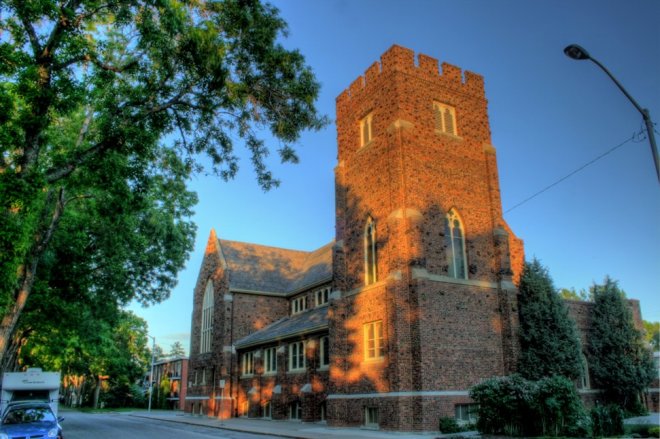
 t belie the goals with which we have been charged. We fail because we are human, but our failures are inevitably held up against the strong light of divine ideals. There’s nothing wrong, and everything right, about those ideals. Nonetheless, we should temper our expectations with the knowledge that people can and do fail.


 Into the blue...