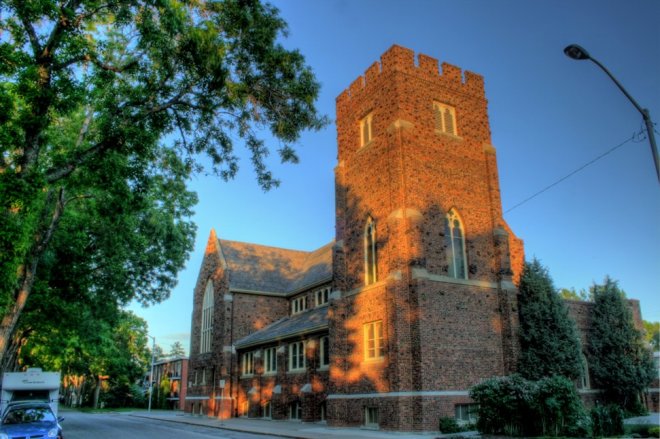
Doing it again

Today I had the privilege of preaching and presiding at the Eucharist at Holy Trinity (aka “HTAC”). I had been scheduled to preach for a while, but other commitments took both our Rector and our Assistant Priest away from the parish. So…

Yours truly got to do what I used to do most Sundays for a quarter of a century. They say that riding a bike is easy once you learn how to do it, and once you have learned, doing it again is simple. You just get in the saddle and pedal.

That’s rather how today felt. HTAC is not “my” parish, at least not in the sense that St. Matthew’s Cathedral and St. Augustine’s-Parkland were. There, I was the Rector, expected to be present and available every day, and to do what had to be done at pulpit and altar most Sundays. Most Sundays at HTAC, I’m sitting in the back row of the bass section in the church choir, and happy to be there.

Today was different. I prayed with the choir before the service as usual, but today I led the prayers. I sang the psalm with the choir, but today from the presider’s desk. I proclaimed the Gospel and preached, and then went to the altar to preside at the sacrament.

These things happen every Sunday at HTAC. But today I assumed roles that other people usually take. And (I have to confess) it felt good.

Readers of this blog may have intuited that I wasn’t really ready to retire in 2013, but rather that the situation was forced on me. Today reminded me that I still feel most alive when I’m ministering in the pulpit and at the altar. I still believe that this I what God made me for, but I recognize that other people have similar calls, and that I have to let go as I am able.

I am truly grateful for today’s experience. I hope that my ministry today helped at least someone. That’s all I can expect, and all any ordained person can hope for.

Thanks be to God for this day. I have posted the text for today’s sermon under “Sermons and theological discussions.” Read it HERE.

Holy_Trinity_Anglican_Church_Edmonton_Alberta_Canada_01A
View from the Northwest – 100 Street and 84 Ave.

A Community that Sends

Notes for a sermon preached at Holy Trinity (Strathcona) on August 27, 2017

Texts: Romans 12:1-8; Matthew 16:13-20

Last Sunday, Fr. Chris spoke of the challenge to the Church to “go out.” There is much more that can be said about this, including Archbishop William Temple’s dictum that the “Church is the only society on earth that exists for the benefit of non-members.” One way of stating our mission: We are to go out to be of benefit to the world around us.

Let’s back this up a step or two, and think about who is doing the sending. What kind of group is it that can send its members out in this way? I take my cue from Paul, and his appeal to the church in Rome, part of which we heard in today’s lesson. The lectionary does us a bit of a disservice, by splitting Chapter 12 between two Sundays, but let’s work with what we have been given.

Paul starts out by saying, “I appeal to you therefore…” That last word should alert us to the fact that what comes next is not some sayings plunked into the text in an arbitrary way. It has a context.

The preceding three chapters (9 – 11) deal with what some contemporary scholars consider to be the central issue of Romans, the question of the fate of Israel. Paul agonizes over the problem, lamenting the fact that most Jews have not accepted Jesus as the Messiah. He ultimately refuses to let go of his faith in God’s fidelity to his promises, concluding that in God’s great mercy, salvation would not be denied to the people of Israel. The section closes with an outburst of praise (curiously not in the Lectionary):

O the depth of the riches and wisdom and knowledge of God! How unsearchable are his judgments and how inscrutable his ways! ‘For who has known the mind of the Lord?
   Or who has been his counselor?’
 ‘Or who has given a gift to him,
   to receive a gift in return?’
For from him and through him and to him are all things. To him be the glory for ever. Amen.

And… therefore…

If God has been gracious to all, our response should then be to strive to live lives that reflect that grace, not merely as individuals, but in a company of the faithful whose corporate life displays God’s grace. Paul uses the image of the body, more concisely than in 1 Corinthians 12, to argue that we are interdependent—needing each other and rejoicing in each person’s unique gifts. Paul enjoins us “not to think of [ourselves] more highly than [we] ought to think,” but to regard ourselves with “sober judgment” as members of the Body of Christ. I might use “humility” here, remembering that that doesn’t mean self-abasement (“worm theology”), but being honest with ourselves, with our brothers and sisters, and with God, about who we are and what are our gifts.

It is easy to miss how counter-cultural is Paul’s concept of Christian community. He wrote:

Do not be conformed to this world, but be transformed by the renewing of your minds, so that you may discern what is the will of God…

The world in which Paul lived was the Roman Empire, one of the most successful regimes in history. This was a time of unprecedented peace and prosperity, enforced by Roman military might. However, the Empire relied on a rigidly structured society, in which everyone knew his or her place, and upward social mobility was almost unheard-of. The subjugated peoples of the Empire could enjoy the benefits of Roman rule so long as they kept to their places. Into this mix, Paul throws a huge measure of egalitarianism. When he calls on followers of Christ to see themselves as no better than they should, it implies that they should regard their companions on the way as their equals, just as Jews and Christians are equal in God’s economy of grace and mercy.

The point of the church, however, is not just to build a community where everyone loves each other. That’s a good thing by itself, of course, but the mission of proclaiming God’s love in the marketplace must be based in a people practicing what they preach. The life of the Christian community is a large part of its message.

Harold Percy, a well-known Canadian writer about mission, has outlined Christian mission in terms of the Kingdom of God. We are called
to proclaim the Kingdom,
to celebrate the Kingdom, and
to model the Kingdom.

When people look at us—a community of people who follow Jesus as the Messiah—they should see a body which strives to behave as if God’s reign is being fulfilled in our midst. Our calling is to be a model of the Kingdom. Of course, models never quite live up to the reality they are pointing to; every church community inevitably falls short of the Glory it is striving to proclaim. But that doesn’t mean we should quit trying!

It grieves me deeply to know that there are people who assert themselves over others by “who they are,” at times invoking the name of our Saviour. We saw some of the symptoms of that in Charlottesville two weeks ago. So-called “identity politics” have no place in God’s Kingdom. White supremacy, racism, anti-Semitism, misogynism, homophobia and their like are evils upon the body politic. When they find their way into Church life, they are toxic to the Gospel we are called to proclaim.

We are followers of Jesus of Nazareth, the one whom Peter confessed to be the Messiah. Jesus came to “draw all people to [himself].” As his Body, we are called to draw all people to him, inviting all to share in the grace, mercy, and unbounded love of the God who cannot let his people go.

God loves ALL his people—and so should we!

Let’s go and show it.

Hiding in plain sight

Reflections on Joseph of Arimathea

Today at the “Saints Eucharist” at Holy Trinity we remembered Joseph of Arimathea. He is mentioned only once in each of the four Gospels (Matthew: 27:57-60Mark 15:43-46Luke 23:50-55John 19:38-42), but all affirm that he gave his tomb for the burial of Jesus. There are various post-Biblical legends about him, including a trip to Britain, where he is said to have planted the holy thorn tree that grows at Glastonbury. He is also said to have taken the Holy Grail with him, and hidden it somewhere in that vicinity. (Holy Grail: the cup used at the Last Supper.)

We had a short discusstombion about this before beginning the Eucharist, focussing on the question of why people thought it necessary to remember someone for things that very likely did not happen, glossing over the one solid piece of evidence about his life. Giving a tomb for Jesus’ burial was an act of devotion and generosity that had profound importance in the Gospel story: why can’t we be satisfied with that? Joseph isn’t alone in this. There are other New Testament figures about whom various legends grew up, mostly without solid attestation, often imputing miraculous lives to these individuals.
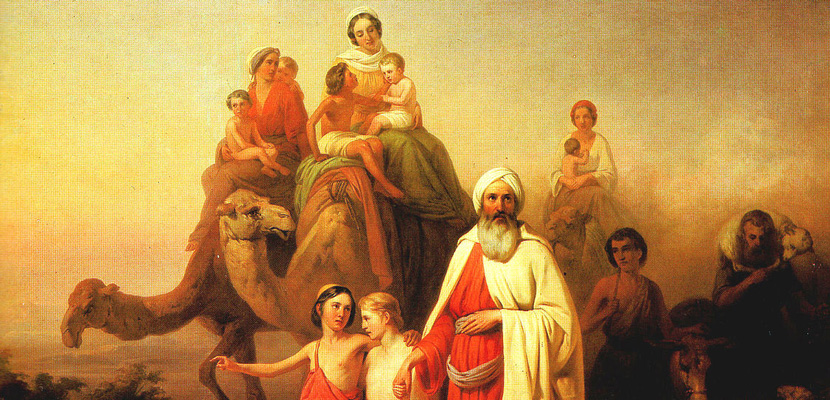
The speculation we entertained was that people are often not satisfied with “ordinary” events as a medium of seeing God in action. If we can ascribe super-natural acts to someone, it may be a more obvious way to see the divine at work in human life. We have trouble understanding something as simple as giving a grave for someone’s burial as an “Act of God“. Insurance companies understand that term as something mostly unpredictable and entirely outside human control. But surely Joseph’s simple deed was divinely inspired, advancing the story of salvation history in a small but vital way. No burial = no death. No death = no resurrection. No resurrection = no salvation.

I believe that God is at work in ordinary human lives in ways that most people have trouble perceiving or articulating. Having a cup of tea with a lonely senior is just as much an Act of God as a hurricane. The Kingdom of God — how things ought to be — can be seen in the very small and (apparently) very ordinary. When we see it, the ordinary becomes extraordinary, revealing what was there all along for us to see — hiding in plain sight.

Being one of “the saints” should not mean being somehow superhuman and supernatural. It should rather mean being a person whose life displays what God intended for human life — sometimes apparently very ordinary, but touching other people in a way that makes God’s ways visible. If we look with the eyes of the spirit, we will see God at work in all sorts of people around us, not necessarily in the supernatural kind of miracle (whose existence I am not denying), but showing forth God’s love, mercy, and grace in many different ways in daily life.

We are all called to be saints — to make visible what God intends for this world. Many who are working out their salvation “in fear and trembling” are all around us. Look for them. They don’t have halos. They don’t always glow with otherworldly radiance. But they reveal to all who will see what holy living is all about.

Joseph of Arimathea did a holy thing: he was a holy person. We remember him for this one special deed.

Look around you today. Who is doing holy things? God’s saints are hiding in plain sight everywhere we care to look, everywhere we turn the eyes of our spirits. See them. Pray for them. Give thanks for them. Love what they do, and do what they love.

Beloved, let us love one another, because love is from God;
everyone who loves is born of God and knows God. (1 John 4:7)

heartofholiness


On the journey to…

A sermon this morning on Genesis 12:1-4a (the call of Abram) started me thinking about various times in my life I have stepped out of what might be expected, and gone where the call has led.

The first was not of my own volition, but my parents’. When I was only three years old, they decided to pull up roots in England and transplant our family to Canada. We settled in Drumheller, Alberta, a far cry from the great metropolis of London where I was born. I don’t know exactly how my parents felt about it at the time, but it became clear over the years that being so far from family and old friends was difficult for both of them, especially my mother. My early years in this country were marked by a sense of being “not quite at home,” a feeling that has stayed with me throughout my life.

The second such event came when I left teaching school to return to Edmonton, and to do… I wasn’t quite sure what! All my spouse and I knew was that we couldn’t stay where we were, and the opportunities were far greater in the city where we had both attended University. Some family members were horrified that I would give a seemingly secure and respectable job to search for something different.

That move led to a graduate degree, a job with our Provincial Government, and us settling down as a family. But God had other ideas. After nine years in that job, we again pulled up stakes and left for Saskatoon for me to enter theological college. I had no real idea where this was leading, except for the conviction that I was called to go down this road.

The road led to ordination and the call to be the pastor of a small-town parish. It was a great adventure, but not without its problems. After a few years there, I moved on to a suburban parish, where I stayed almost thirteen years. In time, I felt the need to move on: I accepted a call to become Dean and Rector of St. Matthew’s Cathedral, Brandon, Manitoba.

This was another move into the unknown: a new parish, a new city, a new province, and a new diocese. I didn’t realize at the time just how big a move this would be. Local customs are different, even at the relatively small remove of a couple of Canadian provinces. But we persisted, through some great years, and some not-so-great, until my retirement in 2013.

Each one of those moves required a measure of faith. In every case, I had the sense that I was going where I had to go, except perhaps the first one, when I had no choice in the matter.

In two of the places where I served the Church, I had conversations with people whose whole lives had been centered on that place. Many of them were puzzled why I might want to live somewhere else: “[town] has everything a person needs.” That may have been true, but going elsewhere was not contingent upon needs, but upon a call, just as Abram heard God’s call to leave home and family and travel to “a land which I will show you.”

I have been on this journey all my life, and now God has brought me to a place where I might reasonably hope to live out my days in peace and reasonable comfort. Sometimes, though, I find myself wondering…

A theology of money?

Notes for a sermon preached at Holy Trinity Strathcona, Sept. 25, 2016

Texts: Jeremiah 32:1-3A, 6-15; 14-16; 1 Timothy 6:6-19; Luke 16:19-31

At one time I was deeply involved in Stewardship in this Diocese, including 1½ years as Stewardship and Planned Giving Officer. In that capacity, I received many preaching invitations, most often to parishes that perceived themselves as needing help in their finances.

“Stewardship” has become an important word in church life over the last few decades. We did various financial programs before that, but an apparent overemphasis on money per se led us to look for a more “theological” term. It’s not a bad word—it has both biblical and theological import—but it seems to me that it has become a code-word for how we fund the church. I believe most church people, if asked, would now say that stewardship is about getting more money out of church members.

In my last parish, I got a strong negative reaction if I raised the question of Stewardship programs. Previous programs had used some strong-armed tactics. It ended up putting them in a worse financial situation than they might otherwise have been.

A few years ago the church renamed our national office of Stewardship and Financial Development as “Resources for Mission,” emphasizing that the main thing is the Church’s mission, which requires a variety of resources, including, but not limited to, money.

dollar-signThe church sits uneasily with money. I read of a recent meeting of national staff in which they had concluded that we need a new theology of money. I would agree, but I would drop the word “new”—have we have had any really coherent teaching on this subject? Historical church attitudes to money have veered between the extremes of seeking either great wealth or intentional poverty.


In my various parish visits for Stewardship preaching, the clergy often said to me that they were grateful that the Diocese had someone to come and talk about these things, things which made them very uncomfortable. I understand that: a parish priest speaking about money from the pulpit cannot help but be aware that his or her own stipend is a major line item in the parish’s budget—in many cases the largest single expense. It can sound like you’re begging—even if your theology of stewardship is totally sound.

This brings me to today’s lessons, all of which have something to do with money. Maybe they will help us (and maybe also Church House!) get a handle on a theology of money.

First, I Timothy, the source of one of the commonest and most erroneous Bible quotes. People often say that “money is the root of all evil,” but note what is actually written:

…the love of money is a root of all kinds of evil.

It is not money that matters but what we do with it in our lives and in our hearts. Money per se is ethically neutral, a convenient means of exchange, a means to an end, whether good or evil. It has no real existence beyond that, but how we regard it and use it has immense spiritual significance.

…in their eagerness to be rich some have wandered away from the faith and pierced themselves with many pains.

And further on,

(The rich) are to do good, to be rich in good works, generous, and ready to share, thus storing up for themselves the treasure of a good foundation for the future, so that they may take hold of the life that really is life.

It’s what we do with it that counts. God’s Mission is the all-important thing. If we have wealth, we are charged to use it for God’s purposes before ours. Regardless of our own personal wealth or poverty, the challenge is to seek the good, to look to know what will help advance the Kingdom of God in this world, and to use our God-given resources towards that goal.

Sometimes it may be very unclear what will actually advance the Kingdom. The prophet Jeremiah lived in just such a time of great uncertainty and anxiety. The Babylonians were threatening the Kingdom of Judah, the kings were weak, and the people had retreated behind a triumphalist theology. (God had made a covenant with them and would not allow his holy city and temple to fall. All they had to do was invoke his name.) The prophet saw otherwise, understanding the reality of the threat, and the people’s confidence to be misplaced. So he does a prophetic action: he buys some land. This looks like madness when the invading hordes are at your gates, but he offers it as a sign of hope. This may not seem the right time to affirm God’s purposes (probably better to be getting all your stuff together in preparation), but Jeremiah asserts that now is the time to work for the Kingdom.

If not me, then who?
If not here, then where?
If not now, then when?

The answer he gives us is “Me, here, and now.” It is always the right time and place to do God’s work.

And do it we must, lest we end like the rich man in the Gospel. There’s much else that could be said about this story, but it seems that at least part of the message is the injunction to do good when the opportunity presents itself. The rich man had years in which he could have helped Lazarus, but he did nothing. As Jesus tells it, the consequences are clear.

Notwithstanding the current recession, we live in one of the most fortunate countries in the world. The vast majority of our people are well-fed, decently housed, educated, and in good health. We have been given great riches, as a people, and as individuals.

Let us then not fail to use what God has given us for the good of God’s people and God’s world.

Let us keep the eyes of our Spirits open, that we may see the need around us.

And let us keep all of our resources at the ready to do God’s work.

May it be so.

Under Authority

Notes for a sermon on Luke 7:1-10, preached on May 29, 2016 at Holy Trinity Anglican Church (early service)
and Trinity Evangelical Lutheran Church (English service).

ACofC logoELCiC logo

About 15 years ago, on a beautiful Sunday morning in July, I walked with the rest of the Diocese of Edmonton’s General Synod delegation from the Waterloo University residences to the university arena. There we joined with other Anglicans and Lutherans from every part of Canada, and many people from the area around. We joined in a grand and joyful celebration, during the course of which Archbishop Michael Peers and National Bishop Telmor Sartisan signed what is now known as the Waterloo Declaration. Since that time, the Anglican Church of Canada and the Evangelical Lutheran Church in Canada have been in Full Communion. [Pastor Jason’s] [My] presence here today is one of the fruits of that relationship. Trinity Lutheran and Holy Trinity Anglican have been working at building a relationship based on Waterloo.

The years leading up to that day were a time of dialogue between our churches, beginning with discussion among theologians, moving out into the dioceses and synods, and eventually into congregations. In my first charge, I was delighted to share a celebration of shared communion with the neighbouring Lutheran congregation. A few years later, in a different community, after the release of the proposed Waterloo Declaration, I participated with parishioners in a study of the proposed text, along with counterparts from the Lutheran congregation from just down the street.

We had very good discussions over four weeks, but things came to a head when a man from the Lutheran congregation said that this was all very interesting, but what difference would it make to their church? I told him that if their Pastor received another call, and they were in the call process, they would be free to call me if they so desired. “But… but… you are not Lutheran!” was his spluttered response. Aha!

So… what is this all about?

One several levels, it’s about authority, which is one of the underlying themes of today’s Gospel reading. It appears to be a simple story: Jesus is interrupted (something that happens all the time in his ministry) and asked to go to heal the slave of a centurion. Without actually meeting the slave or his master, Jesus effects the healing from a distance. A miracle!

We could leave it there, rejoicing in Jesus’ mastery over the forces of evil and disease. But let’s take a closer look at the story, and especially at the centurion, the second most important character, even though he never appears.

He’s quite a surprising character. The fact that he paid for the synagogue in Capernaum sets him apart immediately as a friend to the people whose land his army is occupying. He is a soldier with a heart, who cares deeply for his sick slave. He recognizes Jesus as a holy man who can help him. He knows enough about Jewish customs and beliefs not to risk defiling Jesus with his physical presence, or asking him into his house. What he has done has already pushed the boundaries of ordinary expectations.

Jesus’ response also pushes those boundaries. His ability to heal the sick is not constrained by space, ethnicity, or social status. Rather, he reaches out to someone beyond his community who recognizes Jesus’ authority, when the centurion declares:

For I also am a man set under authority…

Although he is set under authority, and wields it over others, the centurion’s power is limited. He can’t heal his slave without appealing to Jesus’ authority. Jesus likewise is “set under authority,” doing the will of his Father in heaven in bringing healing to this world.

“Authority” has a particular meaning in the New Testament. It is associated with power—the ability to do things—but it is more than that. Having authority implies the legal or moral right to exercise power, which means that the power and the right come from elsewhere. The centurion has authority under the rules of the Roman Empire and its army. Jesus’ authority comes from God alone.

After the Resurrection, Jesus committed his authority to proclaim and to build the Reign of God to his disciples. We read in John 20:21

Jesus said to them again, ‘Peace be with you. As the Father has sent me, so I send you.’

We are the inheritors of Jesus’ authority, and so we are called to exercise that authority in the knowledge of its source. It comes ultimately from God, through Jesus, through the apostles, down the ages in the Church with all its historical twists and turns, to us today, in this building in this city in this year.

Authority brings responsibility. Power can never be left idle. Having the ability to do good demands of us that we actually do good. Power must also be exercised rightly. The moral or legal right to do things does not mean that whatever we do is the right thing.

It is no accident that the Church has devoted a huge amount of energy over the centuries to the matter of authority. It goes back right into the New Testament, beginning in Acts, when the eleven remaining apostles added Matthias to their number, only after making certain that he had the right history. Later the Church in Jerusalem needed to check Paul’s credentials before agreeing that his mission could continue. First Timothy contains a detailed list of qualifications for a bishop.

In today’s Church, as both Lutherans and Anglicans have received it, we give great attention to authorizing people to the ministry of word and sacrament. For both communions, these are crucial matters. Article VII of the Augsburg Confession says this:

The Church is the congregation of saints, in which the Gospel is rightly taught and the Sacraments are rightly administered.

You can find almost the same words in Article XIX of the (Anglican) Articles of Religion.

We spend a huge amount of our institutional energy in trying to ensure that the people who lead our congregations—both lay and ordained—are properly authorized. Some people may view that at as a waste of time, but I would submit that it is of utmost importance. Jesus was “under authority.” He left his church under the same authority. We are under God’s authority, called to help build God’s kingdom in this world.

May all our doings, corporate and individual, display our commitment to doing our Lord’s will.

Amen.

All Things New

Notes for a sermon on Rev. 21:1-6
Holy Trinity Edmonton, April 24, 2016

These past two Thursdays mornings, the study group discussed “This Holy Estate,” the report by a commission of the General Synod which seeks to find a theological case for the amendment of the Marriage Canon to permit same-gender weddings. I’m not going to discuss the report here, but one of the report’s questions on which the group spent time was the issue of how Anglicans use scripture. The answer is—to put it very broadly—very broadly!

Even within the group who met this week, we found a wide range of approaches to the Bible. I believe we would be fairly representative of the spectrum of Anglican practice. But even within this spectrum, none of us approached the Bible completely literally. More importantly, I believe, all of us affirmed the value of interpreting it in community.

The question of how to read and interpret Scripture is crucial; not just in the matter of same-gender marriages, but in how we frame the corporate life of the Church. We Anglicans have historically defined ourselves as a liturgical church, not simply because we “do liturgy,” but because our Scripture-filled liturgies express who we are.

Why am I spending time on this? In part because it’s a current topic in the Church’s decision-making, but also because we are in the midst of a series of readings from the Revelation to John, the book of the Bible with the most convoluted and controversial interpretational history.

It has a complex history of usage. It almost didn’t make it into the Bible. In the Orthodox Churches, which never read it in their liturgies, it functions more like an appendix. Some today tend to dismiss it as a historical relic with little relevance today. Other churches find it a rich source, constantly mining it to attempt to read the signs of our times. The central interpretational problem, I believe, is in the book’s use of symbolism, more by far than other book of the Bible.

My view of Revelation: it is a letter to seven churches experiencing oppression under the Roman Empire, probably written in the last decade of the 1st century. It uses coded language and symbols, largely drawn from Ezekiel and Daniel, telling of the tribulations that the churches will face, and exhorting them to stand firm, because, in the end – God will win! The meaning of the symbolism would be clear to anyone familiar with the Hebrew Scriptures, but unintelligible to others. Reading its message could be dangerous in the political climate of the time. Perhaps we could think of Revelation as “underground prophecy”.

One thing I am sure it is not is a book of clues about how to read contemporary events. Its roots are in the 1st-century Church, and the actions of “Babylon the Great” (read “Rome”) in the oppression of Christians who refused to bow the knee to Caesar.

For three Sundays we have selections from the book’s final chapters, presenting John’s vision of “a new heaven and a new earth” and the New Jerusalem, coming down out of heaven. There are great battles in the preceding chapters, but now we hear God proclaiming that he will make his dwelling place among humanity, and every tear will be wiped away. It is a vision of everlasting peace and justice, and of the ultimate fulfillment of God’s purpose for creation.

It is not a vision of death and destruction and the ending of time. There is no rapturing of the faithful into heaven, no wiping out of all things. Instead, we see a new creation, where God will reign among his people for ever.

But just what does this mean: a “new” earth?

A family member makes his living as a cabinet maker. He recently posted some job pictures, showing a kitchen before and after his work. It was recognizably the same space, with the same general layout, but it was clearly new – almost unrecognizable. It was the same, but renewed, freshened, given new life. It seems to me that the new creation of which John tells us is much like this: the same, but renewed and given new life and purpose. It recalls stories of resurrection appearances in which Jesus is not recognized at until some cue happens. Remember how Mary Magdalene at the tomb believes Jesus to be the gardener until he calls her by name.

The same but different is an integral part of John’s vision for the age to come.

It is a vision of a redeemed creation. We are perhaps more accustomed to thinking of redemption as pertaining to people, but we should never forget that we human beings a part of creation. We are not independent from this earth, but are radically dependent on it. God’s self-description points to this dependence:

alpha and omegaI am the Alpha and the Omega,
the beginning and the end.

The second part could also be translated as “the origin and the fulfillment.” The end (Gk telos) is not a point beyond which nothing else is, but the fulfillment of God’s intentions for this renewed creation. From here on, everything will work together in harmony according to God’s desires—all creation singing God’s praises as the divine purposes are brought to be.

John’s final vision is of the world (creation) as it should be. It is a future vision, to be sure. It might be easy and tempting to dismiss it, but let us please not do that. Let us instead affirm that God will, in God’s own time, restore and redeem creation, and that God’s people will live in peace and justice for ever.

In the meantime—in these times—we are charged not to cede defeat to the powers, but to stand firm in the sure hope of God’s redemption, to work as we are able for the fulfillment of John’s vision, when God makes All Things New.

God’s love wins. That’s the message of Easter. We proclaim it aloud in our gatherings. Let us go forth to proclaim it even more loudly in the world we live in, through all we do and say.

Amen.

The Cross—From the Other Side

Notes for a Good Friday sermon preached at Holy Trinity Strathcona
Edmonton AB, March 25, 2016

3 crossesWhy did Jesus have to die?” is a very common question, arising from believers and sceptics alike.

St. Anselm’s simple answer, known as “substitutionary atonement,” was that this was the only way to pay the price for our sin. It has become the dominant answer in much of Western Christianity. The early church did not have the doctrine and the Eastern (Orthodox) churches have never embraced it, but almost every hymn in the Holy Week section of Common Praise shows its influence.

The doctrine found early roots in the High Middle Ages, a troubled and turbulent era, when many theologians emphasized the wretchedness of human existence. Its influence continued into the Protestant churches, finding fertile ground in the teaching of John Calvin and his followers.

It works on a kind of quid pro quo economic system: Everything has a price, so somehow someone has to pay the price of sin.

However—it’s a very troubling doctrine in many ways, depicting God as vengeful, demanding blood sacrifice – of his only Son! Some have called it “divine child abuse.”

Under Anselm’s system, the Incarnation (God taking human form) was necessitated by the need for the cross. Jesus’ ministry was almost by-the-by. Our creeds don’t help us in this respect: both Apostles’ and Nicene Creeds contain “the great comma,” sliding directly from Jesus’ birth to the passion.

As one writer pointed out in a recent blog, the whole thing could have been accomplished much more quickly if Jesus had perished with the Holy Innocents of Bethlehem.

There are other problems, but let’s not spend much time on them. Let’s instead try to look at the death of Jesus of Nazareth through the teaching of another medieval saint – Francis of Assisi, who turned the whole equation around, only a century after Anselm.

Francis held that God’s fundamental act of redemption and salvation was the Incarnation. By entering into human life, God blessed and redeemed all of human existence. God loved humanity enough, that to step into our midst, and pitch his tent among us. And the Incarnation led inevitably to the cross.

What do I mean by that? Simply put: when the Word became flesh in Jesus of Nazareth, “flesh” included and assumed all of human existence. Jesus had to die because Jesus was human – and human beings die.

This human being differed from all others in his pre-existence as the Word (Logos), but as a human being he lived into the failings, all the limitations, all the frailties of ordinary people like you and me.

This human being – God incarnate – came to his own people – and “his own knew him not.” He was rejected by those who should have known him, religious leaders who accused him of blasphemy, people who looked for a human solution to their oppression and found Jesus wanting, leaders of the nation who were prepared to sacrifice one man for his supposed sedition to keep the peace, disciples who were drawn to him but could not hear the fullness of his message.

He was despised and rejected by others; a man of suffering and acquainted with infirmity; and as one from whom others hide their faces he was despised, and we held him of no account.
(Isaiah 53:3-4)

He came to bring divine light into this world. “The light shines in the darkness, and the darkness did not overcome it.” (John 1:5) Jesus came to open the doors to eternal life. And what does that take?

For God so loved the world that he gave his only Son, so that everyone who believes in him may not perish but may have eternal life. Indeed, God did not send the Son into the world to condemn the world, but in order that the world might be saved through him. (John 3:16-17)

This is the action of a loving God – who desires that all his people should share his divine life, which is what eternal life means.

Jesus offended the blinded leaders of his nation by his words and actions. He made their lives uncomfortable, making it expedient to have him executed.

Crucifixion makes an example of the offender. It did so in this case, but ultimately not in the way his accusers could ever have imagined. Jesus died as one of us, taking with him to the cross all our triumphs and defeats, all our joys and sorrows, all our gains and all our losses. He died the most shameful death his age could give him. He died a criminal’s death, turning that death into victory, shaming those who wielded the lash and drove the nails, triumphantly proclaiming at the last “It is finished!”

He took the worst the powers of this world could muster against him, and turned it against them through the power of love.

In his birth, in his life, and in his death, God in Jesus took upon himself all that it means to be human.

When we rejoice, remember how Jesus rejoiced over his disciples.

When we weep, remember that Jesus wept at Lazarus’ tomb.

When a child is born, remember that Jesus also was born of a woman.

And when we meet death, remember that Jesus also knew its pains.

Today we remember that God loved us so much that he gave us his Son to lead all people to eternal life. As we look to the cross, let us see not a sign of shame and suffering but the throne of the King of Glory. Our King is crowned with thorns, his face streaked with tears for the people who would not receive him as their king, and handed him over to the powers of this world.

Today and every day, Jesus weeps for us.

Today and every day, let us weep for him and with him.

But finally let us remember that today is not the end of the story. We will tell the next chapter over the great 50 Days of Easter, as we rejoice in the fullness of God’s salvation of the world.

[repeat John 3:16-17]

Thanks be to God!

Remembrance Day 2015

Red-PoppyOur parish church is the regimental church of the Southern Alberta Light Horse. Their retired colours hang in the ceiling of the nave; a regimental memorial display sits at the rear of the south aisle, below the WWII Roll of Honour; and every November 11, we host a Remembrance Day service, beginning with prayers at the Church, followed by a procession to Light Horse Park on 104 St., where wreaths are laid at the cenotaph. I have participated in many different events for Remembrance Day, but the practice at Holy Trinity is special, bringing together in a highly explicit way the Christian faith and the public commemoration of our war dead.

Today’s service was better attended than any in the past, because Premier Rachel Notley attended and took a special role, reading a lesson from Micah, and a “Commitment to Service” at the end of the church prayers. It was standing room only. Ms Notley had attended our service for some years as the MLA for our area, and many of us had expected that she would be at one of the larger events around the city. Instead, she chose to continue her commitment to her constituency. I congratulate her for that. It’s too bad that the media mucked up the time, in one case announcing the service for 10:45 — we began at 9:45.

Another special element was the inspired preaching of our Rector. I have rarely seen him more passionate in the pulpit, delivering a truly heart-felt message of calling us to remember until the age to come is fully upon us.

It was a very good service, and many people commented on it. However, the thing that made it special for me was something very personal. My brother (the family historian) managed to find our grandfather’s service record on the website of the Royal Leicestershire Regiment. Grandpa Jack died one month before the Armistice in 1918. Our grandmother kept much of the story to herself: a very private person, for the rest of her life she grieved privately for the husband who had left her with three young children and a fourth on the way. A few years ago, my brother tracked down the location of his grave in France. We had hoped to visit it in 2013, in conjunction with a trip to a conference in Paris, which did not come to fruition. It remains on my bucket list.

His death had profound implications for our family. Granny moved from the Lake District in the north of England to Eastbourne, on the English Channel — about as far away as she could get and still be in England. My mother grew up with a horror of war, which I first really realized at the time of the Cuban missile crisis in 1962. She took to her bed for days, terrified that war was coming. Her feelings about war conflicted with my father’s sense of duty, contributing to my own very mixed emotions around this day.

We didn’t have much more than a few sketchy details about the circumstances of Grandpa’s death. The entry on the regimental website explains much that I didn’t know before, including a wonderful testimony to my grandfather’s character. What this gave to me this morning as I watched wreaths being laid, as we stood in silence for two minutes, as the piper piped the lament, was a focus to my thoughts I had rarely had before. William JackI found myself asking all kinds of “What if’s” What if he had not died? He would have returned to his medical practice, my mother’s life would have been vastly different. She would probably never have met my father — and I wouldn’t be standing here today.

The death of Cap’t William Boyd Jack in France on October 11, 1918 is in that sense one of the defining moments of my own life, even though it happened almost 30 years before I was born. How many others standing around that cenotaph had similar stories to tell? My Grandpa’s death seems at the same time heroic and futile — but utterly and profoundly important 97 years later.

Remembrance Day will never be the same for me again. I will always seek to remember, and to ask “What if?”

Why are the poor in poverty?

A sermon on Mark 12:38-44, with a nod to Ruth 3:1-5; 4:13-17
Delivered at Holy Trinity Anglican Church, Edmonton, November 8, 2015

When I meet someone from another denomination who asks me about what I do in the church, the title “Honorary Assistant” usually confuses them. I explain it by saying that I’m a retired priest who hangs around the church, helping out as needed and as I’m able. Retirement has its benefits, not least the freedom from some of the duties that full-time paid ministry entails.

Over my years in parish ministry I built up an archive of sermons. There have been times when I’ve simply pulled something of the shelf, touched it up a bit, and used it here or elsewhere. I confess to being tempted to do so once more for today.

However…

Another benefit of retirement is the opportunity to reflect on past deeds, and in some cases, to repent of them. Today, I repent of most of the sermons I have preached on the Gospel story from Mark known as “The Widow’s Mite.” For a variety of reasons, I have almost always connected this to the theme of sacrifice and faithful giving, using it as the text for both stewardship and Remembrance sermons. Particular contexts pointed me in that direction and I failed to take account of what I have come to see as the story’s main point.

Let’s try to imagine ourselves in that scene in the temple. Jesus is talking to his disciples, watching a stream of wealthy people deposit their offerings. We see these folks dropping bags of coins noisily into the treasury boxes, making sure that others see them. Then we see a poor woman approaching the treasury, and dropping two tiny coins in, with an almost inaudible tinkle. Who else might be watching? Maybe she came with a friend or two, and maybe they’re saying something like, “What are you doing? That’s your last coin! Now how will you live?”

Notice that Jesus doesn’t actually commend her, but notes the same thing—she has given “everything she had, all she had to live on.” What might have led her to do this? What would it take for one of us to give everything—every last cent!—to a religious institution? And why is she so destitute? Why does she have nothing left but two small coins?

Jesus has already answered the question, in the first part of the story:

Beware of the scribes… They devour widows’ houses …

The people who were able to pour bags of money into the temple treasury were able to do so because they had made a great deal of money, very likely at the expense of the least able in the community. They participated in a system backed by the religious authorities which worked greatly in their favour. The widow was likely giving her two coins to the temple out of a sense of obedience to the dictates of this same system. God requires that you make your gift to the temple, but does God also demand that you leave yourself with no means of support whatsoever? I think not—and I believe this story suggests that Jesus also thought not.

Clearly the temple and its economic underpinnings had become corrupted in Jesus’ time. The story stands not so much as an affirmation of the widow’s sacrificial giving, but rather as an indictment of a social, economic, and religious system that abused those on the margins of society.

Throughout the prophetic writings in the Hebrew Bible, care for widows and orphans is one of the signs of the age to come. Widows and orphans had no standing in the community, having to rely on the generosity of others. The book of Ruth, from which we heard two excerpts, revolves around the plight of two widows, Naomi and Ruth, who use their slim resources (and some “feminine wiles”) to come under the protection of Boaz, who becomes Ruth’s husband. It is a story that moves from desperation to a renewed life, quite the opposite of the widow’s situation in the Gospel.

If Jesus challenges the religious and economic system of his time that has led to the utter poverty of this nameless widow, surely we are bound to challenge the systems of our world that conspire to keep many people in poverty. The fourth of the Five Marks of Mission of the Anglican Communion, now enshrined as part of our Diocese’s constitution, acknowledges this:

To seek to transform unjust structures of society, to challenge violence of every kind, and to pursue peace and reconciliation.

The church is thus committed to challenging the ways of the world, seeking to live into the peace and justice of the Kingdom of God. It’s not always going to be popular. Dom Hélder Câmara, the late Roman Catholic Archbishop of Recife, Brazil, who was widely known for his work among the poor, famously said

When I give food to the poor, they call me a saint. When I ask why they are poor, they call me a communist.

The Diocese’s Social Justice Committee held a “Day on Poverty” just over a week ago. In the morning, we participated in the United Way’s poverty simulation, followed by an afternoon of theological reflection on poverty, including a presentation by Bishop Jane on the work of the Task Force on poverty which she co-chaired with the Mayor.

Another speaker spoke of the types of social ministry: relief, individual development, community development, and structural change. There is a role for the church at every level. It is fair to say that most church work in the area of poverty is on the level of relief. Relief work is necessary, but it will not by itself eliminate poverty, which is deeply rooted in society. Structural, systemic change must happen in order to make any real progress towards the elimination of poverty.

Some will quote Jesus, who said to Judas “The poor will always be with you…”, as if this somehow absolves us of responsibility for the poor and the hungry. However, as a Bible study we did at the Day on Poverty showed us, the out-of-context quote from Jesus refers to a passage from Deuteronomy which first states that there should not be any poor in the land, going on to say that because the will always be with you, you should never miss an opportunity to help them.

The Mayor’s Task Force has challenged us to work for the elimination of poverty. It’s a big goal, but it’s a goal that comes with Jesus’ own blessing. When the Kingdom of God comes in its fullness, there will be no poor in our midst. May God give us the grace to work towards that day.