God is Calling

Notes for a sermon preached at Holy Trinity, Old Strathcona, Edmonton, June 16, 2024
Text: I Samuel 15:34 – 16:13.1

Adults often ask children what they want to be when they grow up, and often the responses are unrealistic. Someone once said that adults ask kids this question so that they can get some new ideas! When we put on one of our favourite CD’s,2 my wife often says “When I grow up, I want to be Tommy Banks.” My own history is one of changing direction several times, most recently from full-time to retired ministry, which took a while to figure out what it meant – it wasn’t totally by choice! The “churchy” word about discerning your path in life is “vocation”, about which our lesson from I Samuel has something to teach us.

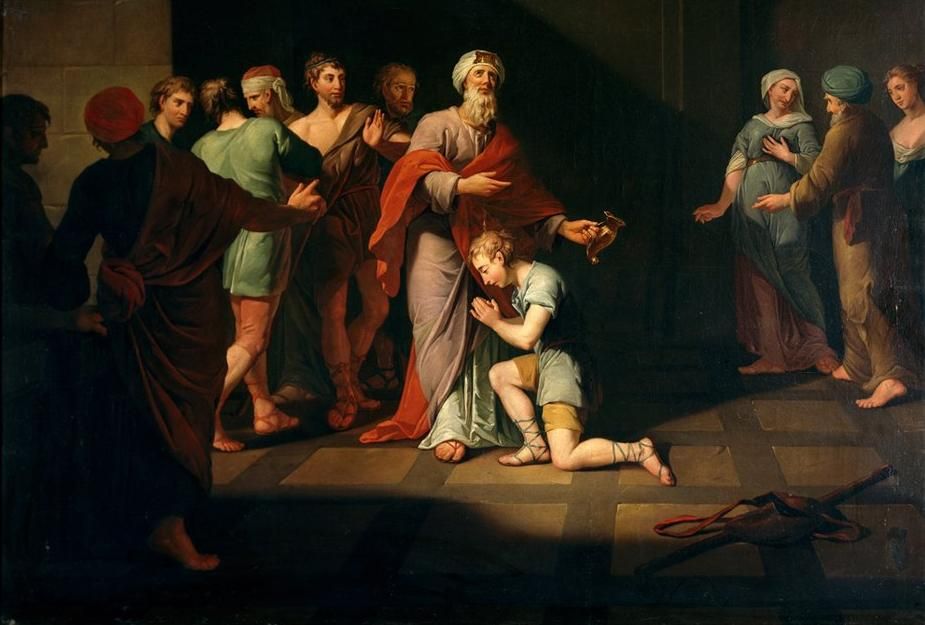
This is where we first meet David, as he is summoned from herding the sheep to have Samuel anoint him as God’s chosen King. Samuel’s coming meant that something important was afoot, and surely David wanted to be part of it. As the youngest son, the task of tending the sheep fell to him, while his brothers could stay home to greet the great man. I can almost hear him saying “It’s not fair!” just like any other teenager.

Was he wondering about Samuel’s purpose in visiting his father? He might have had an idea about what was up: King Saul had fallen from God’s favour, and Samuel’s visit likely had something to do with that. Did he have any idea of what God intended that day? Had he heard some kind of call? We’re not told. What we are told is that none of his older brothers passed muster as they paraded by, while Samuel listened for God’s voice. None of them were called to be King.

The rest of the family was surprised when Samuel told them to bring David to him. The youngest? A mere boy? Directed by God, Samuel saw otherwise, and called David out of his family to become King. Samuel named David’s vocation. Had David already heard it? We don’t know, but later events show him growing into the realization and fulfillment of his divinely-ordained role in life.
I have twice been an assessor for ACPO3, a major part of the process our church uses for discernment of vocations to the priesthood. Candidates are interviewed in a variety of settings, looking at the “3 C’s”: Character, Charism, and Call. Dealing with the first two is a bit like a conventional job interview, but the third presents some special issues. “Call” means both the candidate’s personal sense, and the affirmation of their community. I met some who said strongly that they knew that God needed them for the priesthood, but whose recommendations from others were more equivocal. Contrariwise, I met one young man, immensely gifted, by all accounts a really fine person – charism and character in spades! – but who simply could not articulate any kind of personal call. When we asked, “Why do you want to be a priest?” his only response was “Everyone says I should be.” When we asked him what he would do otherwise, he was able to map out a clear direction in academic work – he almost had his Ph.D. dissertation written in his head. We recommended that he continue with that work, and if at some time he was able to say, “I believe God is calling me to be a priest,” he should once more present himself as a candidate.

Vocations to Christian ministry come from both within the person (the “inner call”), and from the community (the “outer call”). Both must be present. Samuel gave David his outer call in dramatic fashion. We will hear more over the summer how David’s inner call developed, but we may be sure that he heard it.

Church folks most often use the word “vocation” in the context of ordained ministry. But please remember this: Christian ministry is not confined to the three-fold ministry of Deacons, Priests, and Bishops – not by a very long shot! The Catechism of the Episcopal Church of the USA teaches that there are four orders of ministry, naming the ministry of all the baptized (laypeople) as primary. I wish our Church had adopted this Catechism.

The ministry of the laity does include the various roles people assume in the church: lay readers and assistants, sides people, sanctuary guild, lectors, intercessors, musicians, teachers, wardens and vestry members, to name some of the most obvious. More importantly, it means the ministries that lay people exercise in the wider world, in all the many and varied ways they follow their calling as disciples of Christ. Every baptized person is called to a new life, dedicated to living into the promises found in the Baptismal Covenant. There is a good reason why this covenant is renewed by the whole congregation at every celebration of Baptism: the newly baptized are welcomed into a community of people who are striving to be God’s ministers in the world – people with many and varied vocations.

What’s your vocation? Some of us – a very few – can say “I’m called to be a priest or deacon in the Church.” But others might say something like “I’m called to be a (_______), the best one that I can be, so that people around me can see Christ at work through my life.”

When an ordination candidate is presented to the Bishop, the Bishop describes the nature of the ministry in question, and then asks, “Do you believe you are called to this ministry?” The Baptismal Covenant is the counterpart of ordination for the ministry of the laity. Any Baptized person can ask the call question for themselves, and then seek the affirmation of the wider Church when they believe they have heard a special call. Just like David, just like that gifted young man, we all need to hear both inner and outer call. We need to listen for the voice of God. And then we need to test our insight with others who are similarly striving to follow Jesus.

And let us never assume that a calling once heard is once and for all time. I once thought I wanted to be a railroad engineer – that didn’t last long! Things change over time, and God may lead us in ways that we hadn’t previously imagined or couldn’t imagine. No-one in my school years could have articulated a desire to design video games! And the kind of job I had with the Provincial government in the ‘70’s and ‘80’s has been almost totally changed by the internet.

We need to keep on listening for God’s call, because it can and does change. But make no mistake about it: God is calling you, and you, and you, and me. God is calling every one of us. We may not always hear clearly, but we may be assured that God will in God’s time send us our own Samuel or Samuels to help us hear better.

God is calling. Listen, pray, test, and respond.

God is calling. Live into that call, and rejoice!

God is calling. In Jesus’s name, may we hear and follow.

Amen.


  1. Video of the sermon and the full service may be found at https://www.facebook.com/holytrinityanglican ↩︎
  2. Yes Indeed“, Tommy Banks, solo piano, Royalty Records RRI-300-9647, 1997 ↩︎
  3. Advisory Committee on Postulants for Ordination ↩︎

A Call from the Edge

Notes for a sermon preached at Holy Trinity (Strathcona/Edmonton), Dec. 10, 2023
Texts: Mark 1:1-8; Isaiah 40:1-11  
  

I once saw a priest start a kid’s talk with the question, “What’s a prophet?” It’s great when the answers you get lead into what you want to talk about, but this time the response from one young person was “It’s when you make money.” The talk went sideways from there, because the kids really didn’t seem to know the biblical word, and just wanted to talk about money. They understood that! “Prophet” is a word that doesn’t turn up very often in daily speech, and when it does, its usual sense is a person who foretells the future.

Predicting the future can be part of the prophetic role, but it’s not the whole story – not by a long shot! This past fall I thought a lot about prophets, when our Wednesday morning Bible study group read the Book of Ezekiel. If you haven’t read Ezekiel, let me tell you that the group found it very challenging, often harsh and violent, with relatively few signs of hope, notably in the first half. People left some sessions saying things like “I sure hope things get better!” Not a fun read, but if a doom and gloom kind of guy like Ezekiel is considered a major prophet, we might well be excused for wondering why these people play such a large role in Scripture, especially in the Hebrew Bible.

Fr. Richard Rohr says that all the prophets speak from “the edge of the inside,”[i] and Ezekiel is a case in point. The book is set in the early years of the exile to Babylon. A member of the priestly class (an insider), Ezekiel is among the deportees, far removed from the centre of his people’s life – Jerusalem and the Temple. The big question is why this disaster has happened. The prophet condemns the people of Jerusalem, whose faithless ways have led to the departure of God’s glory from the holy city. From the edge of his people’s existence, the previous insider can speak God’s message clearly.

The latter part of the book is devoted to a vision of a restored Temple and land, which bears little resemblance to what actually happened some years later, when a new Temple was eventually built. Before that could happen, the people had to return, an event on the near horizon for the prophet whose words we heard in today’s first reading, so-called “Second Isaiah,” who proclaimed:

Comfort, O comfort my people, says your God.
Speak tenderly to Jerusalem, and cry to her
that she has served her term, that her penalty is paid,
that she has received from the Lord’s hand double for all her sins.

The exile in Babylon was drawing to its end. The deportees would be led home to the land of Israel, forging their way through the wilderness, protected by God’s hand as they journeyed through a place of great discomfort. God would give them comfort, which is not the same as making them comfortable. This would be no easy chair kind of existence, but a journey through a wilderness transformed and turned upside-down by the hand of God. Like Ezekiel, Isaiah also spoke “from the edge of the inside,” but now of a return to the centre.

Receiving comfort from God means to be strengthened by God for the days ahead. It means being empowered by God to work through and in places of discomfort. The message of all the prophets, including Ezekiel, Isaiah, and John, is not to “get comfortable”, but to seek God’s way, knowing that God’s way may well – may often! – involve discomfort.

Writing in the December 2023 issue of The Christian Century, Pastor Melissa Bills said this:

Discomfort is holy when it leads us to deeper love for God and neighbor. It is sacred when it spurs our hearts to love and good deeds. It is a blessing when it drives us to seek justice and liberation. It does not cut us off from God’s promises of comfort but rather makes space for us to receive them.[ii]

Chapter 40 of Isaiah ends this way:

[God] gives power to the faint, and strengthens the powerless.
Even youths will faint and be weary, and the young will fall exhausted;
but those who wait for the Lord shall renew their strength,
   they shall mount up with wings like eagles,
they shall run and not be weary, they shall walk and not faint.

This is the prophet whom John invoked in his call to prepare the way of the Lord. John stood in the heritage of Isaiah and all the Hebrew prophets, speaking and acting as God had directed. That’s what makes a prophet a prophet: they don’t speak for themselves, but for God!

John’s message was clear: the Kingdom of God was drawing near, soon to be fulfilled in the one to whom John pointed – Jesus!

John’s life was not comfortable – living in the wilderness, clothed roughly, eating what he could find on the land. But he surely took comfort from knowing that he was doing God’s work, speaking for God, proclaiming the one coming after him, pointing away from himself and his own desires to God’s wishes, pointing to what God would do among those who heeded the call.

I have sometimes heard people say things like “If you say, ‘yes’ to Jesus, your life will be great from then on.” If only that were true! Following Jesus has a cost. It demands much of us. But the good news is that God offers the same comfort – the same strength – that was offered to the Hebrew people in exile. John called the people to repent, and to accept baptism as a token of that repentance – and repentance is hard work. It takes strength and determination, and the courage to refuse the easy way – the comfortable way.

On this Sunday of John the baptizer, let us remember that the need for prophets like John did not end with the coming of Jesus. If anything, the world stands in greater need than ever of hearing the prophet’s call to repentance. We followers of Jesus have inherited the role of John: to point to Jesus, to call people out of their comfortable places, and to proclaim God’s desires for the world.

The great Biblical scholar Walter Brueggemann has said this:

The prophetic tasks of the church are
to tell the truth in a society that lives in an illusion,
grieve in a society that practices denial,
and express hope in a society that lives in despair.

Only by telling the truth, by grieving honestly, and living in hope can we ever begin to find the comfort promised by the prophet so many years ago. Like the prophets before us, we are not called to leave this world behind, but to challenge the world from “the edge of the inside,” as we see in the ministry of the prophets. We must be prepared to leave the comfortable places in the centre, seeking God’s strength as we live into our God-given mission – our prophetic tasks.

So… let’s go back to that first question: What is a prophet?
Better to ask “Who is a prophet?”
Look around you – anyone you see may be called to step out of their comfort zone, to rely on God’s comfort – and to speak God’s word in in a world that desperately needs to hear that Word!

In the name of the one who came to give us holy comfort,

Amen.


[i] https://cac.org/daily-meditations/the-true-center-2023-09-10/

[ii] https://www.christiancentury.org/article/lectionary/december-10-advent-2b-isaiah-40-1-11-mark-1-1-8


Come and see … and then go

Notes for a sermon preached at St. Matthew’s Anglican Church, St. Albert, Alberta, January 19, 2020. Text: John 1:29-42

On a cold day in January, we might forgive someone for asking us why we are here, although I sometimes wonder the same thing on a beautiful summer day.

Every one of us has made the decision to be here today. If we started asking each other about our reasons, we might well be into a long discussion. Every one of us has a unique story, and every one of those stories is worth telling and sharing—but maybe not this morning!

I once had a conversation with a person who was bothered that other parishioners didn’t seem to share their level of commitment. As we talked, the person started to disparage others’ reasons for church attendance. “He only comes because his wife doesn’t drive.” “She’s only here to hang out with her friends.” … I managed to call a halt, and then I said something that I meant with all my heart, and which I firmly believe to this day.

No matter how they might articulate their reasons, every person who walks through the doors of this (or any other) church, has been led here by the Holy Spirit.

It’s not for us to judge their motivation, but rather to give thanks that they are here, and then to seek the Spirit’s guidance about how to minister to them and with them. The act of walking through a church door, whether for the first time or the ten-thousandth, is a decision to accept Jesus’ invitation to “Come and see,” as he gave to the first disciples, and which continues to come to people today.

When Jesus invited Andrew and his companion to come and see, it did not come out of the blue, but was a vital step in a longer process. The two were already disciples – of John the Baptist. They were seeking the Messiah. They had no doubt gone to John in the hope that he was the One, but John pointed away from himself, to the one on whom he had seen the Spirit descend and remain.

John’s testimony about Jesus presents us with a full-blown doctrine of Christ: pre-existence, the Spirit remaining on him, God’s Chosen One. John knows who he is, and when he sees Jesus passing by again, he points to him and says to his disciples “Look, here is the Lamb of God!” They leave John and follow Jesus, apparently without any question.

Jesus asks them a very simple question: “What are you looking for?” to which they answer, “Rabbi (‘Teacher’), where are you staying?

This response may seem odd to our ears, but it would not have been out of place from someone seeking to follow a new teacher. To follow a teacher meant to spend time with him, not in a formal school setting, but staying or traveling with him. Today we might call it “hanging out.”

Jesus said, “Come and see.” They went, and they stayed with him for the rest of the day. We are told that it was four o’clock in the afternoon, which might mean that they stayed only a few hours, or perhaps that they stayed into the next day. Either way, they were with Jesus long enough to become convinced that he was the One whom they had been seeking. They were convinced enough to find Simon and to take him to Jesus, who then gave him the name by which we remember him, Peter.

And that’s the beginning of the story of Jesus’ disciples, as it is described in this Gospel. The story of Jesus’ disciples continues today, not written in the Bible, but in the stories of billions of followers of Jesus over two millennia. It continues here in this church today, with people who in some way have heard Jesus say, “Come and see,” who have come, who have seen, and who have believed.

It is the work of the Holy Spirit – the same Spirit who descended upon Jesus at his baptism – that has brought us together today. We come. We see. We believe.

The work of the Church began with people seeking God and God’s salvation, going to John for baptism, hearing John testify about Jesus, and then following Jesus at his invitation.

The work of the Church continues today with people seeking God, entering the Church through baptism, learning by word and example how others have followed Jesus, and then following – each in our own way.

Every one of us has his or her own story of how we came to follow Christ and how we continue to do so day by day. Every one of us made the decision to be in this place on this day. Every one of those decisions is one more step in our story as individual disciples and as a small part of the Body of Christ, the Church.

It has been said that the most important point of the liturgy is the dismissal. “Go in peace to love and serve the Lord,” is not just someone telling us that it’s time to put on our coats and go home. Rather, it is a charge to go out from this place and BE the Church in the world, doing the work of God wherever it needs to be done and wherever we are able.

Andrew and his companion went out from their first time with Jesus and found Peter. They got to work spreading the news.

The Spirit of God called them to find and to follow Jesus, and then sent them out again.

The Spirit of God has led us to this place, to find Jesus once again in Word, Sacrament, and fellowship. Renewed, refreshed, and reinvigorated, may we be sent forth by the Spirit to do the work of God’s mission.

May we go in joy and peace and with love in our hearts.

Amen.

Doing it again

Today I had the privilege of preaching and presiding at the Eucharist at Holy Trinity (aka “HTAC”). I had been scheduled to preach for a while, but other commitments took both our Rector and our Assistant Priest away from the parish. So…

Yours truly got to do what I used to do most Sundays for a quarter of a century. They say that riding a bike is easy once you learn how to do it, and once you have learned, doing it again is simple. You just get in the saddle and pedal.

That’s rather how today felt. HTAC is not “my” parish, at least not in the sense that St. Matthew’s Cathedral and St. Augustine’s-Parkland were. There, I was the Rector, expected to be present and available every day, and to do what had to be done at pulpit and altar most Sundays. Most Sundays at HTAC, I’m sitting in the back row of the bass section in the church choir, and happy to be there.

Today was different. I prayed with the choir before the service as usual, but today I led the prayers. I sang the psalm with the choir, but today from the presider’s desk. I proclaimed the Gospel and preached, and then went to the altar to preside at the sacrament.

These things happen every Sunday at HTAC. But today I assumed roles that other people usually take. And (I have to confess) it felt good.

Readers of this blog may have intuited that I wasn’t really ready to retire in 2013, but rather that the situation was forced on me. Today reminded me that I still feel most alive when I’m ministering in the pulpit and at the altar. I still believe that this I what God made me for, but I recognize that other people have similar calls, and that I have to let go as I am able.

I am truly grateful for today’s experience. I hope that my ministry today helped at least someone. That’s all I can expect, and all any ordained person can hope for.

Thanks be to God for this day. I have posted the text for today’s sermon under “Sermons and theological discussions.” Read it HERE.

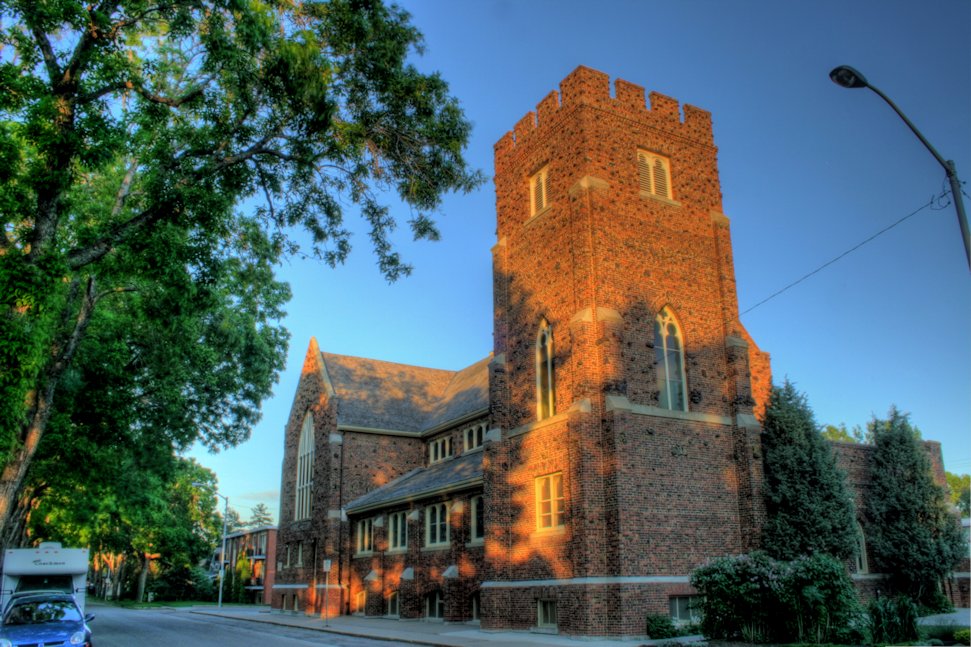
Holy_Trinity_Anglican_Church_Edmonton_Alberta_Canada_01A
View from the Northwest – 100 Street and 84 Ave.

Is it about you?

Last night, at All Saints Anglican Cathedral in Edmonton, Bishop Jane Alexander ordained three people to the priesthood and seven (!) to the diaconate. If I’m not mistaken, it was the largest ordination in this Diocese since at least 1986. The Cathedral was almost full, and there was a large turnout of the diocesan clergy. Some of us had speculated about how long the liturgy would take, and we were agreeably surprised when it came in at about 2 1/4 hours. I didn’t hang around too long afterward.  Bun fights in tight spaces make me a bit anxious, and my hearing issues (hypersensitivity to crowd sound at voice range) make it difficult to function in that kind of noisy environment. Nonetheless, I did have time to greet one of the ordinands, a person with whom I have had a long and special relationship.

I don’t ever recall being at an ordination service for so many people. Most of the ordinations I participated in during my time in the Diocese of Brandon were for individuals. I have no problem with the church celebrating the new ministry of a person who has been raised up for ordination. What has often troubled me is that these celebrations often become about the individual. Ordination should not be about a person having “made it,” but about the church renewing its leadership.

Last night’s service filled me with joy. I knew three of the ten ordinands personally, one better than the other two, but that’s not really the point. I saw ten (count ’em – 10!) people being affirmed in ministries that we prayed would be of benefit to the church and the world. It wasn’t about any one of them, but about the church engaged in the continuous and joyful renewal of its leadership. It was wonderful! I give thanks for the privilege of being present for all ten, even if seven of them were previously totally unknown to me except as names on a list.

On Holy Cross Day, our preacher recalled for us the love displayed and exemplified by Christ’s death on the cross. It doesn’t make sense to some people, but that’s okay. The ten who were ordained last night will share in proclaiming that truth, in their lives and their ministries. (Is there really any difference?)

Today, I welcome three people to the fellowship of the Holy Priesthood and seven people to the company of Deacons. May they continue to proclaim the love of God at all times and all places.

Finally my question to anyone who may be considering ordination in the church. Is your call about what YOU want to do, or about what GOD needs in the world. Is it about the church (God’s people) or about you? I pray that you may be able to answer that question prayerfully and honestly.

Hiding in plain sight

Reflections on Joseph of Arimathea

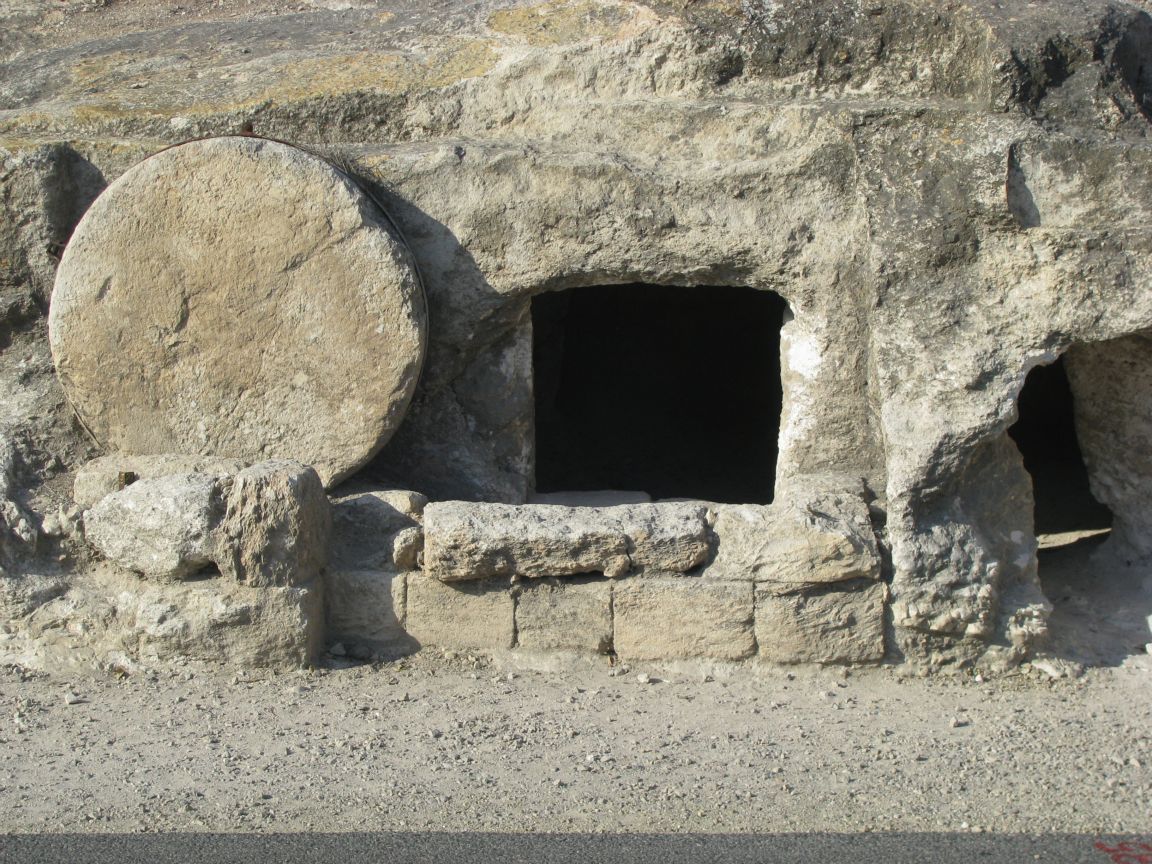
Today at the “Saints Eucharist” at Holy Trinity we remembered Joseph of Arimathea. He is mentioned only once in each of the four Gospels (Matthew: 27:57-60Mark 15:43-46Luke 23:50-55John 19:38-42), but all affirm that he gave his tomb for the burial of Jesus. There are various post-Biblical legends about him, including a trip to Britain, where he is said to have planted the holy thorn tree that grows at Glastonbury. He is also said to have taken the Holy Grail with him, and hidden it somewhere in that vicinity. (Holy Grail: the cup used at the Last Supper.)

We had a short discusstombion about this before beginning the Eucharist, focussing on the question of why people thought it necessary to remember someone for things that very likely did not happen, glossing over the one solid piece of evidence about his life. Giving a tomb for Jesus’ burial was an act of devotion and generosity that had profound importance in the Gospel story: why can’t we be satisfied with that? Joseph isn’t alone in this. There are other New Testament figures about whom various legends grew up, mostly without solid attestation, often imputing miraculous lives to these individuals.
The speculation we entertained was that people are often not satisfied with “ordinary” events as a medium of seeing God in action. If we can ascribe super-natural acts to someone, it may be a more obvious way to see the divine at work in human life. We have trouble understanding something as simple as giving a grave for someone’s burial as an “Act of God“. Insurance companies understand that term as something mostly unpredictable and entirely outside human control. But surely Joseph’s simple deed was divinely inspired, advancing the story of salvation history in a small but vital way. No burial = no death. No death = no resurrection. No resurrection = no salvation.

I believe that God is at work in ordinary human lives in ways that most people have trouble perceiving or articulating. Having a cup of tea with a lonely senior is just as much an Act of God as a hurricane. The Kingdom of God — how things ought to be — can be seen in the very small and (apparently) very ordinary. When we see it, the ordinary becomes extraordinary, revealing what was there all along for us to see — hiding in plain sight.

Being one of “the saints” should not mean being somehow superhuman and supernatural. It should rather mean being a person whose life displays what God intended for human life — sometimes apparently very ordinary, but touching other people in a way that makes God’s ways visible. If we look with the eyes of the spirit, we will see God at work in all sorts of people around us, not necessarily in the supernatural kind of miracle (whose existence I am not denying), but showing forth God’s love, mercy, and grace in many different ways in daily life.

We are all called to be saints — to make visible what God intends for this world. Many who are working out their salvation “in fear and trembling” are all around us. Look for them. They don’t have halos. They don’t always glow with otherworldly radiance. But they reveal to all who will see what holy living is all about.

Joseph of Arimathea did a holy thing: he was a holy person. We remember him for this one special deed.

Look around you today. Who is doing holy things? God’s saints are hiding in plain sight everywhere we care to look, everywhere we turn the eyes of our spirits. See them. Pray for them. Give thanks for them. Love what they do, and do what they love.

Beloved, let us love one another, because love is from God;
everyone who loves is born of God and knows God. (1 John 4:7)

heartofholiness


Living in the Middle

Notes for a sermon preached at St. George’s, Edmonton on July 16, 2017
Texts: Gen 25:19-34; Ps 119:105-112; Rom 8:1-11; Matt 13:1-9, 18-23

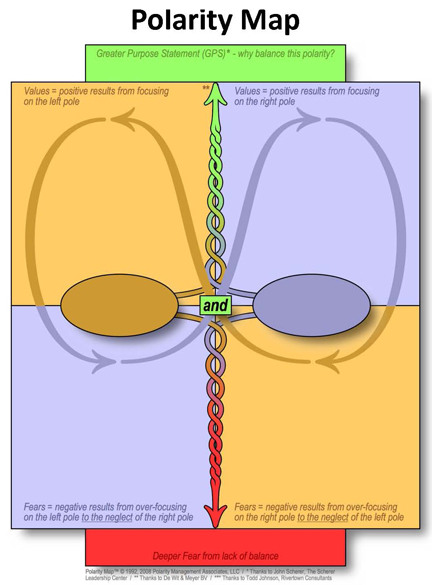
Some years ago, I attended a workshop entitled “Unresolvable but Unavoidable Problems in Church Life” led by the Rev. Roy Oswald of the Alban Institute. The title was a pretty good hook, attracting about 200 clergy and lay people from more than 15 denominations. I have since read Roy Oswald’s book, which expands on the workshop’s content. If he’d used the book’s title for the event, I don’t think he would have drawn nearly as many. “Managing Polarities in Congregations” doesn’t have the same buzz, does it? It’s also quite opaque, unless you’re hep to modern management-speak. (What’s a polarity anyway?)

Polarity_Map cropped

I could quite happily spend a couple of hours or more dealing with this topic and how it applies to church life, but since you didn’t bring bag lunches, I will go straight to the bottom line. There are many situations and issues in life – church, personal, business, government – which are unresolvable because they hold two positive things in tension, which work against each other. We can’t resolve issues like this, but we can learn to live with them.

After attending this workshop, I began to look at life a bit differently. It has been said that if the only tool you have is a hammer, every problem looks like a nail. In my case, finding polarity management very interesting, I started applying it everywhere. Sometimes it was even appropriate to do so!

Enough theory! Let’s look at the Scriptures. This is one of those Sundays when the prescribed lessons have no obvious linking theme. We heard a story of family conflict, an exhortation to “live in the Spirit,” and the best-known of Jesus’ agricultural parables. I suggest that there is something connecting them. Let’s look at them in turn:

First, Genesis, and the story of Esau selling his birthright for a bowl of lentil stew, or as the KJV puts it, “a mess of pottage.” This is quite a family: parents playing favourites, brothers competing for their parents’ approval, and with each other. Esau is a “manly man,” helping the family by hunting for food. His brother Jacob likes to hang out in the tent, helping his mother with the cooking. By traditional patriarchal standards, Esau should be preferred, but his sly brother tricks him into giving up his rights as elder son: this family’s story will continue through the younger brother. It’s not much of a model for family life. None of its members come off very well; all of them live somewhere on the edge of integrity. They live somewhere in the middle between the ordinary ways of the world and holy righteousness. Nonetheless, God’s chosen people will come from this family.

Second: From Romans, we hear Paul contrasting living according to the flesh with living in the Spirit. “To set the mind on the flesh is death, but to set the mind on the Spirit is life and peace.” He expands the contrast in Galatians:

Now the works of the flesh are obvious: fornication, impurity, licentiousness, idolatry, sorcery, enmities, strife, jealousy, anger, quarrels, dissensions, factions, envy, drunkenness, carousing, and things like these. By contrast, the fruit of the Spirit is love, joy, peace, patience, kindness, generosity, faithfulness, gentleness, and self-control.                                                                    Galatians 5:19-21a,22-23a

The choice seems clear: choose the Spirit over the flesh. However, Paul’s assertions that his readers are indeed “in the Spirit” seems to me to be more hopeful than factual. He is telling them what they should be, but surely the truth of most people’s lives is that we struggle with the competing pulls of flesh and Spirit, and live our lives somewhere in the middle, sometimes close to one side, sometimes to the other.

A note here: “flesh” doesn’t just mean things associated with sexual matters. Paul uses it as a generic term for the ways of the present age—the world in which we live. Living “in the flesh” is associating ourselves with things that ultimately do not bring life but death. In contrast, living in the Spirit is living according to the ways of the new age inaugurated through the Resurrection of our Lord. We may know well that this is how we are called to live, but as Paul said in the previous chapter (last Sunday’s lesson), it is all to easy to do the things we do not want, and not do the things we want. Our lives are lived in this ongoing tug-of-war between the ways of this world—the way things are—and the ways of the world to come—the way God wants them to be.

Finally, there’s the parable of the sower, which I have heard re-named “the wasteful farmer.” This man goes out and strews seed without apparent regard for the kind of soil at hand. Much of the seed is wasted, because the soil is beaten down, or rocky, or full of weeds. Only some soil is rich and fertile, bearing grain “some a hundredfold, some sixty, some thirty.” Unlike for other parables, Jesus gives an explanation to his disciples. We can almost hear them saying “We’re the good soil! We will give the good harvest.” Maybe so, but I suspect that those disciples were rather more like most of us. Sometimes we are good soil, and we give a good harvest for the Gospel of Christ, but at other times, we are hampered by the lack of understanding, by the cares of the world, by failing to feed our passion for the Word. The various kinds of soil live within each of us, and thus we live in a constant state of being “between.”

We are both good soil and rocky soil.
We live both in the Spirit and in the flesh.
We live both as people called out by God, and as people experiencing the complications of ordinary life.

We live in the middle.

And yet…

Like Jacob’s troubled family, we are called to build God’s people.
Like the earliest disciples, we are called to be fertile soil for the Word of God.
Like the early saints in Rome, we are called to live into God’s new age, living according to God’s ways.

God knows that we live in the middle—and God still calls us, ready to use us in God’s great mission. God has a purpose for every one of us. May we strive to be aware of our calling, and may we be dedicated to following it, in this world into the next.

Amen.

On the journey to…

A sermon this morning on Genesis 12:1-4a (the call of Abram) started me thinking about various times in my life I have stepped out of what might be expected, and gone where the call has led.

The first was not of my own volition, but my parents’. When I was only three years old, they decided to pull up roots in England and transplant our family to Canada. We settled in Drumheller, Alberta, a far cry from the great metropolis of London where I was born. I don’t know exactly how my parents felt about it at the time, but it became clear over the years that being so far from family and old friends was difficult for both of them, especially my mother. My early years in this country were marked by a sense of being “not quite at home,” a feeling that has stayed with me throughout my life.

The second such event came when I left teaching school to return to Edmonton, and to do… I wasn’t quite sure what! All my spouse and I knew was that we couldn’t stay where we were, and the opportunities were far greater in the city where we had both attended University. Some family members were horrified that I would give a seemingly secure and respectable job to search for something different.

That move led to a graduate degree, a job with our Provincial Government, and us settling down as a family. But God had other ideas. After nine years in that job, we again pulled up stakes and left for Saskatoon for me to enter theological college. I had no real idea where this was leading, except for the conviction that I was called to go down this road.

The road led to ordination and the call to be the pastor of a small-town parish. It was a great adventure, but not without its problems. After a few years there, I moved on to a suburban parish, where I stayed almost thirteen years. In time, I felt the need to move on: I accepted a call to become Dean and Rector of St. Matthew’s Cathedral, Brandon, Manitoba.

This was another move into the unknown: a new parish, a new city, a new province, and a new diocese. I didn’t realize at the time just how big a move this would be. Local customs are different, even at the relatively small remove of a couple of Canadian provinces. But we persisted, through some great years, and some not-so-great, until my retirement in 2013.

Each one of those moves required a measure of faith. In every case, I had the sense that I was going where I had to go, except perhaps the first one, when I had no choice in the matter.

In two of the places where I served the Church, I had conversations with people whose whole lives had been centered on that place. Many of them were puzzled why I might want to live somewhere else: “[town] has everything a person needs.” That may have been true, but going elsewhere was not contingent upon needs, but upon a call, just as Abram heard God’s call to leave home and family and travel to “a land which I will show you.”

I have been on this journey all my life, and now God has brought me to a place where I might reasonably hope to live out my days in peace and reasonable comfort. Sometimes, though, I find myself wondering…

On bishops and other callings

bishop-mitre-h-87A good friend and colleague recently disclosed that he had been chosen as one of the four final candidates in an election for Bishop. (Read about it here.) It put me into a reflective mood, recalling the occasions when I had a brush with episcopal office.

The first time was in 1997 in the Diocese of Edmonton, my home and current diocese. I had been serving as an Archdeacon for a couple of years, and for the first time had had some significant interactions with people in other parishes. Out of that came a request from someone present in one of those events that I allow her to put my name forward in the upcoming election of a new bishop. I was quite daunted by the idea, even though I admit to being flattered by the request. After some thought and prayer and discussion with my wife, I decided to let it happen.

The search committee asked each candidate to submit a fairly large bundle of material, including a detailed CV in a particular format, and a personal statement about ministry, and my sense of the episcopal office and how I might fill it if I were so called.

Assembling the CV was a good exercise: it was the first time since my ordination that I had put all of my work history down in one place. The document turned out to be much longer than I expected, considering I had only been ordained for 10 years. I felt a real sense of accomplishment when I re-read it after finishing.

The statement was quite another matter. I sweated blood over it, reading, thinking, praying, writing, tearing up, writing again, finally telling myself that it wasn’t going to get any better. It may be the best piece of writing I’ve ever done. In the years since, I have returned to it often, to check up on my continuing sense of vocation, and where my ministry is headed.

At the electoral synod, I was seated with the rest of the clergy, as required for voting. My wife was sitting in the observers’ seats at the back of the Cathedral, along with some other people from my parish. The preliminaries having been taken care of, we proceeded to vote, and then to sit and wait for the results. I wasn’t dead last in that first ballot, but pretty close, with 2 clergy and 3 lay votes. I knew who the clergy votes came from (me and my proposer), but to this day I have no idea who were the 3 laypeople who felt I was the best choice for bishop. On the second ballot, it was down to 1 clergy and 2 lay votes, still not the very bottom, but it seemed like a good time to drop out and stop wasting people’s time. The folks from the parish said they could all hear my wife’s sigh of relief when my withdrawal was announced.

That day, the diocese of Edmonton elected the Rt. Rev. Victoria Matthews as the first female diocesan bishop in the Anglican Church of Canada.

The second time I found myself on an episcopal election slate was for the Diocese of Qu’Appelle in 2006. I had been quite astonished to get the call from their search committee asking me whether I would accept the nomination. (My proposer had not contacted me first, as should have happened.) I asked for some time to consider it, coming as it was more or less out of the blue. My wife and I talked about it at length, and I  consulted my Bishop of the day. I was less than 3 years into a new ministry, and it hardly seemed the time to leave.

Nonetheless…
A call like this did not seem to be one that could be ignored — it might well be of the Spirit. My bishop suggested that the only real way to determine that was to let my name stand. And so I did. It felt quite different from Edmonton in 1997. For one thing, I would be moving to a completely new city, working with people I did not know at all. For another, that Diocese is a land of wide-open spaces, and many small multi-point charges. As bishop, I would likely spend much of my time in long-distance driving. The final thing was that I was nine years older and more experienced, and had a much better sense of my own capabilities and what the office of Bishop entailed.

The documentation they required was much like that asked for in 1997, so had most of it more or less ready to go, after another revisit to my personal ministry statement.

The results of that election were somewhat more gratifying. There were six candidates, and I ran a solid third until the third and final ballot. My good friend Gregory Kerr-Wilson was elected that day, while I sat at home in Brandon with my phone handy, waiting for results of the ballots.

That’s the story, although there’s an epilogue of sorts. I was approached to let my name stand in another election a year or two later. After considerable thought and prayer, I concluded that I did not hear the call to episcopal office, and did not let my name stand.

The formal processes I went through were quite different from the one my friend is in. Nonetheless, it is very clear to me that the internal process of seeking to discern a call to ministerial office is much the same however it may be externally structured. The writing of my personal ministry statement was an important turning point in my own ministry, and the document became one of the touchstones of my continuing vocation.

I learned, particularly in the 1997 election, that vocation must be heard within, and that requires intense prayer. My understanding of prayer is that it begins with listening, not with telling God what you want God to do. That became abundantly clear in 1997, in 2006, and then when I declined nomination.

Did I ever want to be a Bishop? I don’t know. I do know that some people say that anyone who really want the office shouldn’t get it — but probably deserves it. The office is almost impossible, but some people of my acquaintance have managed to make it look easy. I know that’s not true. I am also quite sure that, had I been elected, I would probably have managed to make it look very difficult!

Thanks be to God for all who let their names stand for Bishop.
And thanks be to God for all Bishops who serve Christ in His Church.